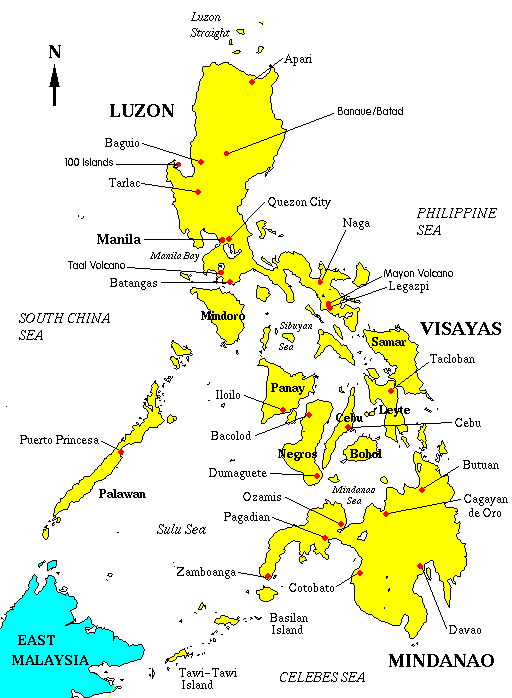
GEOGRAPHY : Philippines which is named after King Philip II of Spain, is an archipelago composed of 7,107 islands. Shaped like a sprawling triangle, it stretches 1,851 kilometers (1,152 mi.) from north to south and 1,107 kilometers (688 mi.) from east to west at the base. It is 966 kilometers (600 mi.) off the southern coast of Asia, bounded on the west by the South China Sea, on the north and the east by the Pacific Ocean, and on the south by the Celebes Sea and the coastal waters of Borneo. The entire archipelago lies just north of the equator, within the tropical zone. The northernmost islands are the Batanes group, 161 kilometers (100 mi.) from the southern tip of Taiwan; the southern-most islands are the Tawi-Tawi group lying about 25 kilometers (14 mi.) from Borneo. The total land area of the Philippines is 301,000 square kilometers (116,220 sq. mi.) and its coastline measures 10,850 statute miles. Eleven islands make up 96 percent of the total land area. The largest is Luzon, with an area of 75,710 square kilometers are of 59,418 square kilometers (36,906 sq. mi.) and Palawan comes third with an area of 9,170 square kilometers (5,696 sq. mi.). The other eight, in the order of their area, are: Samar, with an area of 8,547 square kilometers (5,309 sq. mi.); Panay, with 7,703 square kilometers (4,785 sq. mi.), Leyte, with 4,966 square kilometers (3,085 sq. mi.); Cebu with 3,033 square kilometers (1,884 sq. mi.); Bohol, with 2,534 square kilometers (1,574 sq. mi.); and Masbate, with 2,529 square kilometers (1,571 sq. mi.). TOPOGRAPHY The Philippines is divided into three islands, namely: Luzon, Visayas, and Mindanao. The Philippines is mountainous in nature, with mountain ranges in the bigger islands, sometimes with large river valleys separating two parallel mountain ranges. The peaks are volcanic in origin. The highest mountain Mt. Apo, is in Mindanao (the second largest island) and rises to 9,600 feet. The second highest is Mt. Pulog in Luzon (the largest island) with an altitude of 8,841 feet. There are recorded 50 volcanoes, a number of which are active. The most famous is Mt. Mayon, reputed to be the world's most perfect cone, and the most unique is Taal Volcano, considered the lowest volcano in the world, its top not quite reaching the waterline of Taal Lake on which it sits in a volcano-within-a-volcano structure. Limestone deposits, often crystalized by volcanic action, are plentiful throughout the islands, especially along the coastal regions. While the country has only a few large rivers, it abounds in small mountain streams which swells up to as much as three times their size during the rainy season. The principal rivers are navigable and are therefore mainly responsible for the development of the valleys in which they lie. The Cagayan River in Northern Luzon is 270 kilometers (168 mi.) long and drains an area of about 16,000 square miles. The Agno River and the Pampanga River drain a large area in Central and North Central Luzon. The Pasig River, where at its mouth located the city of Manila, is the outlet of a fresh-water lake, Laguna de Bay. The Mindanao River is the largest in the whole archipelago. Philippine Deep, recognized as the world's second greatest ocean deep, is located 72 kilometers (45 mi.) off the coast of Northern Mindanao and has a recorded depth of 10,802 meters (25,400 ft.). Climate: The climate of the Philippines is divided mainly in two seasons: The Dry Season and the Rainy Season. The cool dry season extends from December to February and is followed by the hot dry season which is from March to May. The rainy season begins in June and continues to November. In Manila, the annual mean temperature is 80 degrees, the January mean is 77 degrees, and the June mean is 82 degrees. The highest recorded temperature is a little over 100 degrees and the lowest a little under 60 degrees. Oscillations in temperature occur more often in points farther north of the equator than they do in points nearer the equator. At high altitudes the temperature is much lower. In the city of Baguio, a summer resort and the summer capital of the country, located at an altitude of about 5,000 feet, the annual mean temperature is 65 degrees, the mean maximum is 77 degrees and the mean minimum is 53 degrees. The mean annual rainfall varies from less than 40 inches to more than 120 inches. The country is divided into three zones, as far as rainfall is concerned. The first zone covers the places with very definite dry and rainy seasons, mainly the western coast of Northern and Central Luzon, western coasts of Mindoro and Panay and the Calamian Group. The second zone includes the southeastern end of Luzon, the Eastern Visayas, Eastern and Southern Negros and Panay, the eastern and southern coasts of Mindanao and the Jolo Group}. The typhoon season is generally from July to September although occasionally there have been typhoon as late as November and December and very rarely, in January. These cyclonic winds, (called bagyos locally) cause great destruction to growing crops, shipping and buildings. The more severe winds are accompanied by heavy rains and these flood the streams and the lowlands causing loss of lives and property. Southern Mindanao and the Jolo Group are particularly free from these typhoons which generally originate from the east and southeast of the archipelago and follow a general northwest trend. FLORA : The Philippines has a rich and varied flora essentially Malayan and tropical but with a sprinkling of temperate zone varieties in the higher altitudes. The country has more than 10,000 species of flowering plants and ferns, but the great percentage of the natural vegetation consists of its forest which occupies almost one half of the total land area. The forest regions are located in the less populated areas--in Mindanao, Palawan, and Mindoro and other islands south of Luzon. There are mountainous regions, in Luzon, however, that yield important quantities of timber, such as the Mountain Province which is noted for its pines, and the provinces of Camarines Norte and Camarines Sur from which come the red and white lauan, called Philippine mahogany. The timber resources of the Philippines consist of 13,198,406 hectares of commercial forests, estimated to hold a total volume of 720 million cubic meters, or about 305 billion board feet of standing timber trees of a diameter of 70 centimeters (2 ft. and 3.5 inches) and more, and about 514 million cubic meters or 218 billion board feet of standing trees 40 to 70 centimeters (1 ft. and 3.7 inches to 2 ft. and 3.5 inches). Other important forest products, besides timber, are dyewoods, tan barks or cutch, rattan, bamboo, resins, gutta percha, gum copal, and other valuable gums and fibers. FAUNA : The wild animals of the country include deer and wild hogs, monkeys and a small buffalo called the Tamaraw. There are on record at least 739 known species of birds. More than 2,000 varieties of fish are known, distributed in abundant quantities in the Philippine territorial waters which include 705,000 square statute miles of marine water. The most common are sardines, mackerel, tuna, milkfish, and sea bass. There are more than 70,000 hectares of fish ponds maintained inland. Among the domesticated animals, the most important is the Carabao, a water buffalo, the principal work animal in farms. There is a nationwide livestock and poultry industry, consisting mainly of foreign breeds of cattle, hogs, and chicken. MINERAL RESEOURCES : The Philippines is rich in gold and base metal. In the thirties and right up to the outbreak of World War II, the Philippines was considered one of major gold-producing countries of the world, with an annual production of over $30,000,000. Gold is found in both iode and placer deposits, the main gold producing regions being the Mountain Province and Camarines Norte in Luzon, Surigao in Mindanao, and Masbate in the Visayas. Base metal mines in the Philippines include chromite, iron ore, copper, and manganese ore. Chrome deposits rank among the most extensive in the world, estimated from 10 million to 15 million tons. Iron, lead, and molybdenum are also mined to some extent. So is bituminous coal, although the quality is relatively poor. PEOPLE : The first inhabitants of what is now known as the Philippines were the Negritos, a primitive people whose ancestors came by land from Central Asia during the Old Stone Age. Evidence of their tools and their weapons indicate their arrival some 30,000 years ago. Their arrival marked the beginning of the New Stone Age. They built the first houses, tilled farms, manufactured clothing. Their descendants are to be found today among the tribes of Northern Luzon, (Kalinga, Gaddang, and Apayao); in Mindoro and the Visayas (Pagans); in Palawan, (Tagbanuas); in Mindanao, (Bagobo, Manobo, Mandayan, Tiruray, and Badjao). After the Indonesians came the Malays, in several waves, from Southeast Asia, beginning around 200 B.C. The Malays--brown skin, of medium height, with slender bodies, flat noses, black hair and brown eyes--had extensive cultural contacts with India, China, and Arabia before they settled in the Philippines. They had their own government, laws, languages, alphabets, literature, arts and sciences. Their weapons consisted of daggers, bronze cannons, swords, spears, knives, bows and arrows. Their culture belonged to the Iron and Porcelain Ages. The prototypes and descendants of these first Malays are the Ifugaos, the Bontocs, the Igorots and the Tingguians living in the mountains of Northern Luzon. The second wave of Malays came about the beginning of the second century and continued until the 13th century. They were the ancestors of the present Tagalogs, Visayana, Ilocanos, Pampangos and other Christian Filipinos. The third wave came between the beginning of the 14th century and the middle of the 15th century. These Mohammedan Malays were the ancestors of the present Muslim Filipinos of Mindanao and Sulu. Prior to the landing in 1521 in the Philippines of the Portuguese explorer, Ferdinand Magellan, the inhabitants of the country carried on trade relations with the Chinese, but few Chinese, if any, had settled in the islands. Only after Spanish colonization had begun did Chinese migrate to the Philippines. On the contrary, Japanese colonies existed in certain parts of Luzon, which fact accounts for the racial imprint in the features of a small minority of the people. Previous to World War II, a considerable number of Japanese emigrated to the Philippines, the most important of their settlements being in the province of Davao in Mindanao, where they were engaged in abaca (Manila hemp) production. Spain also left her racial imprint on the population. Spanish blood, like Chinese blood, is quite apparent among the leading people of every Christian area of the islands. American influence on the physical aspect of Filipinos is almost negligible.
LANGUAGE : There are more than 100 different languages and dialects spoken in the Philippines. Tagalog is spoken by 15 million Filipinos, and English is understood by 13 million. The ten major tongues are Tagalog Cebuano, spoken in Cebu, Bohol, Negros Occidental, Eastern Leyte, and parts of Mindanao; Hiligaynon spoken in Negros Occidental and the Panay provinces; Waray spoken in Samar and Western Leyte; Bikolano, spoken in Bicol provinces; Kapampangan, spoken in Pampanga and Tarlac; Ilokano, spoken in Pangasinan, part of Tarlac, La Union and the Ilocos provinces; Maguindanao, spoken in some of the Moslem regions; and Tausog, spoken by the Muslims of Zamboanga and the Sulu archipelago. These languages are mainly of Malayo-Polynesian and Sanskrit origin, but many have assimilated words from the Indian, Arabic, Chinese, Spanish, and English languages. In 1937, President Manuel Quezon of the then Commonwealth of the Philippines proclaimed Tagalog as the basis of the national language. The National Assembly later passed an act making the Filipino national language (now Filipino) one of the official languages of the Philippines effective July 4, 1946, which date marks the beginning of the third Philippine Republic.
~excerpts from Republic of the Philippines Site~
|