

LIFE CYCLE JAVANESE CULTURE
GENERAL
Important moments in the life cycle are memorized by organizing a feast, ceremonies and rituals. Within the life cycle the marriage, 7th month pregnancy, birth, circumcision and death are important moments. Traditionally a "slametan", which is a sacred meal is organized for such an event. During such sacred meal it is prayed for the health and wealth of the persons involved.
Men are invited to be present at the sacred meal. They sit around several dishes which are prepared specially for this event. Special Javanese incense, called "menyan", is burned by the religious leader. An explanation is given about the purpose of the sacred meal and the meaning (symbol) of the dishes. Hereafter the religious leader prays. After the praying the dishes are devided among the participants.
Men are invited to be present at the sacred meal. They sit around several dishes which are prepared specially for this event. Special Javanese incense, called "menyan", is burned by the religious leader. An explanation is given about the purpose of the sacred meal and the meaning (symbol) of the dishes. Hereafter the religious leader prays. After the praying the dishes are devided among the participants.
MARRIAGE
The Javanese marriage can be devided into two parts, namely the religious and official part and the traditional Javanese ceremonies. The religious part is executed by the religious leader at home or in the mosque or in the temple, depending upon the religion they practice. The official part of the marriage is executed by the marriage official during this ceremony or at the townhall.
 |
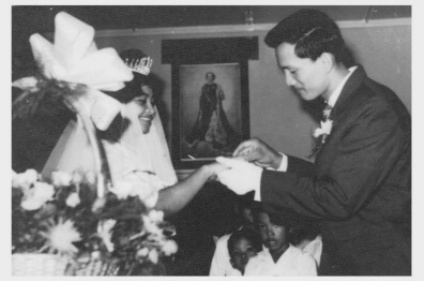 |
Marriage according Javanese traditions, Soekodoedoek, 1965Personal Photo collection |
Official Marriage at the townhall, Paramaribo, 1965
Personal Photo collection |
The traditional Javanese ceremonies are executed by the "dukun manten", which is a woman in charge with the ceremonies and is specialized in the activities for this event. The ceremonies are rich with symbols. The bride and bridegroom as well as the house are decorated. Each action and each decoration have its meaning. Generally after about one week the bride is taken to the home of the bridegroom.
SEVENTH MONTH PREGNANCY
The seventh month pregnancy of the first child is memorized by a ceremony, called "mitoni". During this event the marriage pair is bathed. In conjunction with this ceremony a sacred meal is organized, whereby special dishes for this event are prepared. All the dishes are symbols for life and life lessons.
The ritual bath is executed by the "dukun bayi", who is the traditional midwife, to whom the care of the future mother is entrusted. The ritual bath symbolize the start of the parenthood and the end of the childhood.
BIRTH
The birth is an important event for the Javanese people, where the tradition midwife played an important role in the past. They executed all the activities regarding the the birth, like cutting the umbilical cord. Nowadays only recognized midwives are allowed to do this last mentioned activity. However the traditional midwives still play an important role around the birth. As mentioned before they execute the ceremonies and they take care of the mother and child before and after the birth.
Immediatly after the birth the baby is welcomed by the father. The placenta is cleaned by the father with assistance of the traditional midwife, and wrapped in white cotton, put on a white porcelain dish and burried at the front door, with the retuals for this event.
After the birth a small or a big sacred meal is organized. After 5 or 35 days after the birth the head is shaved. When it is a girl, earring holes are made in the ears, and the girl is circumcised symbolically. About 8 months after the birth a ceremony is organized to lead the baby in touching the earth for the very first time. Nowadays not always all the rituals regarding the birth are practiced by the younger generation.
CIRCUMCISION
At an age of about 8-13 years boys are circumcised. In fact also the girls are circumcised, but symbolically, when they are 5 days or 35 days old. When it is a boy a part of the front skin of the sexual organ is cutted. In the past this was done by a person who circumcise traditionally, and nowadays it is done by a medical doctor. Some ceremonies are organized previous to this event. Also a sacred meal is organized and generally also a feast.
DEATH
According to Javanese traditions many attention is payed to the death of someone. At the day of the burial a sacred meal is organized, and respectively at the 7th day, 40th day, 100th day, at the first year, at the second year and at the 1000th day after the death.
Important actions regarding the death of a person is that the dead body is washed, and it is prayed for the person and the dead body is buried. Ceremonies and actions according to the Javanese traditions are done with regard to the death of a person.
Traditional Javanese Wedding in Suriname
Mitony, ceremony for seventh month prignancy of the first child
Back to Homepage
Copyright © 2002-2006 Moekiran A. Amatali
SEVENTH MONTH PREGNANCY
The seventh month pregnancy of the first child is memorized by a ceremony, called "mitoni". During this event the marriage pair is bathed. In conjunction with this ceremony a sacred meal is organized, whereby special dishes for this event are prepared. All the dishes are symbols for life and life lessons.
The ritual bath is executed by the "dukun bayi", who is the traditional midwife, to whom the care of the future mother is entrusted. The ritual bath symbolize the start of the parenthood and the end of the childhood.
BIRTH
The birth is an important event for the Javanese people, where the tradition midwife played an important role in the past. They executed all the activities regarding the the birth, like cutting the umbilical cord. Nowadays only recognized midwives are allowed to do this last mentioned activity. However the traditional midwives still play an important role around the birth. As mentioned before they execute the ceremonies and they take care of the mother and child before and after the birth.
Immediatly after the birth the baby is welcomed by the father. The placenta is cleaned by the father with assistance of the traditional midwife, and wrapped in white cotton, put on a white porcelain dish and burried at the front door, with the retuals for this event.
After the birth a small or a big sacred meal is organized. After 5 or 35 days after the birth the head is shaved. When it is a girl, earring holes are made in the ears, and the girl is circumcised symbolically. About 8 months after the birth a ceremony is organized to lead the baby in touching the earth for the very first time. Nowadays not always all the rituals regarding the birth are practiced by the younger generation.
CIRCUMCISION
At an age of about 8-13 years boys are circumcised. In fact also the girls are circumcised, but symbolically, when they are 5 days or 35 days old. When it is a boy a part of the front skin of the sexual organ is cutted. In the past this was done by a person who circumcise traditionally, and nowadays it is done by a medical doctor. Some ceremonies are organized previous to this event. Also a sacred meal is organized and generally also a feast.
DEATH
According to Javanese traditions many attention is payed to the death of someone. At the day of the burial a sacred meal is organized, and respectively at the 7th day, 40th day, 100th day, at the first year, at the second year and at the 1000th day after the death.
Important actions regarding the death of a person is that the dead body is washed, and it is prayed for the person and the dead body is buried. Ceremonies and actions according to the Javanese traditions are done with regard to the death of a person.