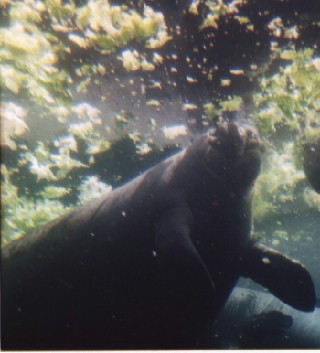
Manatee Population Growing?

A recent synoptic survey in Florida in January of 2001 seems to indicate the manatee population is starting to grow. There were approximately 2,200 manatees left in the United States at last count, but The Florida Marine Research Institute produced a count of 3,276!! A synoptic survey is an aerial survey to get a head count of each manatee, but it's dependent on weather conditions. If the weather is cold, then the manatees are more likely to congregate at warm water sites, making it easier to get a count. Synoptic surveys are presently the only available count method and cannot be be relied upon since weather conditions are constantly changing, but a larger number for the manatee is certainly a step in the right direction. Perfect conditions would be a prolonged cold weather front, a significant drop in water temperatures and a sunny and windless day following the cold front. I only hope people are starting to realize the affect they are having on the lives of these wonderful mammals and that they will contribute to their survival. The more we learn the better the chance to keep manatees around for a long time to come! So, is the population growing? We don't know, but a higher count is certainly a positive thing. Does this mean we should let our guard down? No.
My Trip to Sea World!
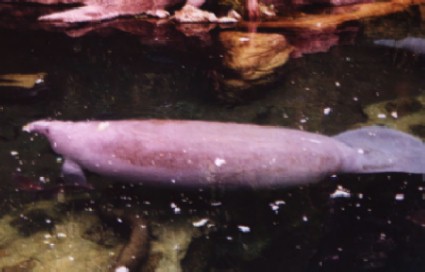
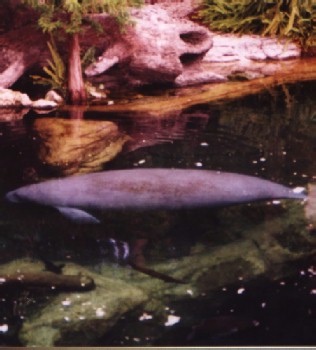
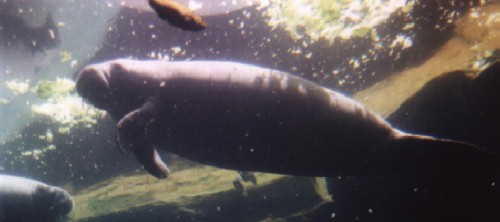
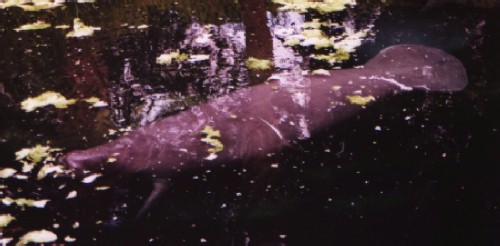
I made a trip to Sea World in Orlando, Florida on May 1, 2001, my first encounter ever with the manatee! I was in awe of the size and of the experience. I just wanted to jump in the water and hug them and tell them I love them :) I've learned so much about them and have come to love the giant creatures. I only wish I could help them with more than just my dollar bill. I would love to be actively involved in their fight for survival, but living in NY makes it a little difficult.
I was elated as well as saddened, the attraction is called 'Manatees, the Last Generation?' I imagine it grabs the attention of new visitors to the park, but I hope that title does not prevail. I was able to take photos above the water and of the underwater viewing tank. Click the thumbnails below to see my Sea World Adventure.

My next stop is the Columbus Zoo in Ohio. At first it disturbed me to think that the manatees were so far inland away from the warm Florida waters, but I've learned that the zoo supports Lowry Park Zoo's(a critical care facility in Florida)rehabilitation program by supplying equipment to researchers tracking released animals. If we all continue to support their protection, we will be able to share with children in the future how wonderful these creatures are.
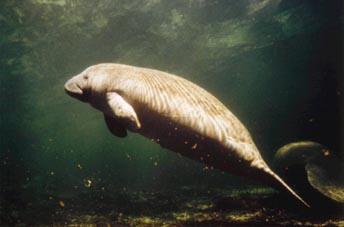
This is Floyd, my adopted manatee. I first adopted him when I was 10 years old. He is still around despite a few run-ins with some fast
moving boaters. Floyd was born during the summer of 1978. In December of 1986 he showed up at the Blue Springs State Park (one of the parks the manatees visit during the winter) with half his tail was missing. Also in March of 1987 he suffered a serious hit with 14 gashes!! It was a tough year for Floyd, but he made it and since hasn't had any run-ins as far as they can tell. Very good news for Floyd!
Star
My newest adoptee is Star, she was born on May 26, 1987, the first manatee born at the Homosassa Springs State Wildlife Park and the first manatee born in captivity. She got her name from the star-shaped birthmark on her head.
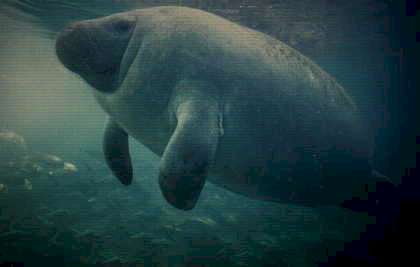
**** UPDATE ****
I am sad to say that Star passed away on May 31, 2000 at 13 years old. She had intestinal problems and did not respond to medical treatment :( Quite a sad day for the Manatee. Most of them live through attacks from boats and other human related causes, but Star had no such threats having been born at the park. She will be missed!
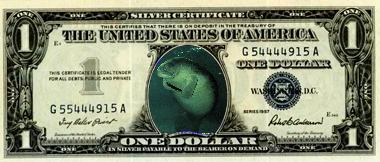
Save The Manatee Club sends out information yearly regarding the manatee you adopt. The money collected goes to the research for their survival. If you'd like to adopt one or find out more information about where the money goes, please click the dollar below:
One Stubborn Manatee
Chessie, a male manatee who was rescued from the cold waters of the Chesapeake Bay in September of 1994, is one stubborn manatee. He seems to refuse to follow the natural pattern of being a tropical mammal - the need for warm waters! He was transported back to Florida by airplane and soon after released near Titusville, FL. When summertime returned again, Chessie decided to shoot north and traveled all the way from Florida to Point Judith, RI!! Before his trip, the most northerly documented manatee sighting was in the Potomac River (Virginia area). It seems Chessie may well have set an all-time record.
Chessie's location has been unknown since July 10, 1996. His transmitter became detached and researchers were hoping to get a sighting of him these past two winters in Florida. The winters of 1997, 1998, and 1999 were warm ones so Chessie didn't check in.
In July of 1998, a manatee was sighted in Delaware and again later in Long Island, NY. Researchers at the USGS Sirenia Project, the agency responsible for tracking Chessie, had reason to believe it was him. Photographs taken of the manatee in Long Island were examined, but they were unable to confirm whether or not it was Chessie.
It is believed that Chessie is alive and doing well. His scar patterns are recorded, so there are ways to identify him if he does happen to appear. It's also unknown as to why he continues to make his journies into the colder northern waters. We can only hope he will one day settle down in the warm and relatively safe waters of the Florida area.
Chessie's case notes the importance of tracking manatees for their safety and researchers can monitor them by tracking devices. The transmitter is attached to the base of the tail and floats freely at the surface of the water from a four foot strap. It is not harmful to the manatee and will release if it becomes entangled. Radio signals are sent from the transmitter to satellites and the data is then analyzed to give accurate locations on the manatee. Sensors built into the transmitter give additional information such as water temperature and activity. Researchers can access this information daily by computer and specific information about migration patterns, habitats and feeding areas are used to help protect this endangered species.
Can you find the Manatee?
Click below to see a three-dimensional picture of a manatee.
You need to stare at your screen and relax your eyes. Eventually the picture will appear. I still cannot see it and would love to hear from you if you have. Please e-mail me and let me know :0) Also, if you happen to have any information you think I should feature here, feel free to offer. I am constantly trying to update this page with new information
3D Picture
See a live manatee webcam here
See a live manatee zoo webcam here



Interested in buying manatee products? Visit these links:
Kritters in the Mailbox
Otter Bay Gifts
The Endangered Manatee Page 1 ~ Page 2 ~ Page 3
~ Jennifer's Dreams Main Page ~ Jennifer's Dreams Inspirations ~

As far as I know, the images displayed on these pages are public domain (please note: the two graphs on page three were created by me). If you are the owner of any of these images and would like me to remove any of them, please e-mail me and I will do so. I do not display them as a copyright infringement, but for the assistance in creating a greater awareness of the endangered manatee. I hope that once you read this you will grant me permission and I thank you for doing so!