Front wheels 1st off the ground & in space the assembly taken off for an airlock

|

|
|
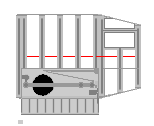
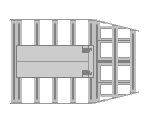
These pictures are overhead underbelly and sideview of the front wheel assembly.
The front wheel assembly can be removed once in space. There would be no need
for a special door for the airlock this way. The door is already powered to open
and close if that is what is desired. The doors are sealed because of the
temperature in this area during the takeoff flight and and possible rentry
(skin temperature 700 f). From this information it is easy to see how the idea
developed.
What is needed is as litle an air lose to space and as fast as possible time though
the airlock. The weight of the equipment to pumps draw the air down to a vacuum,etc
is also important.

|
|

|
The box that houses the front wheel assembly must be solid on most of 5 side in order
that the load can be distributed accross the frame. So a second opening in the
housing did seem to be a problem at first. The solution was to have inside door
bolted closed till the plane was in space. From the pictures one can see that the
inside door is shorter than the outside door. The only things that in housing
now are the two motors that open and close the doors. With the outside two doors
to space sealed the front wheel assembly can be removed. (I have two of the four
tires I will need to make a car, if I get my sphere done. There will be a lot less
pressure in them for a car under 3000 lbs.)
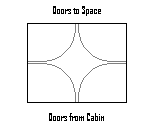
The solution to the question of reducing air lose to space was the use of
bladders to fill the room except of course for the person or person and object
going out into space. It would only take a fan with a small pressure difference
to do this. Then a small tank at a vacuum withdraw what air can be withdraw. The
amount per opening of the airlock would be way under a cubic foot. The amount
of time need to go through the airlock would be under 10 seconds. The picture
below shows how the bladders will be positioned within the airlock. In the
picture the bladders are about half inflated. The maximum the bladder will
expand will be reached before the doors are a quater open. Sorry no rocket
launches out of the airlock door. The use of the bladders does mean care must
be taken using the airlock with something with sharp corner or sharp edges.
Both ends of this area could also be used for access.
In case of a loss of pressure in the cabin the on might be trapped in the cockpit
or pilots seat or if the seal is broken in the area above or the cockpit. This
divides the ship into two or three areas for it's time in space. By this time
if it is not going back down it will have been stripped down for use in space.
This is how mine would have been done once I was sure that everything was going
to work. I will go into the stripping down of the plane in the part where I
show the plane ready ready for long term use in space.
It is quite a sight even on paper. I will tell a part now any way. The lining
of the engines come out and our mounted above and below the ship. Stabilized by
being anchored to the ends of the wings. Just little time could be spent out
there but it would be worth it. This is some of the area that would be used for
animals and for growing plants, the main area for growing would be in the engine
housings. This and the work on the sphere makes the airlock necessary.

This is a piture the same scale as the others of all the wheel assemblies. It is hard to picture from this view but there are three wheels on the rear assemblies. The total number of wheels is 8. The diameter of the engines is larger than that of the fuselage. The rear end opens like a clam shell. Also picture is the cockpit. The pilots seat is pictured in brown in two positions, Up and down. I the up position the seat seals the cockpit from the rest of the plane. This is a low G plane not capable of flight like a fighter, to strength it to fly at those Gs it would lose about 75% of it's possible fuel load.
Bob L. Petersen
Bob Petersen
ssuv_underside_wheel_assemblies_cockpit

