
Pickett's Charge
Battle of Gettysburg
 Battle of
Chickamauga
Battle of
Chickamauga
George Edward Pickett
1825-1875

It was at one o'clock that two
Confederate signal guns were fired, and at once there opened such an artillery
combat as the armies had never before seen. As a spectacle, the fire from the
two miles of Confederate batteries, stretching from the town of Gettysburg
southward, was appalling; but practically the Confederate fire was too high, and
most of the damage was done behind the ridge on which the Army of the Potomac
was posted, although the damage along the ridge was also great. The little house
just over the crest where Meade had his headquarters, and to which he had gone
from Gibbon's luncheon, was torn with shot and shell. The army commander stood
in the open doorway as a cannon shot, almost grazing his legs, buried itself in
a box standing on the portico by the door. There were two small rooms on the
ground floor of the house, and in the room where Meade had met his corps
commanders the night before were a bed in the corner, a small pine table in the
center, upon it a wooden pail of water, a tin drinking cup, and the remains of a
melted tallow candle held upright by its own grease, that had served to light
the proceedings of last night's council of war. One Confederate shell bust in
the yard among the horses tied to the fence; nearly a score of dead horses lay
along this fence, close to the house. One shell tore up the steps of the house;
one carried away the supports of the portico; one went through the door, and
another through the garret. It was impossible for aids to report or for orders
to be given from the center of so much noise and confusion, and the little house
was abandoned as a headquarters, to be turned, after the firing was over, into a
hospital.
During the cannonade the infantry of Meade's army lay upon the ground
behind the crest. By General Hunt's direction the Union artillery fire, with the
exception of that of the Second Corps batteries, was reserved for a quarter of
an hour and then concentrated upon the most destructive batteries of the foe.
After half an hour both Meade and his chief of artillery started messengers
along the line to stop the firing, with the idea of reserving the ammunition for
the infantry assault, which they well knew would soon be made. On the other
side, Alexander sent word to Pickett to come quickly, and the Confederate
assault began.
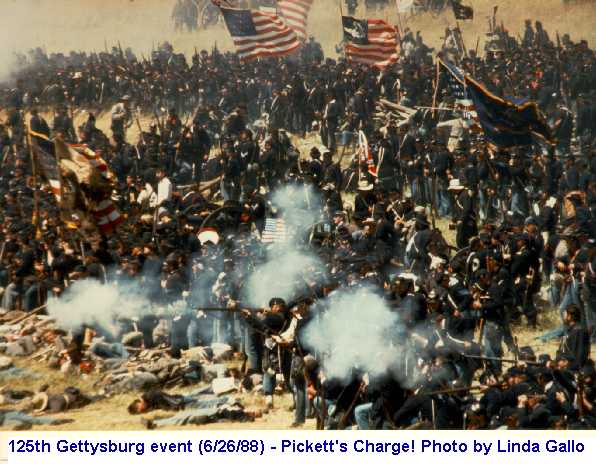
Crossing the depression of the ground, a part of the Confederate line,
after emerging from the woods, found a moment's rest and shelter, and then
started toward the little umbrella-shaped clump of trees on the Union line, said
to have been pointed out by Lee as the objective of the assault. On the left
Pettigrew's division of four brigades advanced in one line, with Trimble's two
brigades of Lane and Scales in the rear and right as supports. Pickett's
division on the right advanced with the brigades of Kemper and Garnett in the
front line and Armistead's brigade in rear of Garnett's on the left. Twenty
minutes afterward the brigades of Wilcox and Perry were to advance on Pickett's
right and repel any attempted flanking movement. The assault was made by
eighteen thousand men. To cover the advance the Confederate artillery reopened,
and when the infantry line appeared the Union guns were directed upon the ranks.
Great volumes of smoke, however, soon obscured the field, and many of the
Confederates could not see that there was a foe in front of them until they were
within two hundred yards of the Union line. Under the artillery fire from
McGilvery and Rittenhouse on Pickett's right his part of line drifted to the
left, and thus, when the brigades of Wilcox and Perry marched straight ahead, as
ordered, for the purpose of protecting Pickett's right flank, their course took
them to far to the south to accomplish their purpose, even if the advanced line
by that time had not gone into pieces. As Pettigrew had formed behind Seminary
Ridge, his troops had to advance under fire a distance of at least thirteen
hundred yards, while Pickett's place of formation was but nine hundred yards
distant from the objective point. The start was made in echelon, with Pettigrew
in the rear; but by the time the Emmitsburg road was reached both divisions were
on a line, and they crossed the road together. Brockenbrough's Virginians,
Pettigrew's left brigade, were disheartened by the flank fire of Hays' troops
and Woodruff's battery after a loss of only twenty-five killed, and these troops
either retreated, surrendered, or threw themselves on the he ground for
protection; but the other brigades of Pettigrew, as well as those of Trimble,
advanced to the stone wall, stayed there as long as any other Confederate
troops, and surrendered many fewer men than did Pickett.
The drifting of Pickett's division to the left exposed the flank of his
right brigade (Kemper) to the fire of Doubleday's division, a part of which
moved with Pickett, thus continuing its deadly volleys, while Stannard's brigade
by Hancock's orders, changed front to the right, and opened a most destructive
fire upon Kemper's flank. Armistead's brigade moved in between Kemper and
Garnett, and together they marched upon the angle of the stone wall held by
Webb's Philadelphia brigade, Garnett, just before death, calling out to Colonel
Frye, commanding Archer's brigade of Pettigrew's division on his left, "I am
dressing on you." Scales' brigade, whose commander, Colonel Lowrance, says it
"had advanced over a wide, hot, and already crimson plain," and through whose
ranks troops from the front began to rush to the rear before he had advanced two
thirds of the way, together with Lane's brigade, advanced to the front line,
Lowrance's brigade reaching the wall. The two guns of Cushing's battery at the
wall were silenced. The greater part of the Seventy-first Pennsylvania Regiment
of webb's brigade had been withdrawn from the wall to make room for the
artillery, and the two remaining companies, overwhelmed by the mass of the enemy
concentrated at this point, were driven back from one hundred to one hundred and
fifty feet. Through this gap the Confederates crossed the wall, and Armistead,
putting his hat on his sword, dashed toward the other guns of Cushing's batter,
near the clump of trees, and fell dead by the side of Cushing. The Sixty-ninth
Pennsylvania of Webb's brigade held its left flanks by the enemy. The
Seventy-second Pennsylvania and two companies of the One Hundred and Sixth
Pennsylvania advanced to the wall; Cowan's New York battery galloped up; Hall's
brigade of Hancock's corps, by the orders of Hancock, on Webb's left, changed
front, and poured its fire into the Confederates' flank; Harrow's brigade also
attacked Pickett in flank. The attack of Pettigrew and Trimble, farther to the
Union right, fell upon Hays' division of the Second Corps. The Eighth Ohio
changed front, facing south, reversing the tactics of Hall's brigade on the left
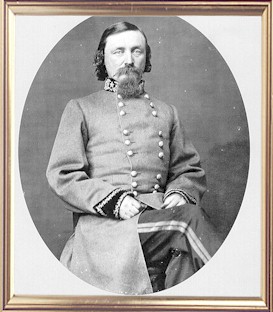
and opened a flank fire. General Pickett, in person, did not cross the
Emmitsburg road. Of his three brigade commanders, Garnett and Armistead were
killed, and within twenty-five paces of the stone wall Kemper was wounded and
captured. Pettigrew and Trimble and three of their brigade commanders (Frye,
Marshall, and Lowrance) were wounded. The brigades of Wilcox and Perry, exposed
to a heavy artillery fire from the fresh batteries moved to Gibbon's front
again, and, seeing the repulse of the assault to their left, fell back to the
main Confederate line.(break) Out of the fifty-five hundred men which Pickett
took into action, fourteen hundred and ninety-nine surrendered, two hundred and
twenty-four were killed, and eleven hundred and forty were reported wounded.
Pickett lost twelve out of fifteen battle flags. Pettigrew's division, in which
there was one brigade of North Carolina troops , lost in killed and wounded
eight hundred and seventy-four, and in missing five hundred. Trimble's two North
Carolina brigades lost in killed and wounded three hundred and eighty-nine, and
in missing two hundred and sixty-one. The two brigades of Perry and Wilcox
together lost three hundred and fifty-nine. Pettigrew's brigade of North
Carolina regiments, commanded by Colonel Marshall, lost in the charge five
hundred and twenty-eight, of which number three hundred were killed and wounded;
and the Twenty-sixth North Carolina of this brigade, which regiment suffered
greater losses during the war than any other on either side of the conflict,
went into this charge with two hundred and sixteen men, and returned with but
eighty-four. The percentage of losses in killed and wounded in the assaulting
column, taken as a whole, was not extraordinary for the civil war. The place
assaulted was less formidable than Fort Fisher, which was taken later in the war
by Union troops, and the assault itself was far less successful than that of
Meade's division at Fredericksburg. Its complete failure was due to the thorough
dispositions made to meet it, and it is improbable that the result would have
been reversed if McLaws and Hood , whose attention was occupied by the
appearance of the Union cavalry on their right, had participated in the assault.
The tactical skill which had prevented the rout of the Third Corps from
involving the whole army in a defeat on the second day of the battle, was
exerted with equal success in supporting the center under attack on the third
day.
At the center of Meade's position, were troops rank after rank, infantry
division after division, line upon line, including even the provost guards, and,
in rear of all, a regiment of cavalry waiting to shoot down the craven if he
would discover himself. Against an army so disposed, in such a position, and so
handled, its different parts thrown from point to point with certainty and
promptitude, with every possible Confederate movement anticipated and provided
for, the assault ordered by Lee was in truth the mad and reckless movement that
Meade characterized it, and it accomplished no more than a slight fraying of the
edge of the front Union line of troops.
On the Union side, Hancock, Gibbon, and Webb were wounded and carried
from the field. The union losses were twenty-three hundred and thirty-two.
Webb's brigade losing more than any other. One hundred and fifty-eight artillery
men were killed or wounded. Before the attack Meade had told Hancock that if Lee
attacked the Second Corps position he intended to put the Fifth and Sixth Corps
on the enemy's flank. Recalling this remark of the army commander, Hancock,
while lying on the ground wounded, dictated a note to Meade, expressing his
belief that if the movement contemplated by the army commander were carried out
a great success would be won. The Sixth corps, however, was not now a compact
organization, its different parts, having been disposed in different portions of
the field. The Fifth Corps was ordered to carry out the contemplated movement,
but it had also been moved to support the center. There is a limit to human
endurance, and the slowness with which the movement ordered by Meade was made,
owing partly to the difficulty of collecting the troops, was no doubt largely
due to sheer exhaustion caused by the supreme efforts which had now been
prolonged for six midsummer days.
