Battle of Gettysburg
Date: July 1-3, 1863
Location: Pennsylvania
Confederate Commander:
Robert E. Lee
Union
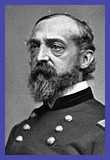
Commander: George G. Meade
Confederate Forces
Engaged: 75,000
Union Forces Engaged:
82,289
Winner:
Union
Casualties:
51,112 (23,049 Union and 28,063 Confederate)

|
|
 |
||
|
(1815-1872) |
(1807-1870) |
JUNE 1863
Following his victory at Chancellorsville in May,
1863, General Lee received approval from his government to invade the north. Lee
hoped an invasion would fuel the northern peace movement and, at least, disrupt
the Union war effort. After the death of Stonewall Jackson, Lee's Army of
Northern Virginia, 75,000-strong, had been reorganized into three army corps
under Longstreet, Ewell, and A.P. Hill, with a cavalry division under J.E.B.
Stuart. On June 3, advance troops of the Confederate army left their camps near
Fredericksburg and marched west toward the Shenandoah Valley.
The 95,000-strong Federal Army of the Potomac, under General Hooker, was
initially uncertain of Lee's intentions. On June 9, Hooker ordered cavalry
general Alfred Pleasonton to conduct a reconnaissance with 11,000 men across the
Rappahannock River toward Brandy Station. Pleasonton ran into Stuart's cavalry,
and the largest cavalry battle of the war ensued. The result was a standoff, but
the Federals were now alerted to the Confederate army's movements.
By June 13, elements of Ewell's corps appeared before Winchester. On the
same day, Hooker with-drew the Army of the Potomac from the Rappahannock and
ordered it north. On June 14-15, Ewell attacked the 9,000-strong Federal
garrison at Winchester and defeated it, inflicting heavy losses and capturing
much valuable war material.
After Winchester, Lee's army moved unchecked into the Cumberland Valley
of Pennsylvania. On June 25, Lee agreed to Stuart's plan to take three brigades
of cavalry across the Potomac cast of the Blue Ridge Mountains, and cut across
the rear of the Federal army. Stuart's march encountered frequent delays and
detours and an increasingly aggressive Federal cavalry, and was unable to rejoin
Lee until July 2.
By June 28, Longstreet and Hill's corps were at Chambersburg. Divisions
of Ewell's corps had crossed the mountains to York and Carlisle, and were
preparing to move against Harrisburg. However, Lee learned on this day that the
Federal army was at Frederick, and that Hooker had been replaced by General
Meade. Lee decided to bring his entire army east of the mountains and offer
battle. At the same time, Meade moved his army north. By June 30, both armies
were converging upon Gettysburg and the battle, which would be the turning point
of the war, was set to commence.
JULY 1 1863
After the discovery on June 30 that Gettysburg was occupied by
Brigadier General John Buford's division of Federal cavalry, the Confederates on
July 1 sent the divisions of Major General Henry Heth and Major General William
Pender of Hill's Corps, down the Chambersburg Road to drive Buford away and
occupy Gettysburg.
The battle began at 5.30 a.m., when shots were exchanged over Marsh
Creek. In the face of Buford's resistance, Heth pushed on cautiously until he
reached a point about two miles west of Gettysburg. Here he deployed two
brigades in line, and pressed ahead; it was nearly 10 a.m. Federal General John
F. Reynolds, commanding I Corps, arrived on the field at this point, and
determined to engage Herb. He ordered I Corps and Major General Oliver 0.
Howard's XI Corps to march to Gettysburg.
Soon after 10.30 a.m., I Corps arrived and engaged Heth along McPherson's
Ridge. By 11.30 a.m., Heth had been defeated and forced to withdraw to Herr
Ridge. Early in the action, Reynolds was killed, and field command devolved upon
Howard. A lull now settled over the field as both sides brought up
reinforcements. The Federal I Corps deployed to defend the western approaches to
Gettysburg, while XI Corps formed up north of the town. Buford's cavalry covered
the flanks. Howard left one division in reserve on Cemetery Hill. His strategy
was simple: delay the Confederates long enough to enable the rest of the Federal
army to concentrate. Lee arrived on the field after noon. He had initially hoped
to avoid a general engagement since the strength of the enemy was unknown, and
the terrain in the Gettysburg area unfamiliar. But, soon after noon, Rodes's
division of Ewell's Corps arrived on Oak Hill and attacked the right of I Corps.
At 2 p.m. Heth's division joined the attack on I Corps. At 3 p.m., the battle
spread north of the town when Jubal Early's division of Ewell's Corps attacked
down the Harrisburg Road and crushed the flank of XI Corps. At about the same
time, west of Gettysburg, Pender's division relieved Heth and assaulted I Corps'
position along Seminary Ridge. By 4 p.m., both Federal corps were in retreat
through Gettysburg to Cemetery Hill. Federal losses numbered slightly over
9,000, including some 3,000 captured, compared with Confederate losses of about
6,500.
The day's action had resulted in a Confederate victory, but Federal
forces held onto the high ground south of Gettysburg, where their position was
soon strengthened by reinforcements.
JULY 2 1863
The success of his army in the fighting on July 1 encouraged Lee
to renew the battle on July 2. An early morning reconnaissance of the Federal
left revealed that their line did not extend as far south as Little Round Top.
Lee directed Longstreet to take two divisions of I Corps and march south until
they reached the flank of the Federal forces. They would attack from this point,
supported by a division of A.P. Hill's corps - a total force of nearly 20,000
men. While Longstreet carried out the main offensive, Ewell was ordered to
conduct a demonstration against the Federal right. However, he was given
discretion to mount a full-scale attack should the opportunity present itself.
The Federal army was well prepared for Lee's offensive. Six of its seven
corps had arrived on the battlefield, and VI Corps was making a thirty-six-mile
forced march to reach it. Meade had deployed his army in a fish-hook-shaped
formation, with the right on Culp's Hill and Cemetery Hill, the center along
Cemetery Ridge, and the left on Little Round Top. The left of the Federal line
was held by Major General Daniel Sickles's III Corps. Sickles was dissatisfied
with his assigned position and in the early afternoon, without orders, he
advanced his line nearly half a mile west in order to take advantage of the high
open ground around a nearby peach orchard.
Soon after Sickles took up this new position, Longstreet attacked. Third
Corps was hard pressed and Meade sent V Corps and part of 11 Corps to reinforce
Sickles in the Peach Orchard. But, after furious fighting, Longstreet's forces
broke through, causing Sickles's entire line to collapse. The Confederates
pursued to the base of Little Round Top, but Federal reinforcements, including
elements of VI Corps, checked their advance. Farther north, elements of a
division of the Confederate III Corps advanced to the slopes of Cemetery Ridge
before they too were forced to retire.
On the Federal right, Ewell did not attack until evening, after
Longstreet's onslaught had subsided. The effort to storm Cemetery Hill was
ultimately unsuccessful. Ewell's attacks were also repulsed at Culp's Hill,
although a foothold was gained near the base of the hill.
The second day's fighting had cost each army some 9,000 casualties. Lee's
forces had again gained ground, but had failed to dislodge the Federal army from
its strong position.
JULY 3 1863
Lee's confidence was unshaken by the events of July 2. That night,
he ordered Longstreet, who had been reinforced by Major General George Pickett's
division, to renew his assault on the Federal left. Simultaneously, Ewell, who
had also been reinforced, was to storm Culp's Hill. Stuart's cavalry, which had
rejoined the army late that day, was ordered to march well east of Gettysburg,
and attempt to penetrate to the Federal rear where they might disrupt
communications and distract Meade.
Meanwhile, Meade had determined to hold his position and await Lee's
attack. However, at Culp's Hill he authorized XII Corps to drive Ewell's forces
out of the captured Federal trenches at daylight. The Federal effort opened with
a concentrated artillery bombardment which precipitated a tremendous musketry
battle.
With Ewell already engaged, Lee rode to Longstreet's headquarters to
observe his preparations for the attack on the Federal left. Longstreet
misunderstood his orders and was planning instead a movement to turn the Federal
left. With the hope of a coordinated attack now lost, Lee was forced to modify
his plans. He determined to shift his main attack to the Federal center on
Cemetery Ridge. Longstreet was placed in command of the effort. The plan was
first to subject the Federal position to bombardment by nearly 140 cannon, then
to send Pickett, Pettigrew and half of Trimble's divisions (formerly Heth's and
Pender's) - nearly 12,000 men - forward to smash the Federal center.
While Longstreet made his preparations during the morning, Ewell's forces
were defeated in their counterattacks on Culp's Hill, and withdrew around 11:00
a.m.
At l:00 p.m., Longstreet opened the great bombardment of the Federal
line. The Federal army replied with approximately 80 cannon and a giant duel
ensued which lasted for nearly two hours. After the bombardment subsided, the
infantry went forward. This has subsequently been known throughout history as
"Pickett's Charge." Federal artillery, followed by musketry, cut their
formations to pieces and inflicted devastating losses. A small Confederate force
effected one small penetration of the Federal line, but was overwhelmed. The
attack ended in disaster, with nearly 5,600 Confederate casualties. Meanwhile,
three miles east of Gettysburg, Stuart's cavalry was engaged by Federal cavalry
under Brigadier General David Gregg. The cavalry clash was indecisive, but
Stuart was neutralized and posed no threat to the Federal rear.
The battle was effectively over. Federal losses numbered approximately
23,000, while estimates of Confederate losses range between 20,000 and 28,000.
Source: This description of the battle was taken, for the most
part, from James M. McPherson's " The Atlas of the Civil War."