
GARBAGE COLLECTING
"...I guess that's the spice of life. Or garbage, anyway." [garbage man Paul Jones]
The History of Garbage Collection
Of all men who walk the earth, garbage men are, in all likelihood, among the least appreciated. Of all constants in the history of mankind, the existence of garbage, in all likelihood, is among the least recognized – certainly the least glorified. However, nausea-inducement and stench factor aside, waste is an intrinsic element of human nature. From the earliest days of prehistoric evolution, human migration has left in its wake a magnificent trail of garbage. As society developed and advanced, so, too, did the role of the garbage collector. And though the heart of the trash collecting profession has remained inherently unchanged – mission: retrieve others’ waste – other details of the job have evolved significantly.
In the
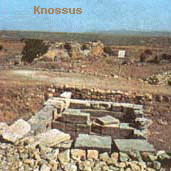
chronology of waste, a momentous landmark was achieved in 3000 BCE when the
world’s first recorded municipal dump was created in Knossus, the Cretan
capital.
 Proletarians
laboring at the site were among the first designated garbage collectors in the
world. Several millennia afterwards, in 1297, “rakers” began to be
employed in London to rake rubbish, load it into carts, and deposit it in
other sites. Over a century later, the call came for more rubbish
collectors when Henry IV issued a decree that garbage must be removed from
homes weekly. As time passed, garbage collectors replaced human muscle
with horse-drawn carts, and horse-drawn carts with automobiles and other
mechanized vehicles. During the early 1900s, in New York, sanitation
workers began using barges to dump refuse into the ocean. In Australia,
“garbos” were assigned to enter backyards and empty rubbish from people’s
garbage bins into collection bins and
garbage trucks.
Proletarians
laboring at the site were among the first designated garbage collectors in the
world. Several millennia afterwards, in 1297, “rakers” began to be
employed in London to rake rubbish, load it into carts, and deposit it in
other sites. Over a century later, the call came for more rubbish
collectors when Henry IV issued a decree that garbage must be removed from
homes weekly. As time passed, garbage collectors replaced human muscle
with horse-drawn carts, and horse-drawn carts with automobiles and other
mechanized vehicles. During the early 1900s, in New York, sanitation
workers began using barges to dump refuse into the ocean. In Australia,
“garbos” were assigned to enter backyards and empty rubbish from people’s
garbage bins into collection bins and
garbage trucks.
The introduction of garbage trucks was a major advancement in the sanitation
field. In the beginning, garbage trucks were simply ordinary trucks.
When the 1920s rolled around, people finally realized that there was a way to
combat (or at least diminish) the reek, and garbage trucks began to be
manufactured with covers. Unfortunately for the garbage collector, with a mound of
filth immediately behind
the cab, the daily assault on his olfactory senses was not much assuaged.
As time
passed, rear hoppers,
auger/corkscrew mechanisms, chain-driven elevators, and side loaders were
added. As a result, the amount
of physical labor garbage truck drivers had to perform was greatly reduced.
Today, trucks such as the sleek single worker-driver UHWD-50 Hazardous Waste
Disposal Vehicle, with automated gripping-and-lifting hydraulic arms, are
utilized across the globe.
an
electric garbage truck prototype
with covers. Unfortunately for the garbage collector, with a mound of
filth immediately behind
the cab, the daily assault on his olfactory senses was not much assuaged.
As time
passed, rear hoppers,
auger/corkscrew mechanisms, chain-driven elevators, and side loaders were
added. As a result, the amount
of physical labor garbage truck drivers had to perform was greatly reduced.
Today, trucks such as the sleek single worker-driver UHWD-50 Hazardous Waste
Disposal Vehicle, with automated gripping-and-lifting hydraulic arms, are
utilized across the globe.
an
electric garbage truck prototype
All material property of the author. Please do not use without permission. Contact info: oneforce@outgun.com
