Detonators and other Explosives
You look on the shelf to see a variety of different thermal detonators. This is quite exciting and it was well worth the trouble.
You can tell that Daar is a good businessman, and likes to keep his customers happy - expecting them to return the same to him.
 A thermal detonator is a compact yet powerful explosive device contained is a small, silvery sphere. Once activated, an internal fusion reaction starts within the sphere which eventually grows into a deadly explosion.
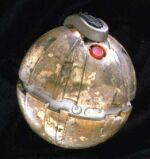 The heart of a thermal detonator's explosive power is the compact sphere of volatile baradium found inside a thermite shell. Once the thumb trigger is activated, the baradium enters a state of fusion reaction that creates an expandable particle field capable of disintegrating everything within a 20-meter blast radius. The detonator is typically set on a timer, since the explosive radius is quite large and represents an extreme hazard to the weapon's bearer.
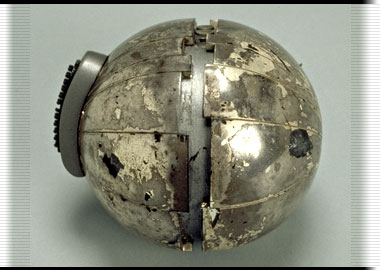 Although a variety of detonators exist, almost all are very carefully regulated and outright illegal to own. The Merr-Sonn Munitions Class-A thermal detonator is an extremely powerful model. Baradium is dangerously unstable, and fusion reactions have been known to start due to improper handling or jarring of the detonators.
 The main purpose of a proton mine is to establish a defensive perimeter. The LX series are refitted proton torpedo warheads attached to two sensors, one of them designed to detect vehicles while the other searches body heat. These mines are usually placed half-a-meter beneath the surface and programmed to detonate if they detect an intruder within five meters, with a blast radius of twenty meters.
There are two types of LX mines, the LX-2 and the LX-4. The older LX-2 can be disarmed, useful to defend a mobile position, such as the landing place of your starship or the surroundings of an encampment and then disable it and get it back, while the LX-4 can only be removed via detonation.
 Proton grenades are high-powered, handheld explosives that contain a proton core, a greatly reduced version of the warheads used in proton torpedoes. First developed for breaching ships' hulls during boarding actions, proton grenades such as Merr-Sonn's 7-PrG are used for large demolitions projects.
Twisting the grenade's arming mechanism primes the battery to deliver a small electrical charge to the proton core; pressing the activation plunger starts the timer. This two-step process offers a fail-save to prevent accidental detonations; this is very helpful, since the proton core is almost as powerful as a thermal detonator. The timer can be set for up to twenty minutes, and the weapon can be disarmed at any time by pressing the twist plunger release.
A proton grenade is much more effective than a standard detonite charge. The pre-stressed metal casing and shaped proton charge channel the explosion's force toward the magnetic plate that holds it to its target and the blast can punch through a meter and a half of permacite. Electromagnetic pulses disrupt any computers, droids, blasters, and other electronic devices within twenty meters. Finally, when the grenade is used in boarding actions, the explosion instantly blasts away armour plating – saving the toil and effort of a fusion cutter.
The Galactic Empire which is notorious for employing the most lethal and sophisticated devices on all of its installations, and the BlasTech Class VI Automated Laser Projectors were no exception to this statement. These automated blasters (nicknamed laser traps) are often used at security checkpoints, where they can be activated by the guards assigned to that area, or controlled by officers who keep watch through security monitors.
 Laser traps also provided a common security measure at prisons, and labor camps where they can be used to put down inmate uprisings. The BlasTech Class VI Automated Laser Projector unit is one that consists of a control computer, a sensor suite, and a small blaster cannon. When responding to an alarm, security guards may control and fire the blaster manually or activate the unit's onboard combat computer, which is capable of tracking up to two dozen targets simultaneously.
The blaster on the laser projector rotates 45-degress in any direction and has an optimum range of 10-meters and a maximum range of 25-meters. These units’ blasters have stopping power equal to a blaster rifle, and the weapon can be set up to fire high-energy stun blasts that can pack enough of a punch to stop a full-grown gundark in its tracks. The projector is equipped with internal power cells that can provide enough energy for up to fifty shots, or it can be connected to a power generator to give it unlimited firepower.
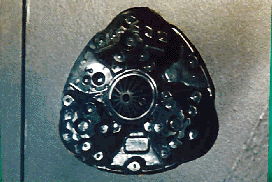 Most of the time, security stations use multiple laser projectors, which can be mounted on the wall or on rotating turrets that hang down from the ceiling. Also to be able to surprise attackers these laser projectors can be mounted on retractable platforms and hidden behind false panels. Often times security cameras are linked to the projectors to feed additional targeting data to the laser trap's combat computer.
Again, most of the time, facilities supplement their security systems by issuing coded identification chips to all personnel, which are detected and scanned by the laser projector when they enter an established security checkpoint area, and if the being lacks the identification, it alerts the control officer.
It is often best to use these in combination with security scanners.
Go Back to the Front Room
Blasters
Miscellaneous Contraband
Droids
Transportation
I know what I want.


