|
|
|
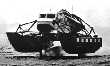
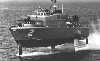
Getting My Feet Wet: During my many trips overseas I became interested in what was going on in the advanced marine vehicles area, Hydrofoils and Surface Effect Vehicles. Russia was operating large fleets of ladder foil boats on their main rivers. 1st generation surface-piercing hydrofoils were operating in Europe and Asia. These designs were mainly German in origin and most of the boats were being built in Italy. The British were big on the Hovercraft and were pursuing the design of a large automobile ferry for service across the English Channel. Boeing had a hydrofoil group that was developing 2nd generation fully submerged foil vehicles for military uses. They had already built: FRESH-1, a Navy research craft, which held the hydrofoil speed record; High Point which was being evaluated by the Navy in Bremerton WA; and Little Squirt (a company funded test hydrofoil) to develop water-jet propulsion. A Navy boat, TUCUMCARI, was under construction to compete with one being built by Grumman, the FLAGSTAFF. All were fully submerged foil vehicles which could provide better speed and ride quality than the surface-piercing types.
FRESH LITTLE SQUIRT TUCUMCARI (to increase size right click on picture and select zoom in) I had the notion that Boeing had the knowledge and tools to build a superior commercial hydrofoil and that there was a world-wide market for such a vehicle. I had made a deal with the VP that got me to take the MM security assignment that when it was done I could select what I wanted to do next, if he agreed that my choice was in the best interests of the company. When I told him that I was interested in the Marine Systems group (part of the Aerospace Division) he was intrigued. At the time the man that had been my first Boeing manager was running it. The VP told me that he believed that there might be a problem with the "TUC" and so I should meet with Airo and see what we could work out and then report back to him for a decision. After a couple of meetings and the discovery that there might really be a problem with TUC it was agreed by the three of us that Airo would work full time on TUC and I would report to him as Marine Systems Development Manager responsible for everything else. So on Sept. 16, 1966 I went into the marine vehicle business at Boeing
Hydrofoils International Hydrofoil Society |