Selection stage 2
CONTINUATION TRAINING
The survivors are then sent for continuation training, during which
they are still being tested for their suitability as SAS soldiers.
The first thing is training in the weapons of the regiment. M16, 203,
Browning pistols, ETC.
Most soldiers will have never used these weapons before so it
essential that thay are skilled in there use.
They also need to be trained on Eastern bloc weapons, AK47`s, ETC.
A lot of the time sas soldiers will be required to use these weapons
rather than their own, especially if operating in a foreign country.
There is still a lot of physical work in the gym to keep the fitness
levels of candidates high.
Candidates are also tested for their mental abilities.
Language aptitude, arithmatic and english language are all tested, as
well as a series of mensa tests.
This is to check if a candidate has the basic aptitude to adjust and
learn to the sas way of doing things.

JUNGLE PHASE
Jungle training takes place in the British army jungle traning
school in Brunei.
It teaches the basic skils required to live in the jungle for weeks on
end, as well as how to navigate in the dense jungle.
This is one of the hardest for candidates to learn, because the jungle
is difficult to operate in.
It is easy to become lost in the featureless environment, with short
visibility no virtually no landmarks.
The candidates then move onto patrolling and contact drills.
This is done individually at first, moving on to patrols of 4-5 men.

COMBAT SURVIVAL PHASE
One of the most testing and controversial elements of con-
tinuation training is a three-week, combat-survival course at
Exmoor, in which candidates are stretched psychologically as
well as physically. The point of such training is to prepare men
to fight a guerrilla war behind enemy lines. Much of the course
is run by a Joint Services Interrogation Unit staffed by SAS and
other personnel. It is preceded by a special period of training at
the regiment's Hereford base. Both courses are a mixture of
tuition in living off the land -- identifying edible seaweed and
fungus, learning trapping techniques to procure game or fish
-- followed by a realistic application of these lessons, in which
the student spends several days and nights on the moor, being
hunted by soldiers from other regiments. Cunning candidates
have been known to pass some of this time comfortably as
unofficial guests of people living on or near the moor.
The Exmoor course contains the usual 'sickener' element.
Devices include a variant of the numbered brick, a five-gallon
jerrycan of water to be carried over long distances. To eliminate
the possibility of cheating, the water is dyed and the Jerrycan
checked by instructors.
At the regiment's Hereford base and, subsequently, on the
Exmoor course, SAS candidates are also subjected to interro-
gation of a kind that, to judge from the testimony of those who
have passed the course, does not differ from the treatment about
which terrorist suspects complained in Ulster in 1971, and which
was studied by the Compton Commission. Already-exhausted
soldiers have been subjected to physical hardship and sensory
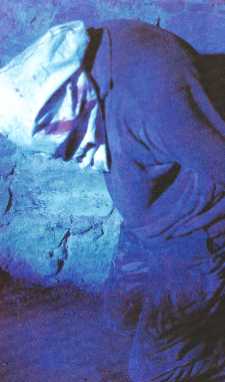
deprivation, including the use of a hood placed over the head for
many hours, white noise and psychological torture. The object
of these techniques is to force the combat-survival students
to reveal the names of their regiments and details of the
operations on which they are nominally engaged. Not all those
participating are SAS candidates; Royal Marine Commandos
and Parachute Regiment soldiers also take part. The difference
is that for the SAS nominee to break is more than a chastening
experience: it means he has failed to win a place in the regiment.
Those who fail at this stage are often the men who seemed best
fitted to the physical rigours of the earlier selection process on
the Brecon Beacons.
The experience of one successful candidate in recent years
is that three periods of hooded interrogation occur during the
two interrogation-resistance courses: a half-hour 'nasty'; an
eight-hour period and finally, during the Joint Services' Exmoor
Course, one of twenty-four hours interrupted only for periods
of exposure to bright electric light while facing the interrogation
itself.
In one instance, hooded SAS candidates were hurled from
the back of a stationary lorry by their over-enthusiastic captors,
members of an infantry regiment, on to a concrete road as part of
the pre-interrogation, softening-up process. One man suffered
a broken arm as a result. A successful candidate on that course,
who was still intact, recalls that he then spent eight hours sitting
manacled in a puddle as a preliminary to questioning. During
another period of interrogation, he was hooded and shackled
to a strong-point in a room in which white noise and coloured,
flashing lights were used. After some time, guessing that he was
alone, he contrived to remove the hood and regain a sense of
reality. 'I looked around and there were all these flashing
lights',
he said later. 'It suddenly seemed ridiculous to me. But until then
it was a bit unnerving. Some people get frantic in there. I think
there is a limit to how long you can stand it. After 24 hours
you begin to wonder if they are on your side. At the time,
while it was happening, I was told that the `treatment` would
go on much longer and I was almost cracking.' At Hereford,
as both victim and interrogator, he took part in more refined
psychological brutality during a preliminary combat-survival
course run exclusively for the SAS. Candidates were tied to a
wooden board and immersed in a pond for up to twenty seconds
before being recovered to face the same questions: 'What did you
say your regiment was? What did you say you were doing?' One
who survived this test later told his interrogators that he realised
no one intended him to drown, but he did fear the possibility of
a miscalculation, or that things would simply get out of hand.
An SAS interrogator with 'a Machiavellian turn of mind'
so arranged matters that hooded captives thought they were
about to be attacked by 'a perfectly lovable Labrador'. In an
adjoining room, meanwhile, they could hear a beating taking
place followed by the sound of vomiting and running water.
The victim of the beating was an old mattress; the groans and
vomiting were simulated by the interrogation team. An even
more elaborate charade involved the use of a railway truck
in an old siding, part of a disused ordnance depot. 'We had
these guys handcuffed to the rails. By this time they were
disoriented and tired. What they heard was a voice shouting
from a distance, "Get those men off the line!" The other
guards
then went through a pantomine. "Bloody hell, there's a train
coming. Get the keys!" The prisoners could feel the vibration
of the truck approaching. As it got closer one of the guards
shouted, "It's too late. Jump!" In fact, the wagon
went past them
quite harmlessly on an adjoining line into the siding. Among
the prisoners, reactions differed. Some positioned their hands so
that the wagon wheels would cut the shackles and set them free.
Some got themselves into a position where they would have lost
an arm. Others went berserk and ended up lying across the rails.
But every one of them thought that this was a real emergency
and that we had made a monumental cock-up.'
The perception of another, older SAS veteran is that the
account given above places undue emphasis on physical bru-
tality. According to this source, the interrogation experts (who
include at least one former captive of the Chinese) regard
such brutality as counter-productive in breaking a prisoner's
will. Furthermore, he adds, candidates are carefully briefed
beforehand about what to expect from the interrogators. 'My
experience was that the Exmoor course emphasised psycho-
logical vulnerability,' he said. In practice, in his case, this
'psychological' approach meant his being left naked in the
snow for several hours before interrogation by a panel which
included a woman. The size of his penis, much reduced because
of the cold, was the object of sarcastic comment. This veteran,
a particularly hard man, added: 'I wasn't always certain who
was being trained: us or the interrogators. I think it was a bit
of both, really.' What is undoubtedly true is that, in action,
account given above places undue emphasis on physical bru-
tality. According to this source, the interrogation experts (who
include at least one former captive of the Chinese) regard
such brutality as counter-productive in breaking a prisoner's
will. Furthermore, he adds, candidates are carefully briefed
beforehand about what to expect from the interrogators. 'My
experience was that the Exmoor course emphasised psycho-
logical vulnerability,' he said. In practice, in his case, this
'psychological' approach meant his being left naked in the
snow for several hours before interrogation by a panel which
included a woman. The size of his penis, much reduced because
of the cold, was the object of sarcastic comment. This veteran,
a particularly hard man, added: 'I wasn't always certain who
was being trained: us or the interrogators. I think it was a bit
of both, really.`
The two combat-survival periods -- the preliminary SAS
course at Hereford and the Joint Services course at Exmoor --
end with a solemn, all-ranks dinner representing tastes acquired
during this time, including seaweed, frog, hedgehog and rat.
On one occasion, following total failure to obtain sufficient
hedgehog in the wild, rats were collected for the feast from
an Army veterinary establishment. 'What do you want these
for, then?' the SAS messenger was asked when he arrived to
pick them up. 'To eat, of course,' was the reply.
As well as resisting interrogation -- or at least, coming to terms
with the grim reality of it -- combat-survival training also teaches
escape and evasion. In winter exercises it is a long-standing
military joke that the SAS man may be identified as the one
who walks backwards across a patch of snow. The Joint Services
Escape and Evasion course devotes a short time to lectures and
demonstrations by police dog-handlers on eluding the dog by
wading in water or through a farmyard where the scent will
mingle with that of more pungent animals. SAS men are also
taught how to kill a war dog, a skill some of the regiment's
soldiers used to remarkable effect during an exercise in friendly
Denmark several years ago, to the outrage of the dog-handlers
concerned.
The final part of selection is for soldiers who have not completed
a parachute course to go to Brize Norton to do so. This is a holiday
compared to what the candidates have beem through, and most can`t wait
to finish it so they can come back to get badged. The handful of men
who complete the process of initial
selection and continuation training -- estimates of this number
vary between five and seventeen out of every hundred -- are
welcomed into the regiment by its commanding officer or
second-in-command, and handed the beige SAS beret and cloth
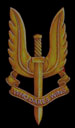
badge bearing the famous winged dagger.