
(Research)
The Role of Women in Ancient Greece
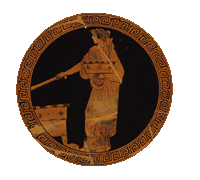
To Since being born, they were controlled by the men in their lives!
What about marriage?
The celebrations or ‘gamos’ was held to honor the passing of a girl from her father to her husband. These celebrations could vary in length and religious influence. The bride would be washed and dressed by female relatives. A white dress would be worn, as it was the correct colour for religious ceremonies. The girl would also wear a crown, and carried a pomegranate or a fruit with many seeds- which could possibly symbolize fertility. Sacrifice was an important part of the wedding- the father of the bride also offered sacrifices at the family altar, rigorously announcing that he was giving his daughter away. The childhood toys of the girl would be offered to Artemis. A source of this time confirms this ritual- ‘Timareta, being about to be married, has consecrated to thee, O Artemis of the Marshes, her tambourines, and the ball she was so fond of, and her hairnet, her dolls, too, she has dedicated in a befitting manner, with her clothes-a virgin’s offering to thee, O Goddess.
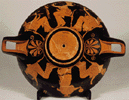
On the second day of celebrations a feast was held for all the families. The new bride and groom would be escorted to the groom’s home, where he would pretend to abduct her, and then carry her across the threshold. The couple and their family would then kneel before the hearth where the bride would be formally introduced to the divinity of her new house. The young bride would only become a full member of the new household when she produced her first child. Women had very little influence, or power in Greek society and were not highly regarded until they could produce this child.
A newly married wife would be eager to fulfill her duty as a wife and bear a child. Childbirth in Athens always took place in the home. Before the birth, the house would be smeared with pitch (a black substance), as a protection against evil spirits. Normally, the women of the house would deliver the baby.
Occasionally in wealthy families they would have a midwife deliver the child. Because contraception was limited Athenian woman had numerous pregnancies. There was contraception in ancient Greece, but it was not readily used or available. Most often it was used after a woman had had a few children. Not all babies survived and life expectancy for women was 35-40 years old, presumably because they were worn out from childbearing. In ancient Greece, mortality rights for mothers and babies were high.
To notify the neighbors of a birth of a child, a woolen strip was hung over the front door- this indicated a female baby. An olive branch indicated a boy had been born. Families did not always keep their new child. After a woman had a baby, she would show it to her husband. If the husband accepted it, it would live, but if he refused it, it would die. Babies would often be rejected if they were illegitimate, unhealthy or deformed, the wrong sex (female for example), or too great a burden on the family. These babies would not be directly killed, but put in a clay pot or jar and deserted outside the front door or on the roadway. In ancient Greek religion, this practice took the responsibility away from the parents because the child would die of natural causes, for example hunger, asphyxiation or exposure to the elements. If the baby were accepted, there would be a celebration- given a name, and presented to the gods and goddesses. It was difficult for a woman to divorce her husband. Most divorces in ancient Greece were by the husband. If he chose to divorce her he would reject her in front of witnesses or merely send her back to her family home. Upon the divorce, the dowry would be returned and the children (if any) would remain with the father. Women would lose all rights to their children. If however, the woman had committed adultery the husband did not have to return the dowry. For a woman to divorce her husband she would have to endeavor to find an archon (and Athenian official) and provide good reasons for a divorce to be granted. A man, however, could put a stop to all this by simply confining the woman to the home. Athenian fathers had all rights to end the marriage, until the woman produced a child. Before that, he could brake up the marriage so that the woman could return home, or marry another man.
Once a woman was married her husband controlled all property. Any property that she might have inherited would go directly to her husband. She had no rights to wander about the town, without a just cause. Any respectable woman would not be seen in public. Greek women had virtually no political rights of any kind and were controlled by men at all stages of their lives. Since men spent most of their time away from their houses, women dominated Greek home life. The wife was in charge of raising the children and making the families clothes. She supervised the daily running of the household. In a totally slave based economy plentiful numbers of female slaves were available to cook, clean and carry water from the fountain. Only in the poorest homes was the wife expected to do these duties by herself. Custom dictated that women should limit her time outside the home. Visiting with a female neighbor was really the only appropriate time for the woman to leave her indoor duties.

Even though the women of ancient Greece were not important, the goddesses were especially Athena- goddess of wisdom, war, arts and crafts and the city of Athens. The people of Athens built a large temple for her and it’s called the Parthenon. The people of Athens put a picture of her on their coins and as Athens became more imperialistic, Athena started to look different, more war like.
Athenian women could not own property in their own right. If they were married, complete control went to their husband. If they divorced, control and rights over any property went back to their father or nearest male relative.
Women had very few rights, let alone legal rights. They had no rights to vote or take part in the operation of the state. They were not allowed to watch the Olympic Games, as the participants did not wear clothes. Chariot racing was the only game women could win, and only then if they owned the horse. Most Greek households had slaves. Female slaves cooked, cleaned, and worked in the fields. If a woman did not have a slave, then they had a lot more freedom, but a lot more work to do.
Jobs that a woman could perform in the public sphere included weddings, funerals and state religious festivals in which women were expected to play prominent public roles.
The Thesmophoria was a significant religious event that women were expected to attend. Men were strictly prohibited and was reserved for married women only. The women were expected to prepare sacrifices and offerings for the goddesses. Another female’s festival was that of Haloa, celebrated to protect the sowing of the grain. Sacrifices were expected to be made by the women to the goddess Demeter, her daughter Kore and also to the god of sea Poseidon. ALL women were expected to celebrate and perform at this festival. Written and archaeological evidence suggests that women played a significant role in the religious life in Ancient Greece.
As part of a woman's public duties, she would be expected to play an important role at funerals. There is evidence for this in both written and archaeological forms. Plutarch in his ‘Life of Solon’, records laws decided in c. 590 BC, regarding the limitation of expenses and ostentatious behavior at funerals in Athens. Athenian women were not allowed to cry neither sacrifice an ox, nor bury more than three garments with the body. Excavations of the Athenian Kerameikos- an ancient burial ground outside the city walls, has also revealed a lot of valuable information. Women played an important role in preparing the dead body for burial. In a funeral procession, the females were expected to carry the libations at the front of the group, FOLLOWED by the male relatives. This was probably the only time a woman was ever allowed to be ahead of the males! According to Solon's laws, the amount of female relatives was limited. On the third and ninth days of the funeral women were expected to deliver food and libations to the gravesite. An extract from Plutarch's ‘Life of Solon’ states: (Solon) also made a law which regulated women's appearances in public, as well as their mourning and their festivals, and put an end to wild and disorderly behavior......besides this he abolished the practice of lacerating the flesh at funerals, of reciting set dirges, and of lamenting any person at the funeral ceremonies of another. People were also forbidden to sacrifice an ox at the graveside, or to bury their dead with more than three changes of clothing or to visit the tombs of others besides their own family except at the time of burial.... Offenders shall be punished by the board of censors for women weak and unmanly behavior, and for carrying their mourning to extravagant lengths'.
It appears that people had altered views of women. Some saw them as important mothers of citizens and for the passing on of legitimacy, women were protected and sheltered, even in their own houses, from the peeping eyes of other men. They had limited access to society and the activities that took place there. Despite this, the writer Simonides depicted women as different types of animals- women represented the forces of chaos. Women were viewed as highly sexual beings who could not control their sexual urges and therefore had to be restricted for their own benefit. Compare this, however, to his paradox in which he explains to the ancient Greeks, ‘woman is the consumer of men, their sex, their strength, their food, and their wealth, and the instigator of all evils in the world; yet without her, society cannot continue'. Euripides from his book ' Meda' writes; ‘If only children could be got some other way without the female sex! If women didn't exist, human life would be rid of all its miseries’. These two authors depict the most constant view of women in ancient times. Most men felt that women were only necessary to produce children.
Many scenes on Greek Pottery depicted women. Many of these women were either dancing girls or prostitutes. This shows that men had little respect for this class of women, as they are pictured as slaves to men’s desires. Certain pots also paint the pictures of the ancient goddesses. A particular pot made in the early 5th Century BC shows the goddess Athena driving a four –horse chariot or quadriga. This explains to us, that the men were a lot more taken with the goddesses of their time, rather than their own women. Sculptures also were made of only the goddesses, and never of the ordinary women. Occasionally, Greek vases showed rituals of their culture. For example on an Attic Red Figure Hydria from 460-450 BC by the Penthesileia Painter, it shows a matron, joined by her young daughter and shorthaired servant, holding a three-legged basket. Behind is a stool with a woven cushion. The items most commonly illustrated on vases and on stone relieves include chairs, stools, couches, tables and various kinds of chests, boxes and baskets. Stories, poems, and plays by the Greek author Homer tell us a great deal about how men viewed the gods and goddesses. They placed a lot of importance on their goddesses, and once again proves that they regarded the goddesses more high than that of their own women. Vase scenes portraying women inside their houses tend to be sparing in specific details. The common presence of columns suggests that women spent much of their time in the courtyard of the house, the one place they could regularly enjoy fresh air. Greek cooking equipment was small and light and could be easily set up there. In sunny weather, women probably sat in the roofed over areas of the courtyard, for the ideal female beauty was a pale complexion.
The work and freedom that a woman did eminently depended on their social position in society. There were three main classes of women in Ancient Greece. There was the wives class. The wives had to stay at home and weave things. They were considered respectable women. They were not allowed to go anywhere except for religious ceremonies. Then there were the Concubines. They were the poor women (widows, slaves and girls that were left out to die by their parents when they were babies) that were prostitutes. There was also the hetaerae class. The hetaerae class were a lot more educated than the wives class. They were companions to men, only if men paid an expensive price. They met the men at parties or festivals. As mentioned, the wives class did work at home, looking after the children, the house and attending to small duties. The prostitute's class of women were sexual companions to men. There were obviously double standards in Ancient Greece, because citizen wives and daughters were protected, but the prostitutes or pornoi were open to all forms of sexual exploitation. These women moved freely throughout society, with basically no rules surrounding them. Prostitutes were maintained by men, or worked in brothels and on the streets. AD 4th Century fragment of writing describes how the common prostitute lived- ‘too tall to wear thin slippers, too small to have a cork sewn onto her shoes, no hips? Put on a bustle and onlookers will comment on her nice bottom.... etc'.
The hetairai or hetaerae were not only men's sexual companions but also their social and intellectual companions. Similar to the prostitutes, in that they were not protected or respected and were also open to all forms of sexual exploitation. The differences being that sometimes these women developed monogamous relationships with men, but their children were classified as illegitimate and had no rights. Unlike citizen wives, these women did not lead a sheltered, restricted life. Instead they too moved freely in society, shopping, attending theatre etc. They were often foreign and skilled at music, dancing, singing and intellectual conversation. They were also obviously trained and skilled in the art of pleasing men. From an ancient Greek comedy the following comments are made about this class of woman; ‘ Besides, isn’t a “ Companion ” (hetaera) more well intentioned than a wedded wife? Yes, far more and most understandably. For a wife remains at home contemptuous because of law, but a companion knows that a man must be bought by her attentions or she will need to go and find another. Ancient Athens had a large slave population. Women slaves were usually the result of the spoils of a foreign war, worked in private households as maids, nurses, cooks, or in industries such as cloth making. They had no rights and were at the mercy of their master or mistress. Slave prices varied. A document from 415 BC shows the price of female slaves ranging from 220 drachmas to 85 drachmas.
The principal work of upper-class women was to take good care of their homes, children and slaves and to balance the housekeeping budget. Jobs included wool buying, then cleaning, carding, spinning, weaving and dyeing it; making garments for the entire household. Women of poorer classes, who could not afford slaves, had to work in the fields or on stalls in the market place alongside men. Evidence from written and archaeological sources suggests that the poorer women were involved in a range of occupations, such as ribbon selling and grape picking. In Aristophanes plays, he refers to women as innkeepers, wet-nurses, bakers, myrtle-wreath and vegetable sellers, perfume sellers, unguent boilers, launders, honey-sellers, wool workers and ‘garlic-selling barmaid bake house girls’. Some foreign immigrants ran brothels, although a lot of brothels were state-owned. The far most respected job that a woman could do was run a household. The work that the poorer class of women did was not at all valued, so they only way to gain any respect in ancient Greek society was to be a housewife.
A woman was regarded as the property of her father (kyrios) and then of her husband until she died. If a daughter did not get married, she remained the property of her father, and became a dishonor for the family and a financial burden.
Girls were treated as daughters all of their lives while boys came of age at eighteen. Greek society was patriarchal -- it was controlled by men and did not allow women full political and social rights. Men tended to behave more like fathers toward women.
Thus, if a woman got married she passed from the authority of one man (her father) into that of another (her husband). Greek wedding ceremonies were portrayed in many pottery paintings and in literature. The first phase of marriage was the betrothal which was arranged by the bride's father. The father chose an appropriate husband which was witnessed by both families. The dowry was agreed to at this time and was a very necessary part of the marriage. Girls whose families were too poor to provide a dowry ran the risk of staying unmarried. If a woman was divorced, the dowry had to be paid back to the head of the household. Thus, a woman was protected against casual divorce by an irresponsible husband . The dowry was the focal point of bargaining in the marriage negotiations and consisted of cash, movables, and sometimes houses, but not land, which went to her brothers. This was the woman's contribution to the joint household and a constant source of protection. Although it was managed by her kyrios (husband, father, or son), it remained hers, going with her if her marriage ended by divorce (unless she had been unfaithful) or by the death of her husband. Consequently, because of this dowry, women were not financially dependent upon their husbands during the marriage and were assured of continuous support regardless of their marital status. It was a matter of family honor to dower a girl as well as possible,
Once the terms of the dowry were satisfactorily arranged, the contract was sealed by a ceremony in which the prospective husband pledged to the kyrios of the bride that he received her, "for the purpose of bearing legitimate children". This ceremony was conducted between two males; the presence of the bride herself was not required, nor need she even be aware of the proceedings. This ceremony was the guarantee of a legitimate marriage and the only legal requirement. There was a separate and more public ceremony in which the bride, by her unveiling, signaled her formal acceptance of the marriage union.
Marriage itself was recognized and validated not by a specific legal ceremony or paper but, as stated above, by the communally witnessed rituals and household events which over time established its legitimacy as an Athenian marriage.
Marriage was a traumatic affair for the bride, even though she desired it; her new husband was considerably older than she was. It was difficult for this new bride to transfer from the protection of her father to a new household under another man and to give her primary loyalties to this new household. This dramatic break with her old home has been expressed in literature and artwork of this time as separation and loss, marriage = death. This bride now was subject to the control of her mother-in-law and she had to be obedient to her in-laws.
Married women were expected to live in their husband's house until death or divorce. A woman was considered to have good behavior in terms of her service to her husband and not by her worth to other women, herself, or to the society as a whole.
A husband expected his wife to be already skilled in domestic tasks, such as weaving, spinning, cooking, cleaning, and managing slaves. Marrying a young girl was thought to be a very positive thing by the men in ancient Greece because she could be taught good habits. The most important task of a Greek wife was to become the mother of sons who would grow up to survive their parents and inherit the family property. It was not appropriate for a female to own her own property. If there was no son, then a daughter would inherit the property but she was expected to marry a close relative chosen by her father so that he might inherit the land.
Sons were expected to work at occupations that would bring money to the household while daughters were trained in domestic skills in preparation for the time that they would marry.
A woman's greatest virtue was chastity. This was for the sanctity of her marriage bed, the cleanliness of her body, the manner in which she chooses to leave her house, her refusal to participate in secret cults of Cybeline rituals, and her readiness and moderation in sacrificing to the gods.
It was extremely important that wives be faithful to their husbands and if they weren't, a husband could divorce her. A woman could divorce her husband but it was very rare. A woman divorced by her husband would be excluded from public ceremonies, forbidden to wear jewelry, and regarded by others as a social outcast. If she breaks with custom in this way, she wrongs the gods of her family and provides her family and home not with its own offspring but with illegitimate children (who could not inherit). She also wrongs her own city, because she does not abide by its established rules.
Men on the other hand were allowed to commit adultery, so long as they did not seduce the wife of a citizen. Wives were expected to ignore their husband's extra-marital activities unless he actually brought a mistress in the house.
In cases of adultery, the adulterer could be killed, if caught in the act, by the offended head of the household or be held until he agreed to pay compensation. In ancient Greece, a man's honor depended partly on the virtue of his wife. If an adulterer seduces the wife and wins, it causes shame and loss of honor to the husband resulting in public interest. Thus, adultery in Athens and other Greek cities was conceived as a "source of public violence and disorder".
Women past childbearing age often stayed with their sons, whose legal obligation was to support them. A single woman still capable of bearing children, whether she was a widow, divorcee, or single, was considered a terrible thing. Community gossip spread fast and was ever alert for misbehavior of any kind from a single woman. The Peloponnesian war of 431-404 B.C. led to the absence of men, thus causing women to go out and work and to exit from domestic hiding. Pericles advised the widows of men from this war to live good lives but not to seek praise. Widows and divorcees were encouraged to remarry instead of staying single, as it was thought to be best for both the community and their physical bodies.
| Process Paper | Home | Women who Made a Difference | Quotes |
| Analysis | Conclusion | Pictures | Bibliography |
