
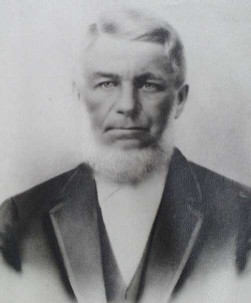
Born April 14, 1816 at Suhl, Germany, Nicolaus married Dora Schacht on Sept. 19, 1838. He died on December 18, 1901, at age 85. Dora Schacht Kleinschmidt was born on April 6, 1815, and died June 6, 1883, at age 68.
1. August Kleinschmidt
2. Mathilde (Emelia) Kleinschmidt Pennington
3. Gottlieb Ernest Kleinschmidt
4. Wilhelm (William) C. Kleinschmidt
5. Louie Kleinschmidt born in Sigourney, Iowa
The actual names found on the 1850-1874 Germans To America immigrant list were
Nicolaus for Nicholas, Mathilde for Emelia, Gottlieb for Gotlieb, and Wilhelm for William.
The Americanized names will be used from now on in this book
i.e.I will refer to Nicolaus as Nicholas from now on - this is the American spelling.
Nicholas' father, who was named Nicolaus also, was a wood worker and repairman as a leaf from his ledger in 1790 and 1791 showed. (Found in the jewel box Nicholas had given to Dora)
This is the house Nicholas Kleinschmidt built the fall of 1855 and the winter of 1856.
Family lived here 1856 - 1880.
It is now at 126 W. Jackson St., Sigourney, Iowa.

This is the house that Nicholas Kleinschmidt bought when they came back to Sigourney after a short retirement on the farm. Now 315 N. Jefferson Street.
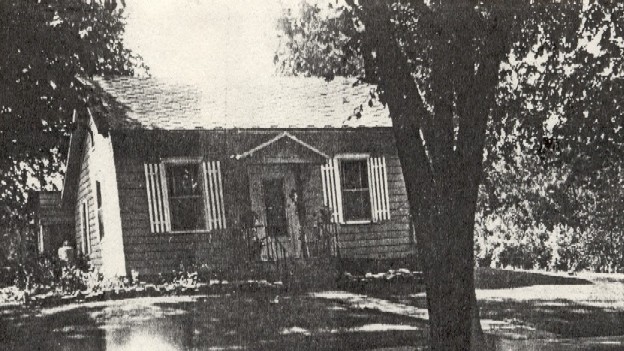
The house is now at 408 'West Street, Sigourney, Iowa.
He met Dora Schacht (born April 6, 1815) when he was 22 years old and, on September 19, 1838, they were married. Both had a good education. Since Nicholas had his cabinet shop, he carried on that work as long as he was in Germany. In 1852 their family was composed of three sons and a daughter - August, Emelia, Gottlieb and Will. The two older sons had finished or nearly finished the regular school course and it would not be long before the government would expect army service of August and the other two boys. Nicholas did not like the thought of army life for his sons, although he had not been required to serve his country.
Nicholas and Dora began to talk of emigrating to the United States of America - no man had to serve in the armed forces (at that time) unless he volunteered. They felt it would be a good home for their sons and themselves.
Nicholas left his parents in the care of his sister, signing over to her the home, as he was the natural one to keep the home and care for his parents. This released him so they could leave Germany. His wife's people, the Schacht's, lived at the port where they were taking the ship upon which they would sail to America.
They packed and shipped to the boat, many things to be used in their new home across the sea. A great many pieces of furniture. "Good-byes" were said, and they waited for the sails to be lifted. Gottlieb was not yet seven years old. He loved his grandparents very much and at the last minute decided he (Gottlieb) would not go to the new world but would stay with his mother's parents, grandpa and grandma Schacht. When his parents and older brother and sister were not watching, he slipped off the boat and went to his grandmother Schacht's, but his father came for him and they reached the boat before it sailed. They left Germany on .August 24, 1854, never to see "the Homeland" again. It was a long trip in a sailing vessel.
Gottlieb made friends with the sailors on the ship and learned to go all over the vessel. He climbed the highest places with the sailors and loved it. One day he made a mis-step and just missed a dunking or worse, had not a sailor caught him by one foot and drew him to safety. The water supply became low - water was issued a pint a day to each passenger. Gottlieb had all the water he wanted with the sailors and often took his mother water. His mother was sick almost all the journey. At last they arrived at New Orleans on November 19, 1854. Here their goods were loaded on a river boat to be transported to St. Louis, Missouri. Some distance below that city, the boat sank. Nicholas and Dora lost all of their household goods which they had brought over but they and their luggage were saved. (It was a racket - the boat sank but was later raised and the goods salvaged and sold. It was years before these criminals were brought to justice.)
Nicholas, Dora and his family reached St. Louis, Missouri, on November 29, 1854. Dora had a number of uncles, aunts and cousins in that city. They settled down and lived there for two years. Nicholas learned the wagon makers trade during that time. He learned wagons were needed far more than furniture. The family met many German speaking people who were going to Iowa where land was selling for $1.25 an acre. In the fall of 1855 Nicholas went to Sigourney. He bought an acre of land in what is now the northern part of Sigourney, as of now 126 W. Jackson St. He built a two story building with a wagon and blacksmith shop in the front and living quarters above and at the back. It had great double doors in front with big windows. He had brought his family to Sigourney in April 1856, and at once opened his shop for business. He conducted it with great success.
Four children had come to Sigourney with their parents, but on January 9, 1860 they welcomed another son to their family circle. On that date Louie Kleinschmidt became the youngest member. The two older children - August and Emelia - had finished their education in Germany but Gottlieb and Will attended school in Sigourney. One teacher was Mrs. Barker. This lady was the mother of Mrs. Frank Page (who had the millinery shop on the south side of the square). She remained a special friend as long as she lived. Her daughter was a special friend always. In time Louie attended school until a short time before, or almost until his marriage. Gottlieb liked school and learned easily.
On August 8, 1861, August, who was working in St Louis, Missouri, enlisted in the United States Army - with the north. He enlisted in Company G, 24th Regiment of the Illinois Infantry Volunteers. He was discharged from the service on August 8, 1864 in Chattanooga, Tennessee. He saw service for three years. At the close of his enlistment he came home to Sigourney. He had been offered $500 in gold if he would go back in the army taking the place of a St Louis boy who had been drafted, but August turned down the money. The war lasted just six months more, but he was never sorry he had not accepted the money for he had had enough of war. He worked in St Louis until the war closed. Then he came back to Sigourney and home. He was married in 1866 to Laurette Seeber. He opened a tavern at South English and did well. In 1883, when South Dakota was opened up for homesteaders, he took his five children (Gus, Will, Louie, Millie and George) and their mother, and lived the rest of his life at Blunt, South Dakota.
Emelia had met a young man sometime in early 1862, but her family, who had never met him, knew he was a good looking young man who seemed only bent on a good time. Before the parents or brothers realized what was happening, she was leaving with this man - George Pennington - to be his wife. Emelia kissed her brothers Gottlieb, Will, and Louis "good-bye" late one night in November 1862, and for more than 16 years her parents did not know where they had gone. Her brother, Gottlieb learned that the pair had driven a team of horses and buggy (belonging to Sidenbender Livery Stable) to Oskaloosa, Iowa, where the team was left. Many years later they learned that the pair had been married there and had taken the train to Mr. Pennington's home near Morresville, Indiana. How Dora's heart ached - one daughter and she had gone away with a man whom they really did not know, and who could not speak a word of German.
In about 1878 Nicholas Kleinschmidt sold his shop and home and bought a farm northwest of Sigourney, taking their sons Will and Louie with them to run the farm. Louie, who did not like the farm life, came back to town and stayed with Gottlieb, who had married Sophia Bakehouse and lived on West Pleasant Valley Street in the south part of town.
Mr. and Mrs. Nicholas Kleinschmidt did not live on the farm very long before Will married Hannah Namur and the newlyweds moved in with Will's parents on the farm. It became a little hard for the older woman giving over her home to the young folks, so Nicholas and Dora decided to go back to town and leave the farm to Will and his wife.
A small cottage on North Jefferson Street, now 315, became the home of Mr. and Mrs. Nicholas Kleinschmidt. The house has been moved in later years to 408 South West Street. A two story square house was built in its place on 315 North Jefferson Street. Nicholas opened his wagon shop on the corner of North Jefferson and East Elm Street - where the Sigourney Library building is today. Gottlieb had left school when a little past 12 years old. Will left school sometime after Louie started school. Will never cared for the work in the shop. Gottlieb had taken up teaming when his father went to the farm. Now Nicholas and his son Gottlieb again carried on the wagon and carriage making trade.
One day in the winter of 1882 a young matron came into the shop and said to Mr. Nicholas Kleinschmidt, "I am your daughter Emelia." Mr. Kleinschmidt said he didn't believe her. He asked her a question in German but the lady didn't know what he had asked - she could not understand German. Before Emelia left home she was a scholar in German, yet this lady could not understand or speak it, and insisted she was Emelia Kleinschmidt Pennington. She was sure her mother would know her. The two, Mr. N. Kleinschmidt, and the lady who claimed to be his daughter, repaired to his home just a short distance from the shop. Mrs. Nicholas Kleinschmidt did not recognize the lady, but was sure she wasn't her daughter. At last in desperation Mr. Kleinschmidt said "Emelia, our daughter had a birthmark on her left shoulder; if you have that mark, you are our daughter." The lady loosened her dress and dropped it from her left shoulder. "I have it; there is the birthmark, father" said Emilia Pennigton. It was a real reunion. She visited for some time with her parents. She wanted to stay with them, but her father and mother convinced her that her children Mary, Ellen, Walter and Dora needed her. So she returned to Indiana and her family. She came back to visit again several years later. Her daughter Ellen visited with her grandfather and uncles Gottlieb, Will and Louie in their homes in 1884-1885, but died a few years later after her return to her home. She and her fiance, John Grishan, both died of typhoid fever a few days before their wedding day was to have been; which proved to be their funeral. Mrs. Gottlieb Kleinschmidt and her daughter Clara visited Mrs. George Pennington and family at Mooreville, Indiana the summer of 1905; found she was still living in the old log Pennington home. She was reconciled to her home, although she was not proud of the man she had married. She lived to see her three children in their own homes. Dora returned to her mother and stayed with her mother on the home place until her mother's death, after which she made it her home as her sister Mary and brother Walter had both died. Mary's daughter passed away soon after her grand-mother so there ere just Walter's two children left of Dora Kleinschmidt Pennington's family.
Louie Kleinschmidt did not like farm life, but when he married Lucetta Bereiter in 1882, they went to farming near Brighton. He farmed until he turned the farm he had bought near Harper over to his son Danny. Louie and his wife lived the last years of their lives in Keota, but after the death of Louis in 1924, Lucetta made her home with Danny and his wife Mary and daughter Erma.
When Mr. and Mrs. Nicholas Kleinschmidt were left alone in their home, they gave the management of the shop to their son Gottlieb, though for a few years longer Nicholas continued to take an interest in the business. Gottlieb conducted the business until he turned the management over to his son George in 1900.
Nicholas and Dora Kleinschmidt were members of the Lutheran faith but they united with the Evangelical Brick Church east of Sigourney. They trained their family according to the doctrine of their faith. The two older children - August and Emelia - were confirmed in Germany but the other three boys were confirmed in the Evangelical Brick Church east of Sigourney. When the Evangelical Church was built in Sigourney he moved his membership to the new church.
During the winter of 1883 Dora fell ill with a liver ailment. She made no improvement but grew steadily worse. Her sons were in the home daily. Early in June 1883 she passed away at the age of 68.
Nicholas Kleinschmidt lived alone for 18 years. He loved flowers and his yard was full of blooming flowers from spring, summer and through late fall. He had beautiful houseplants through the winter. He gathered many bouquets from the flowers in his yard, and gave them to the neighbor children. His life was full of faithful continued labor and honesty. He was a successful business man. He be came a real good housekeeper. He died December 18, 1901. He was 85 years old. He suffered a stroke a few days before his death.

