Slide 7 of 25
Notes:
- Determination of whether a variable is measured on a nominal level is usually straightforward in behavioral sciences. Not necessarily true for other levels of measurement. Controversy over whether intelligence scores reflect only an ordinal measure of intelligence or an interval level of measurement.
- Critical question is whether test score differences always represent equivalent differences in intelligence; for instance, is the difference in intelligence between individuals w/IQ test scores of 110 and 120 the same as the difference between individuals w/test scores of 90 and 100? If so, scores are interval. If not, scores are ordinal.
- What is clear, is that test scores do not reflect a ratio measure, there is no evidence that an intelligence test has a true zero point.
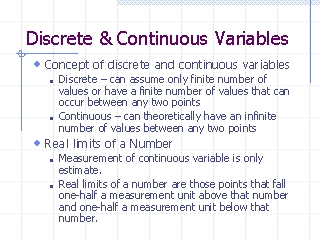
- Reaction time to a stimulus is an example of a continuous variable. Even between the values of 1 and 2 seconds, an infinite number of values could occur.
- Whether variable is classified as discrete or continuous depends on the nature of the underlying theoretical dimension and not on the scale used to measure that dimension. Tests used to measure intelligence, for example, yield scores that are whole numbers (101, 102, etc.). Nevertheless, intelligence is still continuous in nature because it involves a dimension that allows an infinite number of values to occur, even though existing measuring devices are not sensitive enough to make such fine distinctions.
- When we say that person reacted to stimulus in 10 seconds, do not usually mean exactly 10 seconds but only approximately 10 seconds because more refined measures are always possible, such as 10.02 or 10.093 seconds. When we say reaction time was 10 seconds, actually mean that it was somewhere between 9.5 and 10.5 seconds.
- Real limits of a number can be stated not only w/respect to whole numbers but also for numbers expressed as decimals. Example, consider number 10.6 – real limits are 10.65 and 10.55.