Slide 6 of 25
Notes:
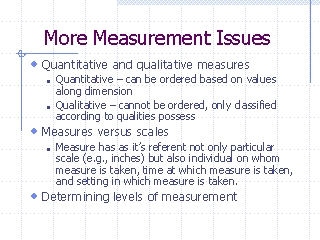
- Quantitative – ordinal, interval, and ratio measures. Qualitative – nominal measures.
- Distinction between quantitative and qualitative variables is crucial in statistics – as will see later.
- Example using height. Consider four individuals whose heights are 54, 53, 52, and 51 inches. Can rank these individuals from shortest to tallest. Typically think of rank order measures as having ordinal but not interval properties. For this particular set of measures (that is, for these 4 individuals at this time and in this setting), the measures on Y have interval level properties. More specifically, a difference between scores of one unit between any two individuals (e.g., for individuals 1 and 2) corresponds to the same amount of underlying height difference as for any other two individuals who have a difference of one unit on Y. For this set of measures, Y has interval properties, even though it is measured on a scale that is traditionally thought of as yielding only ordinal level properties.
- Now assume add 5th individual w/height of 58 inches. Person receives rank of 5 Y no longer exhibits interval properties.
- Instead of 5th individual being 58 inches, are 55.1 inches. This person also receives rank of 5. Strictly speaking, Y no longer has interval properties. But it very closely approximates interval level characteristics because the differences in the underlying heights between scores of 5 and 4 is almost equal to the underlying height difference between 2 and 1.
- Will see later chapters, validity of substantive conclusions made for some statistical tests assumes equal-interval measurement. Although some stats are sometimes applied to situations without strict interval properties, if approximation to interval properties is reasonable, the the substantive conclusions are not affected.