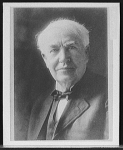
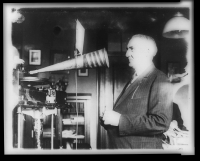
Mr. Edison's
Phonograph
August 12, 1877, is the date popularly given for Thomas Alva
Edison's completion of the model for the first phonograph, a device
that recorded sound onto tinfoil cylinders. It is more likely, however,
that work on the model was not finished until November or December of that
year, since Edison did not file for the patent until December 24,
1877.
While working to improve the efficiency of a telegraph
transmitter, Edison noted that the tape of the machine gave off
a noise resembling spoken words when played at a high speed. This caused
him to wonder if he could record a telephone message.
Edison began experimenting with the diaphragm of a telephone
receiver by attaching a needle to it. He reasoned that the needle could
prick paper tape to record a message. His experiments led him to try a
stylus on a tinfoil cylinder, which, to his great surprise, played back
the short message he recorded, "Mary had a little lamb."
Edison's discovery was met first with incredulity, then awe,
earning him the moniker "The Wizard of Menlo
Park." By 1915, sound recording, which evolved from Edison's
invention, was rapidly becoming established as an American industry.
| As a young boy growing up on an Illinois farm in the late
nineteenth century, Harry Reece remembered the invention of the
phonograph as one in a series of technological marvels:
Electric lights were something to marvel at . . .
the old Edison phonograph with its wax cylinder records and
earphones was positively ghostly . . . and trolley cars, well they
too were past understanding!
"Harry
Reece,"
New York, New York, Earl Bowman,
interviewer,
November 29 1938.
American
Life Histories,
1936-1940 |
Enjoy early sound recordings and motion pictures from the Edison
companies:
- Inventing
Entertainment: The Motion Pictures and Sound Recordings of the
Edison Companies features 341 motion
pictures, 81 disc sound
recordings, and other related materials, such as photographs and
original magazine articles. Cylinder sound recordings will be added to
this site in the near future. In addition, histories are given of
Edison's involvement with motion pictures and sound recordings,
as well as a special page focusing on the life of the
great inventor.
- Listen to another sampling of early recordings produced by the
Thomas Edison company and found in the American Variety
Stage Audio Sampler section of Sound
Recordings. It features such gems as the classic "rube" sketch
"Arkansas Traveler" and Billy Murray singing George M. Cohan's World War
I anthem "Over There."
- Learn more about Emile Berliner who was responsible for the
development of the microphone, flat recording disc and gramophone
player. Search
on the term acoustical engineering in Emile Berliner
and the Birth of the Recording Industry to read, for example, a 1927
newspaper clipping concerning a "New
Acoustic Device Shown by Berliner" in the "echo infested" auditorium
of the James F. Oyster school in Washington, D.C..
- Read the Today in History feature on Edison's
kinetoscope, the forerunner of the motion-picture film projector.
Search the Today in History
Archive on the keywords inventor or invention to find
more features on creative Americans including Alexander Graham
Bell, Samuel
F.B. Morse, Elias Howe, and
Henry
Ford.
- Search
across on the name Warren Harding in the collection American Leaders Speak,
1918-1920 to hear Harding speak on subjects of concern to U.S.
citizens at that time. Hear Harding speak, for example, on the topic of
the nation's readjustment
following World War I.
|