|
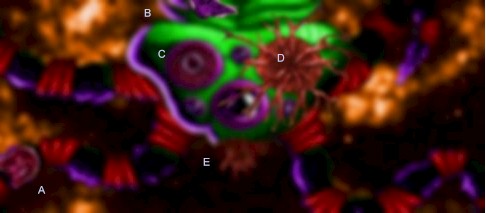
Our first specimen, the UR-QUAN KZER-ZA, is a most fascinating creature. Although comical in appearance, close examination reveals the Kzer-Za's true lethal nature. At first glance, the Kzer-Za would appear slow, with it's ponderous shape akin to a Terran caterpillar, but this similarity is a pure coincidence. The creatures claw-tipped tentacles are quite capable of punching through inch thick steel or even human flesh with lightning speed, as proven by an escaped captive and an unfortunate security guard. It's vast body contains multiple copies of all the major organs, meaning that the Ur-Quan can sustain massive amounts of damage without losing any of it's combat efficiency. Unfortunately, one flaw that evolution overlooked is that the Ur-Quan may not notice that it is dying. The exposed tentacle at A shows the tightly bunched and taut muscles in the 4-metre long tentacles, which allow the Kzer-Za to grasp objects or prey with a vice-like grip, or delicately operate the controls of a starship. The small cut at B reveals one of the Ur-Quan's two brains, a spherical organ 20cm in diameter. The organ itself is very dense, weighing over 50 pounds, a fact which astonishes xenobiologists even today. The tissue of the Kzer-Za brain is the fourth densest material in the known stars. Twice the number of brains does not only mean that one can be lost without serious hurt, but also that the two can work in tandem, or on separate tasks, meaning that the Kzer-Za has incredibly rapid thought-processing capabilities. This dual processing ability has hugely aided the Kzer-Za's scientific and mathematical prowess, giving rise to their current reputation as intellectuals. The two dissected major optical organs, and the third intact specimen, offer us a great insight into the detail of the Kzer-Za's sensory abilities. The eye is protected by two thick sheathes, the inner of which keeps the eye moist and protects it while the Kzer-Za rests, and the outer of which protects the eye, and can resist an accurately thrown surgical instrument. C shows the exposed eye socket, and the tube of cartilage which protects and contains the bundle of optical nerves leading to the brains. D shows the highly unusual inner structure of the Ur-Quan eye - the normally tightly bunched strands of nerve tissue which, when correctly arranged, can focus on a far greater range of the electromagnetic spectrum than the human eye, so the extent of being able to see both ultra-violet and infra-red rays. The sensory and vocal organs at E have decayed rapidly since death, meaning that detailed examination is impossible. We have, however, been able to determine the reason for this rapid decay. Vast cultures of bacteria thrive on these organs, and are normally harmless as the Kzer-Za can draw the organs within itself, allowing antibodies to exterminate the bacteria, but upon death, the muscles are loosened, and the organs fall from their protective shell, and are thus rapidly consumed. The organs are, to our knowledge, multipurpose. They are primarily used for speech - the tiny muscles contained in the organs oscillate at different frequencies, allowing communication in the Ur-Quan tongue - which the talking pets interpret for alien species. This is not such a difficult job as the communications normally consist of 'Submit or Die'. They are also used for receiving sound waves, which are interpreted either as the Ur-Quan dialect or other, sometimes unfamiliar, sounds. |