
Salinity, the amount of salt dissolved in a given volume of water, is an important factor in determining distribution of aquatic organisms and those who feed in aquatic systems. Most organisms are stenohaline and are unable to tolerate much variation in levels of salinity. Only a few number of species can survive in marine or hypersaline conditions because the physiological stress is too great, (Johnston et al., 1990).
Salinity is a variable factor that changes with rainfall, water volume, tidal inundations, and evaporation in low saline habitats. An increase in rainfall, water volume, and tidal innundatations lead to lower levels of salinity, whereas evaporation increases level of salinity. Extremes in salt concentrations are often a result of unusually wet or dry seasons.
Changes in water volume has a negative effect on wading birds by limiting the available foraging habitats and the number of fish that can survive in the area. The wading birds cannot reproduce when water levels are elevated since there is not enough food or habitat available, (Custer et al., 1996). Most wading birds require shallow water to hunt successfully.
Infrequent tidal inundations and rainwater reduce surface salinity in low-saline bay water. When fresh water enters the habitat, it floats above the denser seawater, allowing a freshwater layer to rise for organisms to feed upon, (Price et al., 1988).
Northern marshes have a higher number of species tolerant of salt than southern marshes due to differences in climate, hydrology and offshore salinity, (Price et al., 1988).
There is a minimum concentration of salt after the snow melts, and reaches maximum levels prior to freezing in November. which coincides with the migratory season for most birds and fish, (Swanson et al., 1984).
The productivity of species living in salt marshes and other salt-variable habitats decreases as salinity increases, (Price et al., 1988). The changes in salt content in saline lakes lead to changes of species dominance and level of habitability for other organisms.
It is important for organisms to adapt to varying levels of salinity because humans have altered most of the Atlantic inland wetlands, (Erwin, 1994). Migratory birds have to utilize coastal wetlands more now, often due to destruction of the more ideal, freshwater and slightly saline wetlands. Flexibility in nesting-habitat choices is important to the success of a migratory species because of the constraints of food, predation and competition in such environments, (Lauro, 1989).
Ardea herodias, the Great Blue heron is found a wide variety of habitats. Some are found in areas with variable levels of salinity, such as brackish waters and estuaries, predominately fresh water areas, such as lakes, ponds and rivers, and salt water areas such as marshes, some lakes and along shorelines.
Herons nest in diverse habitats as well. Colonies usually form where there are large amounts of similar, uninhabited land, (Beaver et al., 1986). There is a direct relationship between foraging range, the number of nests per colony and the availability of tidal wetlands, (Gibbs et al., 1987).
The heron's wide distribution seems to imply they are euryhaline and salinity has very little affect on their survival. The Great Blue Heron is most successful in freshwater mangrove swamps and are linked to inland environments, since the conditions are ideal for retaining water, (Ramo et al., 1993).
Salt marsh animals, such as the heron, survive by avoiding severe changes from hot to cold, wet to dry and salt to fresh. They usually do this through migration or adaptation, (Price et al., 1988).
Within freshwater to slightly saline habitats, like mangrove swamps and marshes, food availability varies temporally and spatially, (Gibbs, 1993.) Species diversity is high in these inland environments and the heron has ample opportunity to feed on small fledglings, lizards, frogs, salamanders, snakes and rodents. Significant changes are needed in foraging behavior and diets when species switch between fresh and salt marshes, (Collopy et al, 1987).
Herons breed in marine or hypersaline habitats. This is probably done to decrease rates of predation on the nestlings, since marine habitats have less species, decreasing competition and predation. The first fledglings are born in April or May, during times of the lowest salinity levels due to rainfall. The colony size is positively correlated to the size of nearby estuaries and food availability, (Gibbs, 1991). Unfortunately, some fledglings of different species cannot survive solely on salt-water prey.
In an experiment conducted by Johnston et al., ducklings who were fed a high-salt diet, (salt-laden crayfish), and no fresh water lost 3% of their body mass in the first week. They ate 30% less food than the ducklings who ate low-salt crayfish and obtained 33% less energy from the food than fresh-water prey. When the ducklings reared on salty prey were given access to fresh water, they began eating more and growing at an average rate. The authors concluded the ducklings could grow normally when fed high-salt items if they had access to fresh water.
As the salt concentration decreases, duckling survival rates increase. Fledglings that don't receive fresh water suffer from starvation and paralysis before dying, (Swanson et al., 1984). This could explain why there are smaller clutches on coastal colonies than in land colonies, (Johnston et al., 1990).
Great Blue Herons, like several other species, feed their nestling small, low-salt prey and semi-processed food. The nesting colonies of Great Blue herons usually are located within 5 km of feeding areas, (Bennett et al., 1995) and are influenced by the local availability of wetlands. Colonies are also formed where there is minimal human disturbance. The trade-off for lower predation rates and less human interference is increased energy requirements for foraging. The parents go between the colony and freshwater source up to five times a day. They glide to conserve energy. This system has more benefits than disadvantages for the heron and is one reason they are so successful in so many diverse habitats.
As fledglings grow older, the effects salinity has on them decreases considerably. The birds develop a higher salt tolerance.
Adults can avoid salt-loading in hypersaline lakes by taking in very little lake water when feeding, and visiting freshwater sources along the shorelines, (Mahoney et al., 1985) Also, drinking freshwater helps to lower salt concentrations in the body. When tides are high, there is lower levels of feeding among adult Eiders and and most other species, (Cantin et al., 1974).
Animals adapted to high levels of salinity do not need freshwater as long as they feed on prey with dilute body fluids and high body-water content, (Johnston et al., 1990). These modifications help during migration, when several species are unable to handle unexpected levels of salt concentration, (Madenjian et al., 1995).
Birds respond behaviorally and physiologically to avoid the water stress of saline habitats, (Barnes et al., 1991). This includes the adaptations for highly saline environments, or avoidance of highly saline environments.
"In birds there is evidence that prolactin, coriticial steroids, thyroid hormones...can all influence migration...," (Rankin, 1991). In Rankin's study, the hormones that influenced migration were produced in response to changes in light and temperature. These hormones produced a change in salinity preference, as well. The pituitary glands peaked in February and March, with production of the hormones continuing throughout April, May, June, September and January, (Rankin, 1991), which correlated to the migration periods of several bird species.
Barnes et al. conducted an experiment to investigate whether duckling survival and growth varied with salinity. The authors noted that ducks in a St. Lawrence estuary nested on mainland areas and on offshore islands. They restricted their use of tidal marshes to areas that were close to the shore, where salinity is usually lower.
Many aquatic birds possess nasal salt glands, which allow for elimination of excess salts through excretion in saline environments. The salt glands secrete NaCl in response to the osmotic stress, so they won't be overloaded in salt, (Barnes et al., 1991). The ducklings' salt glands increased in weight as they got older. In a comparison of Black ducks, a salt-tolerant species, the Mallard, a salt-intolerant species, and a hybrid Barnes et al. found fresh-water birds had lighter salt glands than those adapted for high saline areas. The gland size increased with age and high salinity.
The presence of supraorbital salt glands in marine birds make it possible for them to survive drinking only seawater, (Gray et al., 1989). The levels of the hormone produced change according to adaptation to seawater. Marine birds were able to secrete more chemicals faster than freshwater species. Euryhaline species found in estuaries reacted similarly to marine species when exposed to higher levels of salinity.
The diversity of water birds in beached-bird deposits in saline habitats was high due to high mortality rates of poorly-adapted stenohaline migratory birds, (Jehl, 1988). Rare species landed in open-water habitats, unaware of the high salinity levels. Those individuals who were exhausted from migration died within a few hours, since they could not feed in hypersaline-saline habitats to replenish their energy, (Jehl, 1988).
Jehl concluded the fossils indicated highly saline lakes were predominately dominated by a few salt-tolerant species that breed there in large numbers, the same situation as today.
"High diversity may also be realized, as in freshwater habitats, because many species attracted to such lakes are unable to tolerate highly saline environments and soon succumb," (Jehl, 1988).
In an experiment conducted by Mandenjian et al., the impact of migrant water birds on the fish in western Lake Erie was determined. The Great Blue Heron lays it eggs in April, consistent with the optimum hatching time of low salinity levels. The lack of presence of Great Blue Herons from November until March is also the time of extreme levels of salinity. This experiment did not take into account the seasonal change in diets, so it is hard to say salinity changed affected the diet of the herons from this individual experiment.
The ability to adapt to variations in salinity for the Great Blue Heron is a major factor for its high survival rates and wide distribution.
The Great Blue Heron is generally the top predator in its habitat because of its ability to adapt. During migration, the heron has a stronger chance of survival and hopefully will use this ability to adapt to the declining conditions of its preferred habitats. It is necessary for all species to adapt to variable saline conditions, since the destruction of wetlands will limit their habitats and chances of survival.
Global warming, the melting of glaciers and ice caps, human pollution and interference such as damming, all change the properties of water, making it difficult for species to survive. Wiping out ecosystems will only have dire consequences and the more adaptations an organism has, the better its chances to survive into an uncertain future.
Barnes, G.C., T.D. Nudds. 1991. Salt tolerance in american black ducks, mallards and their f1-hybrids. The Auk 108:89-98.
Beaver, D.L., R.G. Osborn, and T.W. Custer. 1980. Nest-site and colony characteristics of wading birds in selected atlantic coast colonies. Wilson Bulletin 92(2):200-220.
Bennet, D.C., P.E. Whitehead, and L.E. Hart. 1995. Growth and energy requirements of hand-reared great blue heron (Ardea herodias) chicks. The Auk 112(1):201-209.
Burger, J. 1979. Resource partitioning: nest site selection in mixed species colonies of herons, egrets and ibises. The American Midland Naturalist 101(1):191-208.
Cantin, M., J. Bedard, and H. Milne. 1974. The food and feeding of common eiders in the St. Lawrence estuary in summer. Canadian Journal of Zoology 52:319-334.
Collopy, M.W., K.L. Bildstein. 1987. Foraging behavior of northern harriers wintering in southeastern salt and freshwater marshes. The Auk 104:11-16.
Custer, T.W., R.K. Hines and C.M. Custer. 1996. Nest initiation and clutch size of great blue herons on the Mississippi River in relation to the 1993 flood. The Condor 98(2):181-188.
Dodd, M.G., T.M. Murphy. 1995. Accuracy and precision of techniques for counting great blue heron nests. Journal of Wildlife Management 59(4):667-673.
Earle, J.C., K.A. Kershaw. 1989. Vegetation patterns in James Bay coastal marshes, III. Salinity and elevation as factors influencing plant zonations. Canadian Journal of Botany 67:2967-2974.
Erwin, R.M., J.S. Hatfield, M.A. Howe, and S.S. Klugman. 1994. Waterbird use of salt marsh ponds created for open marsh water management. Journal of Wildlife Management 58(3):516-524.
Gibbs, J.P. 1991. Spatial relationships between nesting colonies and foraging areas of great blue herons. The Auk 108:764-770.
Gibbs, J.P., S. Woodward, M.L. Hunter, and A.E. Hutchinson. 1987. Determinants of great blue heron colony distribution in coastal Maine. The Auk 104:38-47.
Gray, D.A., T. Erasmus. 1989. Plasma arginine vasotocin, angiotensin II, and salt gland function in freshwater-and seawater- adapted kelp gulls (Larus dominicanus). The Journal of Experimental Zoology 249:138-143.
Jehl, J.R. jr. 1988. The beached-bid assemblage of a highly saline lake and its relevance for reconstruction paleoenvironments. The Auk 105:97-101.
Johnston, J.W., K.L. Bildstein. 1990. Dietary salt as a physiological constraint in white ibis breeding in an estuary. Physiological Zoology 63(1):190-207.
Lauro, B. and J. Burger. 1989. Nest-site selection of american oystercatchers (Haematopus palliatus) in salt marshes. The Auk 106:185-192.
Mandenjian, C.P., S.W. Gabrey. 1995. Waterbird predation on fish in western Lake Erie: a bioenergetics model application. The Condor 97:141-153.
Mahoney, S.A., J.R. Jehl Jr. 1985. Physiological ecology and salt loading of california gulls at an alkaline, hypersaline lake. Physiological Zoology 58(5):553-563.
Nystrom, K.G., K.O. Pehrsson, and D. Broman. 1991. Food of juvenile common eiders (Somateria mollissima) in areas of high and low salinity. The Auk 108:250-256.
Parker, M.S. 1993. Opportunistic predation by a great blue heron on an american dipper. Wilson Bulletin 105(4):698-699.
Price, J.S., K. Ewing, M. Woo, and K.A. Kershaw. 1988. Vegetation in James Bay coastal marshes. II. Effects of hydrology on salinity and vegetation. Canadian Journal of Botany 66:2586-2594.
Ramo, C., B. Busto. 1993. Resource use by herons in a Yucatan wetland during the breeding season. Wilson Bulletin 105(4):573-586.
Rankin, M.A. 1991. Endocrine effects on migration. American Zoology 31:217-230.
Swanson, G.A., V.A. Adomaitis, F.B. Lee, J.R. Serie, and J.A. Shoesmith. 1984. Limnological conditions influencing duckling use of saline lakes in south-central North Dakota. Journal of Wildlife Management 48(2)340-349.
Wilson, D.J., R.L. Jefferies. 1996. Nitrogen mineralization, plant growth and goose herbivory in an Arctic coastal ecosystem. Journal of Ecology 84:841-851.
Back to the top
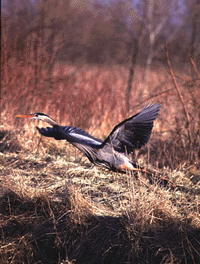
Click for more information on the Great Blue Heron. Click for free web photos, like the heron take off shot on the top of this page.
Back to Stephanie'e Guide to the Universe
Literature Cited

