
Dracula,
Son of the Dragon
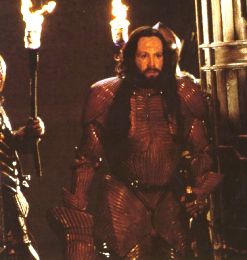
Image: The Son of the Dragon appears much the way legend ascribes to him: long-haired, mustached, and possessed of a feral charm that disguises a black heart. His complexion is swarthy, highlighted by prominent cheekbones and a pair of green eyes that captivate those who meet his gaze. Dracula bears a strong, aristocratic nose that suggests his noble ancestry. He wears fine clothes, but shies away from the ostentatious, preferring to let his natural charisma work for him rather than a gaudy display of “vulgar peacockery.” Impassioned in the extremes, Dracula nonetheless hides his emotions. His gestures are graceful and calculated; none of his movements go to waste. After his “vision” he is often seen wearing a solid silver cross, an ornament he would have actively despised prior to the event.
Background: The life and times of Vlad Tepes Dracula long ago became the stuff of
legend. The second son of a church
knight’s fleeting union with a convent’s mistress, Vladmir of Hunedoara
began his existence in the war-torn fortress Sighisoara. Born into what would
surely have been a life of luxury within Wallachian nobility and the Holy Roman
Empire were it not for the heritage-steeped nation’s massing Ottoman nemesis,
the Son of the Dragon would take Fate by the throat and bend her to his will.
It was not an easy time to be a child, least of all an heir apparent to a
throne constantly besieged by the infidel hordes.
Vlad and his younger brother Radu spent the better part of their
adolescent years as hostages bartered to Murad II in political appeasement.
The Turks released the brothers only when word came that Vlad and
Radu’s father and older brother were dead at the hands of the treacherous boyar
countrymen.
Surely the traumatic conditions surrounding Dracula’s childhood
profoundly shaped the man he would become.
The 17-year-old prince- by birthright if nothing else-fled to the house
of his uncle Iancu, then ruler of Wallachia, and he married into that noble
line. He took up his father’s
sword and title as crusader in Sigismund’s Order of the Dragon, gathered an
army to his banner and pledged himself to vengeance.
It cost the Romanian prince two campaigns, eight years and another
shameful imprisonment, but he ultimately prevailed.
Vladimir, Son of the Dragon, crushed all other claimants to the
Wallachian throne and reduced his competitors’ holdings to rubble.
With his own had, he took the life of his father’s betrayer, Vladislav
II. He forced the boyer
back-stabbers whose double-dealings had taken his brother Mircea’s life, to a
seven-league march that few survived; their families he condemned to the
construction of his castle. He
sentenced the remainder to slow torturous deaths and public display, that their
carrion corpses might testify to the prince of treason.
Thus were born the tales of the man who Turkish soldiers and servant
children alike named kaziglu bey- “impaler prince.”
Once again master of his father’s domain, Prince Vlad turned his
attentions to the Ottoman raiders whose force perpetually tested the borders of
is kingdom and to the iron-fisted precepts of honor and order with which he
ruled the denizens of the kingdom. To
this night, popular culture runs rife with stories illustrating the draconian
nature of Dracula’s justice. Still lingering in many memories is the tale of
the banquet hall, filled with beggars and vagrants, that the prince burned to
the ground after a sumptuous charitable feast.
The razed villages and poisoned well-water he left in his wake to starve
the Sultan Mehmed’s armies attest to a cunning, evil mind, and the forest of
20,000 impaled Turkish dead with which he turned the sultan’s battle host
homeward drive the terrible truth home. Tepes
(“impaler’), they called him, and Dracula (“devil’s son” or
“dragon’s son”), while the lines between man, myth and monster began to
blur.
Ultimately, it was tragic happenstance that proved the Impaler’s
undoing. A treacherous alliance between Mehmed and Vlad’s brother
Radu, coupled with the death of his beloved Livia (who, it is written, flung
herself into the dark waters of the Arghes to avoid Turkish capture), conspired
to drive Dracula from his throne and into hiding for a third time.
In the decade of darkness that followed, the outcast prince first made
use of the Protestant enemy’s guerilla tactics and armored wagons.
Invoking forgotten familial allegiances and pacts with patrons best left
unnamed, he first took counsel from the witch-woman Durge Syn.
Standing before the bound and broken creature his guardsmen had captured
but been instructed not to kill, recalling the familiar legends of
blood-drinkers and bodies that grew young and strong lying in their graves, Vlad
Tepes Dracula first supped from the wellspring of death.
Dracula’s long and illustrious unlife has proved his elder of the
accursed Tzimisce to be a dangerous unknown.
Following his publicly staged “assassination,” the vampyr has
variously declared feality to Hardestadt’s Camarilla, the early Sabbat
death-cult headed by Lugoj, sinister manus nigrim, and easily a dozen
more radical or esoteric causes. More
recently, toward the close of the 18th and 19th centuries,
he seems to have severed all ties and drawn away from Cainite society for
undetermined reasons. In 1897 he
went so far as to influence a bibulous Irish author’s famed fiction, thus
flying in the face of the Masquerade and throwing the delicate balance between
Kindred and kine into disarray. It was his parting gesture par force.
He has never been seen since in Cainite circles.
In the more recent nights, the Impaler holds solitary court from the
ruins of his Tirgovistan fortress, between Pasul Tihuts and the Borgo Pass.
His activities, to say nothing of his allegiances, are unknown; he keeps
his own company, aloof from Camarilla, Sabbat and the greater game Kindred call
the Jyhad, and he emerges only infrequently for matters of inscrutable meaning.
Although his goals are unclear and his motives artfully concealed, when
the Son of the Dragon strikes he is swift and ruthlessly thorough.
Some believe that Dracula is old, tired and broken, a fallen champion
whose power is but a whisper beside the bellow it used to be.
Others claim his hermitage is necessary to his survival- that his failed
attempt to lose himself in the pages of fiction has made a hell of his unlife
and rendered him a target, a prisoner in his own house, prey to fate and the
whim of arrogant foes who play Brutus to his Caesar.
Still other sources allege he holds his private audience with his
unwilling creator, with whom he came to terms long ago.
Some maintain that Dracula hunted down and destroyed his sire years past,
even that he journeyed to the New World to do so, and that the name Lambach
tonight is but another orchestration of Dracula’s cunning.
One fanciful tale even names the Impaler as one of the guiding forces at
the head of enigmatic Inconnu.
Whatever truth may be in these ramblings, in life and death, Vlad Tepes,
Son of the Dragon, Impaler-Prince of Wallachia, has attained a degree of infamy.
His is wholly unlike the unlife of any vampire who has gone before, a
strain of immortality different from any previously known to the Children of
Cain stalks the finals nights.
The truth, as always, is far stranger than any speculation.
Dracula has received a vision, and he believes it a vision from God. In
his vision he saw himself as the master of all he surveyed.
He learned of the demon Kumpala and his servant, the foul Luecretia. He believes that he has been charged with a quest from God
himself to rid the world of both of these entities. To this end he mobilizes his vast forces and has come down
from the castle to once again lead armies into war.
Dracula will stop at nothing to drive Kumpala and Luecretia from the land
and once again become the ruler of the Land beyond the Forest.
Roleplaying
Hints: Centuries of self-imposed solitude coupled with the disillusion of
deathlessness have molded your once-noble mien into something no longer even
remotely human. You find yourself
slipping into alien expressions and gestures with increasing frequency of late-
a predatory sneering curl to the lip here, a telltale winding gait there, a
disquieting low-throated snarl for this one, a chilling sibilant hiss for that
one. You are as apt to transfix
others for hours with your impenetrable gaze as you are to descend upon them in
a murderous rage- or worse, to disregard them entirely as you lose yourself in
the depths of some unfathomable nostalgia.
Something within you longs for the past- for the older, simpler times,
when the affairs of men and monsters were governed by birthright, and bloodshed,
and honor- but the Dracula who exists in the here and now knows such things are
long gone. You are done with the outside world, the folly of man, even
the ambitions and artifices of your modern-minded contemporaries among the
Children of Caine. You endure. You
survey the world from atop your lofty, lonely throne.
And you wait.
Finally, the wait is over.
