

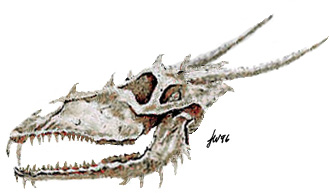
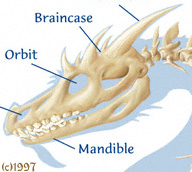
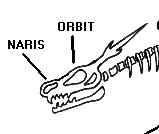
The Oriental (or Eastern) dragon Dracoserpens Lung orientalis has a
extremely long, thin skeleton structure. It has a medium sized head,
very long
neck, short legs, small hips, and a long tail. This skeleton is very
maneuverable because of the shape, such as a long snake is. It can
twist and
turn its body in all sorts of ways. This type of dragon does not have
hollow
bones, and the dragon's skeleton is thin because it doesn't need the
mass to
accommodate flight muscles. This dragon does not have any type of wings
as
it flies with earth-magic verses brute strength.
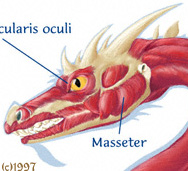
MUSCLES
Western dragons have many more muscles then their Eastern cousins.
This is
mainly due to their massive flight muscles that have to lift their
weight into
the sky with the thrust of their wings. The main wing muscles are the
Supraspinatus and Flexor alae major. Notice that the actual wing does
not
have many major muscles, it is all near the chest area. Other large
muscles
account for a very strong tail, and rear legs. The Western dragon could
easily
hold a human male's weight while in flight. Also notice the large jaw
muscle
Masseter, this muscle can easily crush bones.
OUTSIDE OF THE BODY
The dragon can be a huge creature depending on the breed. The one shown
here is roughly 20 feet long with a wingspan of 35 feet. This type
of dragon
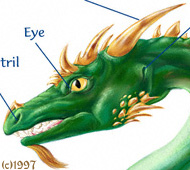
has extremely small ears, large eyes, spines down its back, and a bone-type
spade at the end of its tail. All dragon breeds are different. Some
have long
ears, and no spade, and some have a fleshy-type triangle-shaped spade.
This
type of dragon also does not have scales, it has tough leathery skin.
Most
dragons have scales of some sort.
SCALES
Scales (and horns/claws) on a dragon are densely packed cells made
up of
keratin, a tough fibrous protein. When born, a dragon's scales are
as soft as
tissue paper, and slowly harden while the dragon grows. The iron from
the
blood, or vegetable matter the dragon eats is absorbed by the dragon's
blood
stream and mixed with the keratin to create steel-hard scales. The
process of
getting scales as tough as they can get takes about one year after
being
hatched.
COLOR
Scale color is determand by the genes of the parent dragons. Usually
only red
dragons will mate with other red dragons, etc. But if a mating took
place
between a gold and a green dragon, the result might be a bronze colored
offspring. Scales on a dragon are never simply one shade of color.
If a dragon
is blue, there will be many, many shades of blue. Light, medium, dark,
blue-black, etc. Scales are bright and shiny in a healthy dragon, but
dull and
muted if a dragon is ill.

CAMOUFLAGE

In some breeds of dragons when the dragon is mature, the cells in the
scales
are able to change color such as a chameleon due to chromatophore,
the
pigment cells in the scales.This reaction can be caused by emotion
(anger,
happiness,etc) or by the will of the dragon to change color. If the
dragon is
angered it can change from its original color to a bright, fierce color
such as
red, to look more intimidating or during mating rituals, it can flow
certain
color patterns on its body to attract other dragons. Since dragons
are
extremely intelligent, it can choose which colors to change into to
match the
exact background it is near including subtle shadow and highlights.
It is so
good at this, most things would just walk past a 65 foot dragon hiding
in the
sand.
A DRAGON'S ARMOR
The main function of scales is protection of the soft skin tissue of
the dragon.
An adult dragon can easily take a direct blow from a knight's sword
and
hardly flinch. Adult dragons have 4-6 inch wide, and 7-9 inch long
teardrop
shaped scales covering its body. The pattern of the body scales is
a flat,
rotating design that overlap each other. Easy movement is due to the
unique
depression on the top side of each scale that allows them to lay evenly
flat on
the body.
The scales on the chest area are the largest; easily being over a foot
wide.
The chest scales are one to three flat "scale flaps". These are shaped
differently than a regular scale as they are more squarish. The pattern
of the
chest scales is overlapping and flat running from the throat, under
body to the
end of the tail. All of the scales lightly slide over each other, so
when a
dragon walks it will make a soft scraping sound. The overlapping scales
make it difficult for anything to successfully injure a dragon.
An interesting fact is that the dragon can make the scales stand on
end for
washing. Also, when angered, the dragon can puff up, spread its scales,
and
look a lot larger than the dragon actually is. Lifting the scales is
also an
effective heat reducing element. Making the scales stand on end allows
the
skin underneath to release heat, thus cooling the large animal down
quickly. A
favorite past-time of dragons is to stand the scales up and go into
a cool pool
of water to allow it to run in between the scales and onto the sensitive
skin.
THE WING

The wing. The part of the dragon that distinguishes itself from all
other
creatures. The dragon wing is a huge, leathery appendage that is found
on
several different species of dragon. The wing is usually larger than
the
dragon's body to accommodate the incredible force needed to lift and
maintain flight.
BONES
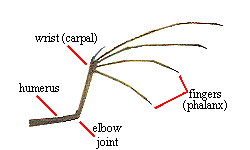
The wing is essentially another arm and hand. If you look at the skeleton
of a
dragon front arm and claws, you will notice that the wing is just a
very
stretched out version. The two thick "arm bones" (humerus and wing
radius)
runs from the body of the dragon attaching itself with cartilage and
muscle to
an "elbow" of the wing. There are usually 4 or 5 elongated "fingers"
on a
wing each ending in a claw. One short "thumb" claw is at the "wrist".
The
"fingers" then attach themselves to the "wrist joints" to form the
complete
wing.
HOW DO THEY FLY?

The actual force of flight is the continuous down sweep of powerful
wings
scooping, and thrusting the body upwards. An immature dragon does not
have
the strength needed for a vertical jump from flat ground to take off.
They will
usually stay near higher cliffs to use the heat updrafts to keep aloft.
It takes a
few years of flying to build the extremely strong flight muscles needed
to lift
the dragon body from the ground. The wings make actually look small
for the
mass of the dragon, but all dragons have an innate magic ability to
help them
fly. This magic helps keep dragons from straining themselves during
long
flights.
WEAPONS
Dragons can also use their wings as an attack weapon if need be, but
this is a
last resort. The wing membranes are easily damaged compared to the
rest of
a dragon body. If a dragon wing membrane is slashed, it takes a very
long
time to heal, and there is a chance the dragon might never fly again
if it does
not heal correctly. If attacked on the ground, the dragon will usually
run then
jump in the air and fly off avoiding the attacker. But if the dragon
is trapped
on the ground it will tuck its wings tightly against its body and use
its breath
weapon and claws to protect itself. If the dragon has to use its wings
to attack
it will scoop down and slash with its razor sharp wing claws to immobilize
the attacker.
SENSES
Dragons have the same senses as humans; site, hearing, smelling, touch,
and
taste. But some have a six sense which is being able to "read" the
emotion of
another being. Their regular five senses are incredibly sensitive.
For
example, the sense of smell is about 100 times more sensitive than
a
bloodhound dog. They can smell and hear a person or animal from a couple
miles away!
Their six sense is very accurate at close range. If a person or animal
is
feeling a strong emotion, such as fear or hate, it will register very
strongly to
the dragon, even if it is not in visual range of it. This is where
dragonfear
comes from. Dragonfear is an all encompassing, frozen-in-place fear
that the
dragon causes upon the animal or person seeing a dragon. The dragons
sometimes use this advantage to beat its foes, such as thieves or knights.
Only
the very bravest (or very dim-witted) are not affected by this terrible
fear.
This is usually an aura around evil-minded dragons, but in a friendly
dragon,
such as the Faerie Dragon, this aura is non-existant.
THE FIRE BREATHERS!

Fire: the thing that makes the dragon most feared. It's a hellish belch
of flame
that can turn flesh and bone into ash. Though, not all dragons breath
fire.
Some have freezing cold breath, others have acid, and some don't use
their
breath as a weapon at all! The two that have fire breathing power are
the Red
Dragon and Fire Drake.
HOW DO THEY BREATH FIRE?
It all starts when the dragon catch their prey. When dragons eat, they
digest
the food in a regular stomach. The digestion then continues in a second
stomach that breaks down the food even further. After the dragon's
body has
used all it can from the second digestion, the body then turns the
leftover food
and acid into a byproduct of hydrogen. The dragon can hold the hydrogen
in
various large glands in it's body for later use, and can call upon
it at any time
it needs to. When the dragon needs to belch it's flame, the glands
release the
hydrogen into the lungs where it mixes with other various chemicals
the body
creates. Once this mixture finds oxygen, it burns extremely hot, and
very
quick. The dragon usually has enough hydrogen in its body for about
three
spits of flame, but that should be plenty for anything coming up against
a large
red dragon. This explanation is about the same for dragons that breath
other
types of breath. Their bodies just break down food into different compounds.
CONCLUSION
I hope you enjoyed your little trip into the physiology of a dragon.
Remember,
all dragons are different, so if you dissagree with this study, no
one can tell
you that you are wrong. This is just one look at this wonderful creature
and I
hope that this might stir your imagination to make up your own mythology
of
the dragon.
