| The basic jist of this concept is that a group of scales (generally seven of them) fit together to make one larger scale (sort of like the mother scale.) Let's take for example the C Major scale. There are seven notes (or degrees), C D E F G A B. Each note has a number. When C is the root note (the root note is the note that is the base note or note that the given song is constructed on) D is the second degree, E is the third degree, F is the fourth degree, and so on. But what about when you use the second degree as the root note? Then E becomes the second degree, F the third, and so on. This is when you are playing the second mode of the major scale (which is called Dorian Mode) D Dorian Mode contains the same notes as C Major, although they are arranged differently and the step pattern is different. All seven modes of the major scale fit together to make the giant major scale. You can also say that all modes of the Dorian scale fit togethor to make the giant Dorian scale. It all depends what you're using as your root note! Here is a list of the names of the modes (relating to the major scale)
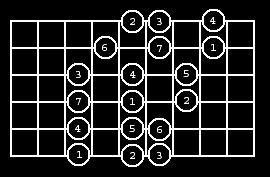
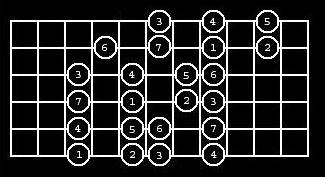
1st - Ionian (another name for the Major Scale) If you were to relate everything to the minor scale, these numbers would all be different. The scales would not be altered, just the degree it is considered to be. Look at it this way, if we were using the Aoelian Scale as the root, Locrian would be the second mode, Ionian would be the third, Dorian the fourth, Phriggian the fifth, and so on. Look at this. Here are the two first forms of the minor scale. As you can see, I have numbered the degrees relating to the Aoelian root note. I put the two scales togethor in the third picture.
the ionian scale:
the locrian scale:
those two scales combined: To further explain what I said before, C Ionian (or major) D Dorian, E Phriggian, F Lydian, G Mixolidian, A Aoelian, and B Locrian contain THE SAME NOTES! Understanding modes is important because it allows you to play a much larger variety of scales over a given piece of music. For example, if you wanted to play a guitar lick over a chord progression that contained C Major, E Minor, and G Major, you could use any of the C Major Modes! This is so that you are not stuck in a rut playing the same scale all the time. It's also VERY important for writing guitar solos. As I said before it gives you a variety of stuff to play, but also it allows you to play ANYWHERE on the fretboard that you want! You can run up the neck, go down the neck, go across the neck, up, down, wherever you want. You are still probably a bit hazy on this subject (don't worry, we all are) so go take a look at some different scales (the Pentatonic is an easy one to understand) and see if you can get a better grasp on what this all means. Good luck!
|