Chat rooms and Multi-user dungeons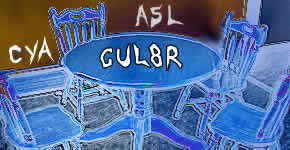
Chat rooms exist on the Internet and allow users to have real-time conversations without giving away their real identity. People usually sign on using a username that can have as much or as little to do with who they are. Profiles of the persons details exist yet do not have to be completed. This allows the person to have total control over how much information they allow other users to know about them, meaning they can become however they say they are without the other person knowing any different. An example of an Internet chat room can be seen by visiting the Yahoo Chat web site.
Another service that allows users to interact online is Multi-user Dungeons (MUDs). Abelson and Lessig (1998) describe MUDs as communities in cyberspace where people create characters to represent themselves. Every member puts on a "mask" to pretend they are of a certain type of person (depending on the setting of the MUD, it can be anything from a serial killer to an ogre), and then they run free in this virtual world. To see a popular fantasy MUD go to Aardwolf MUD.
Turkle (Soules 2001) further adds that MUDs are a new kind of social virtual reality. Where users who participate become authors not only of text but also of themselves, constructing new selves through social interaction. Reich (Soules 2001) says this claim has profound importance if we think of young people, who have not yet armoured their characters.
The virtual environments of chat rooms and MUDs have a major effect of how children and adults not only communicate but also how they form and change their identities.
References
Abelson, H & Lessig, L 1998, Digital Identity in Cyberspace , viewed 1 st September 2004,
http://swiss.ai.mit.edu/6095/student-papers/fall98-papers/identity/white-paper.html
Soules, M 2001, Identity in Cyberspace , viewed 1 st September 2004, http://www.mala.bc.ca/~soules/medial13/netself.htm