
Turkmenistan: An Overview
by
Iraj Bashiri
copyright 1999, 2003
Background
With an area of 189,370 square miles (488,100 sq km) the Republic of Turkmenistan is located
in the southwestern part of Central Asia proper. The most arid region of Central
Asia, it is bound by Kazakhstan to the north, Uzbekistan to the east, Afghanistan
and Iran to the south, and the Caspian Sea to the west.
Next to the Tajiks, the Turkmen are one of the
oldest peoples of Central Asia. They were among the first Turkish tribes to
arrive in Central Asia around the year AD 1000. They survived the Mongol invasion
by staying in the desert and subsisting by herding and plunder. During the last
decades of the nineteenth century, the Turkmen were involved in slave trade.
They attacked caravans, enslaved the members of the caravan and sold them in
the bazaars of Bukhara.
Called the Transcaspian Region, Turkmenistan
was ruled by Russia between 1890 and 1917. As a part of the Russian Empire,
Turkmenistan maintained its autonomy only to the degree that it could develop
its own language, culture, and nomadic way of life; otherwise, its affairs were
controlled by Moscow. Today Turkmenistan and Russia are trade partners. Russia
seeks a market for its manufactured goods, fertile land for growing cotton,
and new natural resources for its factories. Turkmenistan seeks Russia's help
for security against the Afghans and Iranians, especially against militant Muslims
who have dominated Tajikistan, infiltrated Uzbekistan and seek to destabilize
Kyrgyzstan. In any event, Turkmenistan exports natural gas, petroleum, and other
products to Russia and, in exchange, imports foodstuffs, heavy machinery, steel,
construction materials, and vehicles.
After the fall of
the Russian Empire, Turkmenistan was incorporated into the Soviet Union. In
1925, it became a Soviet republic. Under
Soviet rule, the Turkmen nation made a great deal of progress, especially in
agriculture and industry. |

|
Upon the dissolution
of the USSR in 1991, Turkmenistan became an independent nation. While
immediately after the fall of the Soviet Union, the former republics underwent
a period of austerity; Turkmenistan did not suffer as much. Its export of oil
and natural gas provided the Turkmen nation with enough income to retain its
standard of living at the level of prosperous Soviet days. In subsequent years,
especially in 1994, after Moscow refused to allow Turkmen crude to reach the
European markets through its territory, the Turkmen economy was negatively impacted.
Additionally, Turkmenistan's former European partners lost their ability
to pay their debts to Turkmenistan. The combination of these factors changed
the situation for the Republic. At the present, Turkmenistan tries to export
its oil and natural gas to Eastern as well as European markets through Afghanistan,
Iran and Turkey. Were that to happen, Turkmenistan's economic situation would
improve.

|
Geography
The topography of Turkmenistan consists
of flat to rolling desert with dunes. Its main features are the Kara Kum
Desert, which covers about 85% of the land and the Kopet Dagh mountain
range, located in the south. Altogether, the territory is recognized as
the driest region in Central Asia. The aridity and the harsh climate,
however, have a silver lining. Beneath Turkmenistan lies one of the largest
oil and natural gas reserves in the world.
Climate
Turkmenistan's climate is strongly continental
with frequent temperature changes. Although the average summer temperature
is around 60 F (or about 35 C), in the Kara Kum it can reach as high as
122 F (or 50 C). Conversely, the winter temperature may reach as low as
-27 F (or -33 C). The average rainfall is about three inches annually
in the lowlands and about 12 inches in the mountains.
|
Tourism
The ancient cities of Nisa and Merv hark to
the region’s ancient past and its medieval Islamic and Central Asian cultures.
The Sultan Sanjar Mausoleum and the seventh-century ruins at Kyz-Kala, very
close to Ashgabat, are reminders of the heyday of Turkmen ascendancy in the
region.
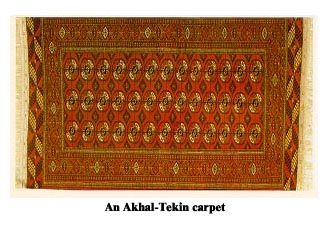
Some of the largest and finest woven carpets
in the world were woven here. Some of them are on display in Ashgabat’s
Carpet Museum. Other places of interest are the Turkmen History Museum and the
Turkmen Economic Achievement Museum. The handiwork of Ashgabat’s skilled
artists appears in the corner bazaars of the republic in the form of carpets
and earrings made of turquoise and cornelian. A row of four-star hotels built
in the early 1990s in anticipation of the oil boom that never materialized assures
the newcomer to Ashgabat of a place to stay.
|
 |
History
From a historical point of view, the Turkmen
are descendants of the Oguz Turks of the 8th to the 10th centuries. As such,
they form one of the earliest layers of Turkish settlements in the region and,
consequently, have been assimilated more deeply into the Perso-Islamic culture
of the region. This assimilation is best understood in the nature of the towns
and villages of the region. In medieval times, due to their proximity to the
Silk Road, two major Turkmen cities prospered. One is the city of Khiva (now
in Uzbekistan), which controlled the farming in the region and was on the caravan
road to Russia and Europe. The other is the town of Merv that was in control
of the silk trade and of spices that flowed from the East to the markets of
Ray and Baghdad. In subsequent years, the town of Charju, in present-day Turkmenistan,
has assumed the traditional role of Khiva and the town of Mary has replaced
ancient Merv. The fate of Merv proper, however, is sealed, as long as the Kara
Kum Canal persists to erode the foundations of its massive ancient structures
and as long as vegetation continues to grow ever closer to the heart of the
old town.
From an ethnological point of view, the Turkmen
are the most distinctive of the Turkish peoples of Central Asia. Mentioned in
the Orkhon inscriptions of the 8th century, they belong to the Oguz tribal confederation
that moved west in the 10th century and formed the Seljuq dynasties of Iran
and Anatolia. In this sense, the Turkmen are more akin to the Ottomans and the
Azeri Turks than to the Turks of Central Asia. But like the Kazakhs, their loyalties
lie with the extended family, which encompasses clan and tribe, before it reaches
the State.
The Turkmen are Sunni Muslims of the Hanafi
sect. Islamization of the region began early and was complete by the 10th century
of the Common Era. Some 86% of the population is Muslim.
Made up of a number of distinct tribes, the
Turkmen have retained their tribal divisions that include, among others, the
Teke, Yamud, and Ersari. Teke is the most dominant clan in the republic. In
Soviet times, it provided almost all the communist cadres and today continues
to make up a large number of the officials of the current government.
Turkmeni belongs to the Oguz division of the
Uralic-Altaic family of languages. It includes a number of dialects corresponding
to the tribal-territorial divisions of the Turkmen. Literary Turkmeni was established
at the end of the 18th and the beginning of the 19th century and is based on
the Teke dialect. Linguistically, too, the Turkmen are more akin to the Azerbaijanis
than to either their Uzbek or Kazakh neighbors.
Turkmeni script went through the same changes
that the scripts of the other republics underwent. From the end of 19th century
to 1929, the Turkmen employed an Arabic-based script. Between 1929-40, the Latin
script was introduced. Since then the Cyrillic script has been modified to meet
their daily needs.
Culture
Turkmen culture is a nomadic culture at base.
Bravery and hospitality play a major role in shaping the old culture, as do
poetry and music. The poetry of Turkmenistan’s major bard, Makhdumquli,
exemplifies some of the rare nomadic values that have been changed by the Russians
and the Soviets who followed him.
Natural resources
The natural resources of Turkmenistan consist
of petroleum, natural gas, coal, sulfur, and salt.
Natural
hazards
The region’s only natural hazard is
earthquake. In 1948, an earthquake nearly wiped out the capital city of Ashgabat.
When an earthquake devastated Tashkent in 1966,
it was rebuilt by the Soviets within a short time. Not so for Ashgabat when
it was literally razed by earthquakes. Joseph Stalin did not even acknowledge
the occurrence of an earthquake. As a result of the earthquake, more so due
to a lack of attention to the people, the Turkmen intellectual pool that had
survived Stalin's purges was totally wiped out.
Environment
Desertification, salinization of soil, and groundwater
contamination through a misuse of chemicals and pesticides are some of the major
problems facing Turkmen authorities. Similarly, the Turkmen farmers are plagued
by poor irrigation methods that lead to water logging of the soil. Both the
Aral Sea and the Caspian Sea are polluted by hazardous waste put out not only
by Turkmenistan but also by Kazakhstan, Uzbekistan, and Russia. In the case
of the Caspian Sea, Azerbaijan, Kazakhstan, Russia, and Iran, too, share the
blame. This situation has created acute medical problems in the area. The problems
are compounded by a poor diet, a lack of proper health care, and poor hygienic
practices. Family planning is another aspect about which little is known, but
which makes Turkmenistan rate first in infant mortality among the republics.
 |
People
With a population of 4,200,000, Turkmenistan
has a labor force of about 488,000. Turkmenistan is one of the strictest
republics of the former Soviet Union both in terms of expression of individual
ideology and of enforcing autocratic authority. Saparmurat Niyazov, the
Republic's president for life, intends to keep the Turkmen away from the
political incursions of Russia as well as from the ideological inducements
of the Republic's neighboring countries. The capital of Turkmenistan is
the city of Ashgabat with a population of about 517,200.
Charju, Merv, Kerki, and Tashauz are the other major cities of the Republic.
Nationality
Turkmenistan’s ethnic mix includes 77
percent Turkmen, 9.2 percent Uzbek, 6.7 percent Russian, 2 percent Kazakh, and
5.1 percent other. The Russian population is usually higher in the cities than
in the rural districts. In Ashgabat, for instance, it might be as high as 40
percent as opposed to the 6.7 percent cited above. There are also 313,000 Turkmen
nationals living in Iran, 390,000 in Afghanistan, 170,000 in Iraq, and 80,000
in Syria. |
Health Care
Before the advent of the Russians into Central
Asia, the Turkmen tribes did not have any organized form of health care. Barbers,
traveling with the caravans, were often employed to perform certain medical
tasks. Learned men as well were often asked to prescribe drugs that had shown
positive curative effect on people in particular cases.
The Russians changed that system somewhat, but
they were not able to make it disappear altogether. When the Soviets took over
in the 1920’s, they were faced with the same problem. However, they came
up with a solution. Through education, they tried to make every individual to
be his or her own doctor. Helped by the European Soviets, Turkmen youths studied
medicine and entered the medical profession.
During the Soviet era, health care was free
of charge; it has remained so after the fall of the Union. Turkmen doctors,
however, worked mostly in tandem with Russian and other specialists. With the
fall of the Soviet Union, most of those specialists left, leaving the Turkmen
on their own. As a result, today, the republic’s hospitals and clinics
do not have good, trained Turkmen doctors, and they are continuously faced with
chronic shortages of nurses, pharmacists and pharmaceuticals.
The reports on medical technology in Turkmenistan
are mixed, by some accounts, today, Turkmen doctors are poorly trained, modern
medical technologies are nonexistent, and medicines are in short supply. By
some other accounts, the state is doing fine in spite of the departure of the
foreign specialists. The fact is that the state has monopolized health care
and is incapable of managing it properly. The reason, of course, is shortage
of funds. In other states, under similar circumstances, private doctors are
allowed to open practice. Turkmenistan, however, does not allow private practice.
If health care continues to operate as it has been during the last decade, the
chances are that the traditional healers, employing herbs and prayer, are likely
to reappear in the rural areas.
The major health problems in Turkmenistan are
cancer, cardiovascular and respiratory diseases, and accidents. Life expectancy
is 58 years for men and 65 years for women. Infant mortality is estimated at
73 deaths per 1000 live births.
Education
Before the Russians and the Soviets came to
Turkmenistan, the education of the young was in the hands of the members of
the family. The Father taught his son all that he deemed necessary to know about
the herds, their feeding, watering, and protection. The mother taught her daughter
how to run an efficient household. Under the Soviets, a compulsory age for education
was fourteen. It remains the same today. The official languages of the republic
are Turkmeni and Russian. Uzbeki is spoken by 7 percent of the population. The
literacy level of the republic under the Soviets was 99 percent.
Turkmenistan’s major institutions of higher
learning are the Academy of Sciences of Turkmenistan (renamed the High Council
of Science and Technology, with President Niyazov as its head), the Makhtumquli
State University, the S. A. Niyazov Turkoman Agricultural University, and many
colleges and institutes, including the Seismology Institute. Due to political
interference in the curricula, some countries do not recognize the degrees granted
by Turkmenistan's universities. It should be noted also that not everyone is
allowed to enter high school and university. There are special tests that determine
whether an individual should be allowed to enter higher levels of education
beyond that which is mandatory.
Welfare
As nomads, the Turkmen did not have an organized
welfare system. The aged and the poor were automatically taken care of by the
tribe, as were children and the infirmed. The Soviets, who were responsible
for dismantling the tribal structures that supported the people, established
a welfare system that took care of all the needs outlined above.
After the fall of the Soviet Union, especially
during the early days of independence, natural gas, electricity, and drinking
water were to be provided to all households free of charge. The new Turkmen
government could do this because it received a great deal of money as a result
of a sharp rise in the price of oil.
Additionally, plans were put in place
to increase the minimum wage and subsidize food and other necessities. Ideally, families were to own houses,
cars, and telephones and there would be no needy individuals in the republic.
Today, only Turkmenistan's pensioners, the disabled,
and children receive payments. A fund was established to which all the employees,
employers, and the state contribute. As a result, Turkmen nationals receive
free gas, water, electricity, and salt. Flour has a fixed low price and public
utility services receive token fees. This needs to be emphasized that were it
not for the export of oil and natural gas, the Turkmen would not have been able
to maintain the standard of living that they had enjoyed under Soviet rule.
|

|
Housing
As nomads, the Turkmen lived in yurts or yurtas.
A Yurt is a round structure, the
size of a large room. In it, there is a left side (er jak), for men, where there is space for saddles and whips,
and a right side (epchi jak) for
women, where there is space for domestic items. There is little privacy in a
yurt. For the newlywed, a curtain
(koshogo) temporarily separates
their space. The yurt has a fireplace
for making tea and for cooking, and an opening at the top (tunduk) for the smoke to leave and the sun to shine in. As
the family grows, the number of yurts in the clan also grows.
When the Soviets settled the Turkmen tribes
by force, they also changed their way of life. Most Turkmen were moved to government-subsidized
apartments in villages and towns, while some others, especially herders, continued
to dwell in yurts. After independence, housing continues to be free of charge in towns and
villages. More than 70 percent of the urban and 10 percent of the rural houses
belong to the state. There is, however, a chronic housing shortage. The situation
is worse in the major urban centers, especially in Ashgabat.
Religion
The Turkmen are primarily Sunni Muslims of
the Hanafi school (89 percent). Originally they were Shamanists. Some of their
Shamanist practices of the past influence their faith. There are also some Eastern Orthodox (9 percent), and other
religions (2 percent) in the republic.
Language
The official language of Turkmenistan is Turkmen
or Turkmeni. Russian, which was the official language during Soviet rule, is
now the language of intercultural and international communication. Russian is
also used in government affairs and in business. Uzbeki is also spoken by a
segment of the population that is close to the border of Uzbekistan.
Government
The name of the republic is Turkmenistan. It
is a republic with its capital at Ashgabat. Administratively, the republic is
divided into 5 provinces. Turkmenistan became independent on October 27, 1991.
A constitution was adopted on May 18, 1992. Turkmenistan’s legal system
is based on civil law with suffrage at 18 years of age.
The Executive branch consists of a chief of
state or President. He is both the chief of state and the head of government.
The president appoints the cabinet or the Council of Ministers. Under the 1992
constitution, the legislative branch consists of two parliamentary bodies, a
unicameral People's Council (100 seats, some elected by popular vote and some
appointed; meets at least yearly) and a unicameral Assembly (50 seats; elected by popular vote for
five-year terms). The judicial branch consists of the Supreme Court. The president
appoints all judges.
Political parties
Formal opposition
parties are outlawed in Turkmenistan. There are, however, several unofficial,
small opposition movements both underground in Turkmenistan, or in foreign countries.
The most prominent opposition group-in-exile is Erkin, based in Moscow. There
is also another opposition group called the Democratic
Party of Turkmenistan.
In order to
develop its resources independently, Turkmenistan has asked Russia and the other
CIS republics to stay out of Turkmen affairs. To this end, Saparmurad Niyazov,
like Stalin before him, has created a cult of personality around himself. This
has worked so far in keeping the opposition at bay and maintaining stability.
But it remains to be seen for how long such an iron-fisted approach to the resolution
of ideological problems will last. A positive point in favor of Niyazov is that
the Turkmen government, too, intends to keep Islamic fundamentalism away from
the borders of the Republic.
Present-day Turkmenistan, even though calm and
collected on the surface, is rife with problems. In fact, thinking about these
problems brings the term oxymoron to mind. The Turkmen wish to privatize and
become a democratic nation; but they also wish to retain their Soviet-style
structure. They share the same ecological problems that the other republics
experience, but have failed to garner the political freedoms they enjoy. Similarly,
they wish to attract foreign investment and foreign technology to develop their
natural resources, but must keep the foreigners at arm's length lest they foment
discord.
The most pressing problem of Turkmenistan is
lack of freedom, which makes of the Republic a veritable test case for gauging
the power and reach of Islamic ideology. Can it penetrate deep enough into the
social, political, and cultural fabric of Turkmenistan to stimulate its so-far
silent intellectuals?
Turkmenistan's main areas of concern rest outside
its border. Helped by Russia, Iran is planning the building of a major nuclear
station in its northeastern territory, near the Turkmen border. This has created
a dilemma because Iran is also agreeing to allow Turkmen crude to reach Europe
through its land. Helped by Saudi Arabia and other interested parties, Islamic
militants have dominated Tajikistan, infiltrated Uzbekistan and seek to destabilize
Kyrgyzstan. How long will it take them to penetrate Turkmenistan?
Flag
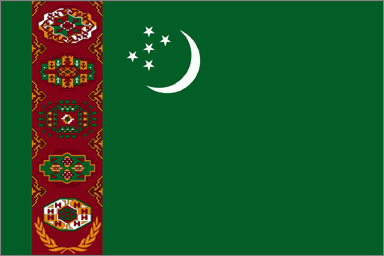
|
Adopted 1992
green field with a vertical red stripe near the hoist side, containing five carpet guls (designs used in producing rugs) stacked above two crossed olive branches similar to the olive branches on the UN flag; a white crescent moon and five white stars representing the five regions of Turkmenistan appear in the upper corner of the field just to the fly side of the red stripe
|
Democratization
General Introduction
In order to understand
the economy of the republics of the former Soviet Union, it is necessary to
understand how centrally controlled economies work and how a centrally controlled
economy is changed into a market economy.
In
simple terms, the Communist Manifesto gave birth to a number of economies in
Central Asia all of which were controlled by the state. The articles
of the Manifesto asked for a total, central control of all aspects of life.
In other words, all the peoples’ assets were taken from them and placed
under the supervision of the State. This included the factories, plants, and
natural resources, as well as human resources.
Privatization is the
reverse of centralization. It requires a centrally controlled state that wishes
to become a modern independent state to decentralize its agriculture, industry,
businesses, and housing. It requires that the individual be given the right
to buy and sell property. Means of transportation, production, and communication
should be placed in the hands of the people. Similarly, the state should decentralize
its banks, allow foreign investment to help develop its resources, and become
a party to local and international efforts in running a meaningful and profitable
market economy.
A truly independent
republic cannot ignore freedom. It must allow its population the right to free
speech by placing the media (newspapers, radios, and televisions) in the private
domain and by removing censorship. Additionally, people should be given political
freedom so that they can form political parties, stand for election, and vote.
What was outlined above
serves as the basis for creating a democratic state with a stable government.
A republic with a parliament that respects international law and which legislates
laws that are sensitive to ethnic, racial, ideological, national, and gender
concerns of the people, a government that recognizes equal opportunity and equal
rights of its people.
Finally, an independent
state must create access to education and health care through state and private
welfare programs, it should form committees to oversee its conduct of human
rights, as well as a committee to handle abuse of natural resources.
Since receiving their independence, the republics
in Central Asia have responded differently to the demands of independence, especially
with respect to privatization, political freedom, and human rights issues. The
difficulty does not rest with the republics as much as with the nature of changes
that are required of them. Obviously these changes cannot be meaningfully implemented
unless those receiving the changes are cognizant of the rules of democracy.
As every one knows, the road to democracy is long. It requires sacrifice as
well as a large amount of funds for educating the people and making them understand
the working of the law vis-à-vis the rights of the individual and the
community.
Economy
Turkmenistan's economy is based on agriculture,
livestock raising, and the textile and oil industries. Long-fibered cotton,
wheat, alfalfa, grapes, and melons are among the agricultural products most
produced in the collective farms of the Republic. At the heart of Turkmen agriculture
is the 1,000 kilometer-long (625 miles) Kara Kum Canal, an artificial waterway
that has created prosperity for Turkmenistan but visited irreparable devastation
on many Kazakh, Karakalpak, and Uzbek settlements whose inhabitants draw on
the Aral Sea for their livelihood.
Before the Soviet takeover of Central Asia,
the Turkmen tribes were not settled. They were nomads, moving constantly from
place to place in search of grass and water for their animals. The Soviets settled
the Turkmen tribes, created an agricultural base next to their already existing
livestock-raising base, and enhanced the complex by adding industry to utilize
the abundant resources of the republic. Once the main components were in place,
Turkmenistan’s agriculture was collectivized and mechanized. Then both
the agriculture and the industry were placed under the direct control of the
center in Moscow. Before long, the republic could provide fertilizer and machinery;
in time, it became one of the major grain and cotton contributors to the Soviet
economy. Agriculture was diversified in the 1980’s by the addition of
planting fruits and vegetables. Unlike the other republics that abandoned the
Soviet system either totally or partially, in Turkmenistan the state-order system
continues to mandate cotton and wheat crops per quotas. Today, one half of Turkmenistan’s
irrigated land is planted in cotton. The world’s tenth largest producer,
the cotton sector employs nearly half of Turkmenistan's work force.
Agriculture
Only four percent of Turkmenistan's land mass
is arable, the other 96 percent is covered by the Kizil Kum desert and the Kopet
Dagh mountains. Thanks to the 1000-kilometer Kara Kum Canal and a network of
other irrigation works, Turkmenistan remains a major producer of cotton. In
addition to cotton, Turkmenistan's other major crops include grains and fodder.
Livestock raising is another contributor to Turkmenistan’s economy. Cattle,
sheep, goats, camels, and horses create a profitable market in hides, wool,
meat, and milk. The contribution of the soft, curly wool of the Karakul sheep
can be added to this.
|
Camels and sheep constitute most of Turkmenistan's
livestock raising. Turkmenistan's Persian lamb, produced in large numbers under
modern conditions, is among the most sought after worldwide. Similarly, Turkmenistan
is well known for its carpets, cotton, wool, and silk textiles.
When the Soviets tried to create a complex of
agriculture and animal husbandry in Turkmenistan, they faced a major problem.
The republic’s rivers--the Amu Dariya, Murghab, Tejen, and Atrak--all
flow in areas that are quite distant from the main arable lands. The Soviets,
therefore, created a system of canals around a main canal, the 1000-kilometer
man-made Kara Kum Canal. Once this major project was completed, Turkmenistan's
area of arable land increased, boosting the prosperity of the surrounding area,
especially Ashgabat. |
 |
While in the past, the country had been a patchwork
of unrelated waterholes, it now
became a network of interconnected oases each serving a particular agricultural
or industrial purpose. For instance, the Murghab oasis contributes fine-staple
cotton, carpet, silk, and Karakul pelts. Similarly, the Amu Dariya oasis, centered
on Charju, contributes cotton, silkworm, and fiber crops. The Kopet Dagh oasis,
centered on the capital city of Ashgabat, serves as Turkmenistan's industrial
center involved in oil extraction and refining, also as the center of chemical
and mining industries and the republic’s fisheries. In fact, extraction
and processing of petroleum and natural gas remain the republic's major industrial
ventures. Plants that produce construction
materials, agricultural fertilizers, and food and process wine are secondary
to this.
Industry
Turkmenistan commands the world's third largest
sulfur deposit and the fifth largest natural gas reserves. Its supply of fossil
fuels, estimated at 700 million tons, is sufficient to meet 100 percent of its
own energy needs. Additionally, Turkmenistan has a number of major rivers that
can contribute to the prosperity of its industry through the generation of hydroelectric
power. In addition to petroleum
and natural gas, Turkmenistan has a number of other mineral resources including
coal, gypsum, mercury, iodine, and phosphate, raw materials used in cement and
glass production, as well as various types of salts.
Carpet making and leather working are two major
Turkmen traditional industries for which the republic is well known. Similarly,
Turkmenistan has a reputation as a source of good quality raw silk and silk
textiles. As a part of their reorganization of the agricultural and industrial
bases of the republic, the Soviets established special plants in the republic’s
center for the production of silk textiles. Today, the number of plants that
specialize in the production of hand-woven silk and Turkmen carpets, especially
in the capital city of Ashgabat, has increased.
 |
Turkmenistan’s industry, however, has to make a difficult choice. On the
one hand, it needs foreign investment and expertise to extract and market its
abundant resources; on the other hand, it cannot allow Islamic extremism and
Western ideologies to enter the republic and corrupt the minds of its people.
As a chief, President Niyazov knows well that he must allow his people and others
to develop the resources of the land for the common good. But he also knows
that the experiences of the other republics, especially Tajikistan and Kyrgyzstan,
have not been encouraging. As a result, he vacillates between two worlds, wondering
whether he should sign a major proposal, like the Trans-Caspian gas pipeline
and the Baku-Ceyhan oil pipeline, or he should be satisfied with sporadic agreements
with Russia, the CIS, and Iran
.
It is this same kind of thinking that has prevented
one of the largest oil and natural gas reserves of the world from competing
in the international arena for development. After the fall of the Soviet Union,
Turkmenistan chose the path of political and economic neutrality as opposed
to either joining the global market or adopting an import substitution economy
plan. Consequently, the outcome of Turkmenistan’s economic growth, i.e.,
its privatization project and the way it relates to the international market
differ from its neighboring states. This road, although difficult, is not alien
to the Turkmen. Turkmenistan does not pretend to be a democratic state. It has
chosen a president for life, Saparmurad Niyazov. As the sole decision maker,
he can direct the affairs of the country in any direction that he sees fit.
|
Privatization
Privatization comes to the Turkmen as a new
thing. It should not since Islam respects personal property and defends an individual’s
right to property against all infringement. At the same time, lands and businesses
are first and foremost the property of the sultan and amir. They have captured
them from the infidel; their descendants have defended them and regulated their
affairs in the past. Naturally, giving up the right and authority over such
properties and enterprises comes easily to the Central Asian rulers in the 21st
century. Niyazov, the President of Turkmenistan, is no exception. He prefers
a good administration to any kind of privatization as the correct path to a
truly socialist state.
Privatization in Turkmenistan has moved very
slowly. By 1992, only 2,600 small trading outlets and home-worker operation
enterprises had become privatized. In the following year, a few more small trade
and service enterprises were sold to foreign buyers but the ownership of large
manufacturing firms and the private ownership of service-sector enterprises
with fewer than 500 employees was never discussed. The privatization effort
in Turkmenistan peaked in 1994, when 1000 small service sector enterprises were
privatized.
Banking
Turkmenistan’s banking system is centrally
controlled. It consists of the
State Central Bank of Turkmenistan, two state banks, the State Bank for Foreign
Economic Affairs (or Vnesheconombank), and the State Savings Bank (Sberbank).
There are also 13 commercial banks that include 4 banks with foreign capital.
There are also 52 Daykhanbanks that deal with agricultural production. The commercial
banks are generally small-and medium-size; their major shares belong to the
state enterprises.
Turkmenistan's currency, the Turkmen manat,
was introduced on November 1,1993. The governmental exchange rate was established
in 1996. One US dollar is worth 21,000 Turkmen manats.
Exports
and Imports
During the Soviet
era, Turkmenistan did not have either diplomatic or economic relations with
the free world. The major partners in its economy were the other Soviet republics,
especially Russia. In fact, Turkmenistan was obliged to produce certain products
for export and import some products that it was not allowed to produce.
After the fall of the Soviet Union, the situation
changed. Rich in natural gas and petroleum, Turkmenistan sought trade relations
with Iran and Turkey. This move forced Russia, in 1994, to refuse to let Turkmen
crude to reach Europe using its pipelines. In December 1999, the decision was
reversed. Lack of export routes
continues to plague the Turkmen economy. More recently, the republic has been
negotiating with China, the United States, and Russia for export of its natural
gas.
|
Exports
Turkmenistan's main exports include petroleum,
natural gas, minerals, chemicals, cotton fiber, textiles, and processed foods.
The republic's total exports in 2001 were estimated at $2.7 billion. This figure
indicates a rise that is the result of higher international oil and gas prices.
Turkmenistan's export partners are Ukraine, Iran, Turkey, Switzerland, Mexico,
and the Far East.
Imports
Turkmenistan's main imports include food and
beverages, textiles, machinery and equipment, and foodstuffs. The republic's
total imports in 2001 were estimated at $2.3 billion. Turkmenistan's import
partners are Russia, Turkey, Ukraine, Kazakhstan, Uzbekistan, Azerbaijan, United
Arab Emirates, France, and Germany. Turkmenistan's total imports in 2001 were
estimated at about $1.5 billion.
|
Balance
of Payment
In 2001, Turkmenistan received $16 million in
economic aid from the United States. With respect to Turkmenistan's exports,
it is significant to note that directly after the fall of the Soviet Union,
Turkmenistan's imports increased considerably. By 1994, however, as the former
Soviet republics failed to pay their debts, Turkmenistan's imports have decreased
considerably. In fact, the standard of living of the republic that is tied directly
to its exports has fallen below the poverty line.
Turkmenistan’s external
Debt is estimated between $2.3 billion to $5 billion . In 2001, Turkmenistan
received $16 million in economic
aid from the US.
Communication
The general state of Turkmenistan's communication
lines and service is poor. In 1997-98, There were 363,000 main and 4,300 mobile
cellular lines in the republic. Turkmenistan is linked by cable and microwave
radio relay to the other republics of the CIS. It is connected to the other
countries by leased connections to the Moscow international gateway switch.
There is also a new telephone link from Ashgabat to Iran and a new exchange
in Ashgabat switches international traffic through Turkey via Intelsat; satellite
earth stations - 1 Orbita and 1 Intelsat. There are 16 AM, 8 FM, and 2 shortwave
stations and 3 Television broadcast stations.
Programs are generally relayed from either Russia or Turkey.
The Internet country code for Turkmenistan is .tm. There is one internet service
provider and about 2000 Internet users.
Transportation
Turkmenistan has a total of 22,000 km of highway,
18,000 km of paved and all-weather gravel-surfaced roads, as well as 4,000 km
of unpaved roads. These latter, made of unstable earth, are often difficult
to negotiate, especially in wet weather). There is also a total of 2,440 km
of railway. Additionally, the Amu Dariya serves Turkmenistan as an important
inland waterway. Crude oil and natural gas move through 250 km and 4,400 km
of pipelines, respectively. In 2001, Turkmenistan had 76 airports, 13 with paved
runways.
Military
Turkmenistan’s military consists of
an army, air and air defense, navy, border troops, and internal troops), as
well as a national guard. The recruitment age is 18. Available military manpower
at the present is 1,239,737. The manpower fit for military service is 1,005,686.
A Russian air-ground force of 34,000 is jointly controlled by Turkmenistan and
Russia. Turkmenistan’s annual military expenditures are $90 million.
Border
Issues
With respect to sharing of the water of the
Amu Dariya, Turkmenistan shares some of the same problems that the other republics
of Central Asia experience. A larger problem for Turkmenistan, however, is the resolution of the division of the
Caspian seabed and the oil reserves beneath it. Currently, the seabed is shared
among Russia, Kazakhstan, Azerbaijan, Turkmenistan, and Iran. Turkmenistan's
boundary problems with Kazakhstan are currently being discussed.
Turkmenistan serves as a transit country for
Afghan narcotics bound for Russian and Western European markets. There is a
limited amount of illicit cultivation of opium poppy in the republic for domestic
consumption. The government often mounts small-scale eradication of illicit
crops projects but has not been able to make much headway.
See also:
Central Asia: An Overview
Azerbaijan: An Overview
Iran: A Concise Overview
Kazakhstan: An Overview
Kyrgyzstan: An Overview
Tajikistan: An Overview
Turkmenistan: An Overview
Uzbekistan: An Overview
Top of the page
Home| Courses