
Kazakhstan's topography is varied, made up of dry steppelands, semi-deserts, and mountain forests. The western and northwestern parts of the republic are formed by the Ust Urt Caspian Depression and the Ural Plateau. The Tien Shan peaks rest in the east and southeast, leading to the central uplands formed by dried-up salt lakes. The arable, fertile portion of the republic is in the north where, in the 1950's, as a part of the Virgin Land program, it formed the former Soviet Union's main source of grain, especially wheat.
Kazakhstan has hot summers and extremely cold winters. The average January temperature in the northern and central regions is between 3 F and -2 F (or -16 to -19 C). In the south, at the same time, the temperature is between 23 F and 29 F or (or -5 C or -1.4 C). Summer is long, dry, hot, and cloudless. In the south, the temperature can reach as high as 104 F. The mean temperature for July, however, is 90 F (or 32 C). Winter is usually short. The mean temperature for the north in winter is 10 F (or -12 C) but some days can be as cold as -36 F (or -38 C). The average July temperature ranges from 68 F (or 20 C) to 84 F (or 29 C). Average annual rainfall is about 12 inches in the north as opposed to 20 inches in the south.
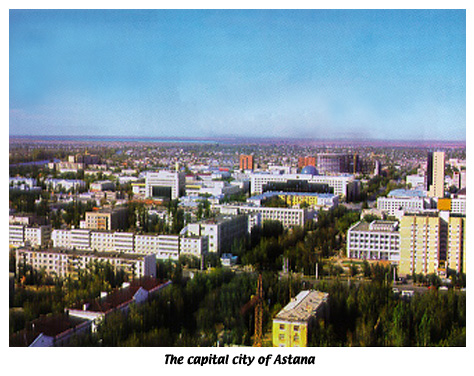
Until recently, the capital of Kazakhstan was the city of Almaty
(Alma-Ata, during the Soviet period) with a population of about 1,210,000. By
the order of Kazakh President, Nursultan Nazarbaev, the capital was moved to
Astana (former Aqmola) which is farther north, closer to the Russian border
and to the concentration of the Russian population of the republic. The official
reasons for the move were the location of Almaty, which is prone to mud slides
and earthquakes, and Astana’s proximity to the Russian population of the
state. Other major cities of Kazakhstan are Karaganda, Chimkent, Jambul, and
Semipalatinsk.
Between 300 BC and 200 BC, according to the Greek sources, the region that is occupied by the present-day Kazakhs was populated by the Scythians, who themselves were overtaken by the Usans. The actual movement of the Turkic people into the region does not begin until the time of the later Sassanians of Iran, i.e., AD 500. The cause for their appearance at this juncture in history is usually explained as population explosion on the Mongolian plain and a lack of pasture for the more westerly Turks.
The movement of the Turks in the direction of Central Asia happens at the same time as the rise of Arabian tribes in what is present-day Saudi Arabia. The two cultures, bypassing Iran, come into a clash in what is present-day southern Kazakhstan. The interaction, however, bodes well for the people of the region as it facilitates communication between the distant lands of China and the Middle East. Running like a silk thread through the cities of China, Central Asia, Iran, and Iraq, all the way to Europe, the Silk Road created an unprecedented network of artistic, religious, and commercial centers. Christianity, Islam, Buddhism, and Manichaeism all found a niche within this vast melting pot.
In the thirteenth century, the Mongols pushed their way into this global metropolis and reshaped it to their own image. Sweeping people from east to west, they uprooted all the communities and civilizations that lied before them. By the time they lost their initial zeal to conquer the world, the world had already conquered them. The Mongol tribes settled down in the northern regions of the Caspian and ruled a managerie of unruly chieftains and a bevy of power-hungry Eastern Europeans.
When the Mongol rule succumbed to Russian might in the fifteenth century and the Golden Horde was dissolved, the Kazakhs and the Uzbeks join forces and moved to the region east of the Ural River. The Kazakh-Uzbek Confederation lasted until the latter part of the fifteenth century. The alliance, however, was an uneasy union. The Uzbeks, the more adventurous wing of the confederation, proposed to invade Bukhara and capture Ma Wara' al-Nahr or Transoxiana. The Kazakhs preferred to establish themselves in the upper Syr Dariya region. The split occurred around AD 1500 when, Khan Kasym moved his tribe southeast and established the grazing land in southeastern Kazakhstan as Kazakh tribal grounds. The Uzbeks, on the other hand, moved directly south, captured Samarqand and Bukhara and established themselves in the Khiva, Bukhara, and Kokand regions.
A similar tripartite division obtained among the Kazakhs as well. Called the
Kazakh Clan Confederation, the Kazakhs are usually divided into three subgroups
or zhuzes. The greater body, known as the Elder Horde, moved to the southeastern
regions where it prospered for a while. The Middle Horde occupied the grazing
lands around the present-day capital of Astana
(former Aqmola), and the Lesser Horde stayed more or less in the region previously
occupied by the Uzbek-Kazakh Confederation.
Once the migration was over and the Hordes "settled" in their respective homes, they began to experience pressure from their new neighbors. The Elder Horde was too close to the Kalmyks, a people of Mongol origin, and the Lesser Horde was virtually a neighbor of the mighty Russian Empire.
The years between AD 1600 and 1700 proved to be very trying for the Kazakhs. Many brave and wise leaders appeared and led the Hordes, but none was able to put an end to internal clan fights and external pressures from the south and the north. By 1700, which coincided with the rule of Taukekhan (d. AD 1718), the Kazakh Clan Confederation broke down and the Hordes became free agents to choose their own destiny.
The Lesser Horde was made up of three tribal confederations: the Zheti Ru, Alim Uly, and Bai Uly. Being the closest of the zhuzes to the Russian Empire--they lived in northwestern Kazakhstan--they were the first, under Abul Khayr Khan, to seek Russian protection in 1731. The needed Russian protection because the Elder Horde had already fallen in the hands of the Kalmyks.
The Middle Horde was made up of the Kipchak, Argun, Naiman, Kerei, Kongrat, and other tribes. They lived in northern and eastern Kazakhstan. Following the example of the Lesser Horde, they sought Russian protection in 1742.
The Elder Horde was made up of the Sary Uisin, Kangali, Dulat, Alban, Jalair, and other tribes. They lived in southeastern Kazakhstan. The Kalmyks defeated the Elder Horde in 1723. Between 1840 and 1860, pressed by the Oriots to their east, they, too, sought Russian protection and became part of the Russian Empire.
When the reduction of the Hordes was completed, Russian pioneers began to scout the new territory and make suggestions for alternative uses of the land and the other resources of the region. This did not sit well with the chiefs who, like Khan Kene of the Middle Horde, led rebellions against them.
In the long run, however, all the Kazakhs’ efforts at preserving their grazing grounds failed, especially when, in 1850, Russia began to build fortifications in the region. The fortifications greatly alarmed the Kazakhs because they formed a core for the attraction of city dwellers and farmers, and because they reduced the amount of grazing land necessary for a large number of livestock.
The conclusion of the Crimean War (1854-56), and the capture of Imam Shamil of Daghistan, opened the way for the victorious Russians to complete a process that they had started in the 1840s, i.e., the reduction of Central Asia and the transformation of its grazing pastures into wheat farms. The Kazakhs were the first of the peoples of the region to feel the impact of what came to be known as Russification, during the course of which the Kazakhs were systematically divested of their land and livestock holdings and were pushed up into the hills or into the harsh desert regions where many of them died.
Between the 1860s, when Russia officially annexed Kazakhstan (1863) as its Steppe District, and 1916, when the Russian tsar, Nicholas II, planned the conscription of Central Asian youths into the army, a state of modus vivendi held the two peoples together. Large numbers of Russian serfs moved into northern and eastern Kazakhstan, preparing the way for even more settlers. By 1910, under the auspices of the Minister of the Interior, Peter Stolypin, almost half a million farms had been carved out of Kazakh grazing lands for the cultivation of corn, wheat, and other grains. Nicholas II's decree that the Kazakhs should work behind the lines, however, destroyed that mutual understanding. As a result, the Kazakhs rebelled in large numbers to protect the work force that maintained their fields and livestock and to prevent the destruction of Muslim lives for Russian gains. It took the Russian army four months to end the rebellion and restore law and order in the region. The process cost the Kazakhs thousands of lives; about a million of them left their homeland for China. A similar rebellion, the Alash Orda (1918-1920), against the Communists was defeated by the Red Army. After the dust settled, the Bolsheviks ignored the ethnic differences of the people and created the Kirghiz Autonomous Socialist Republic in present-day Kyrgyzstan. Five years later, in 1925, the Kazakh appellation was reinstated; the Kazakh Autonomous SSR was given its own capital--Alma-Ata (present-day Almaty).
In the 1950s, Nikita Khrushchev decided to use Kazakhstan to showcase Soviet ingenuity in land management and agriculture. As a result, he appointed Leonid Brezhenev, then the First Secretary of the republic, and commissioned him to carry out what was later known as the "Virgin Lands" project. Helped by the Kazakh Dinmukhammad Kunayev and a large number of Kazakh youths, Brezhnev turned the ancestral Kazakh grazing lands into wheat and cotton fields. While this was a major plan for the Soviet Union--it met the grain needs of the European republics--the project played havoc with the lives of the Kazakhs. Distanced from their major sources of self-sufficiency, bread and meat, they became entirely dependent on imports from the rest of the Soviet Union.
The 1960s and 1970s saw the arrival of a different group of Soviets, the technicians who worked the coal and gas deposits and who took charge of the oil industry. This new community, added to the old communities of farmers and miners, tipped the balance against the Kazakhs who began to become a minority in their own country.
After Brezhnev, Kunayev became First Secretary. Using ancient Kazakh institutions such as the tribal hierarchy and bata, Kunayev forged a new system of exploitation within the already exploitative Soviet system. As the chief of the "tribe" he made all the decisions on hiring and firing of managers of major firms and plants. Then, using bata, or sealed lip, he prevented any information that could damage his operation from reaching the Center in Moscow. The Kunayev "empire," built around a core of his kinsmen, grew very strong. It would have grown even stronger were it not for Mikhail Gorbachev who displaced Kunayev as First Secretary and installed a Russian, Gennadii Kolbin, in his place. As for Kunayev, he refused to disappear quietly. Rather, he set his own forces into motion and created the so-called "Alma-Ata" riots of the late 1980s, the first to shake the foundation of the Soviet Union.
As far as lifestyle is concerned, the Kazakhs have traditionally
been pastoral nomads. Even today, after forced settlement, large numbers of
Kazakh youth live up in the mountains to tend their herds. This mix of quasi-urbanites,
farmers, and nomadic shepherds, prevalent in areas distant from the major cities,
lives a comparatively good life. The culture of the Kazakhs includes a wealth
of oral epics, legends, and ritual songs. Jambul Jabaev, Abai Kunanbaev, and
Mukhtar Auezov are names closely tied to this tradition. Abai, who can easily
be called the founder of Kazakh literature, supplemented the traditional education
that he received at a Kazakh maktep (elementary school) with a solid
understanding of Russian culture and literature. At times, he took his love
for the Russian culture to such an extreme that Soviet commentators regarded
him the epitome of progress in dismantling the Islamic Shari'a law among
the Kazakhs.
The life of Abai Kunanbaev is the subject of two major works by the Kazakh author and academician Mukhtar Auezov. These works entitled Abai and The Path of Abai (1952-56) examine the life of the poet, the history that shaped that life, and the lives of Abai's contemporaries. They make fascinating reading especially for those interested in the process of the forced settlement of the Kazakhs.
The Kazakhs were the last of the Turkic peoples of Central Asia to be Islamized. Influenced by the Tatars, they chose the Sunni faith and within that the Hanafi school of law. The Tatars themselves had become Muslims only in the 14th century under the Khans of the Golden Horde, especially Berke and Uzbek. After gaining dominance in the region, the Russians could easily have stopped the Tartars from carrying the process to an end. But they did not. The reverse would have promoted Central Asian conservatism and Shamanism, neither one of which the Russians liked.
Besides, the Islam practiced by the Kazakhs is quite different from the Islam practiced in Saudi Arabia or Iran. Prevented from reading the Qur'an for over seventy years, Kazakhs have lost touch with the fundamentals of the faith. Instead, they have developed an affinity to what can be termed folk Islam, i.e., a combination of superstition and the dictates of the ishans. Many believe in jinns, in the spirit of their ancestors, and in the intermediacy of Muslim saints. For instance, children are adorned with tumars to protect them against evil eye. Adults tie votives to trees, by running water so that their wishes may be granted, and some visit the graves of Muslim saints to pave their way to heaven.
Kazakhstan's way to independence has not been easy. Tied to the economy of the former Soviet Union, the need for Kazakhstan's traditional heavy industry products declined between 1991 and 1994, resulting in hardship for a large segment of the population, especially the Russians. After 1995, however, the pace of privatization has quickened, resulting in the availability of a larger amount of assets in the private sector and allowance of small industries to grow. This process has also boosted the opportunity for getting and retaining jobs.
Like the populations of the other Central Asian Republics, the Kazakhs wish to remain independent.
Ethnic strife is a potential problem, especially if the Kazakhs, on their way to gaining a majority, decide to influence the laws of the republic in favor of the Muslim Kazakhs. This would not sit well with the 34% percent of Russian Kazakhstanis who claim "ownership" of the northern regions. The Baikonur cosmodrome, which sits on the fringe of this disputed territory, has created its own host of problems for both Russia and Kazakhstan. Resolution of these problems requires Kazakhstan to offer its nationals equal share in its government.
Among the republics of the former Soviet Union, Kazakhstan is relatively calm and collected. It has signed the Caspian Pipeline Consortium agreement (December 1996) to build a new pipeline from western Kazakhstan's Tengiz oil field to the Black Sea and it is trying to resolve residual disputes with Russia and China. This security, however, lasts only as long as Uzbekistan and Kyrgyzstan can prevent the Islamic militants in the Ferghana Valley from spilling into southern Kazakhstan.
In any event, even though the Islamic faith sits lightly on them and their previous adherence of communism is a thing of the past, at some point the Kazakhs, too, must define the roles of Islam and Communism in their own legal matters, educational structures, and society at large. Only then will they be able to enjoy the fruit of their industry and the joy of seeing native Kazakh managers and technicians paving the way to an even more prosperous future.
Kazakhstan Today
For seventy years the Kazakhs were subjects of a totalitarian regime. Their governmental power, a decisive factor in their future economic development, was dictated by the Communist Manifesto, Soviet bureaucrats, and a weak ruble controlled by Moscow. By 1990, the Soviet Union became decrepit. Its giant plants created more pollution than products. There was no demand, either domestically or internationally, for its products. On December 16,1991, Kazakhstan became independent.
Independent Kazakhistan felt obliged to decentralize its economy, a process that required the existence of amenable democratic institutions achieved through the establishment of democratic institutions and severance of ties with the past. In other words, a decentralized Kazakhstan economy meant future unemployment, long lines in front of empty stores, and the inability to attract foreign capital.
Nevertheless, determined to bring about change, Kazakhstan undertook several measures, between 1991 and 1995, to reform its government: it divided the Supreme Soviet into legislative, executive, and judiciary branches. Armed with these powers, a constitution was written to restore peoples' rights to property and freedom. Following that, from 1995 to 1998, elections were held for a bicameral parliament that satisfied the needs of Kazakhstan's diverse national, tribal, religious, and ethnic groups. At the end, the reforms created a fairly democratic system of government--a multi-party system, led by a democratically elected president.
As a first step for restoring peoples’ purchasing power, as well as to generate jobs, open the factories, and end unemployment, the Kazakhs dismantled the defunct Soviet centralized economic system, restructured their surviving institutions, and implemented social and political reforms. The first step in this direction was taken when the Kazakhs ended their dependence on Moscow by introducing their own monetary unit, the tenge (see below for details). Additionally, they built a legal system to accommodate the basic institutions of the state. Then, within this framework, they established a program for liberalizing their new economy. A large-scale reduction in production and an imposition of quotas on distribution of goods were the results of this initial bold step by the state. Once the results of these endeavors materialized, the Kazakhs found themselves masters of a viable private sector in which a market economy operated. Only then did Kazakhstan adopt a fast-paced, viable program of privatization.
Between 1991 and 1995, Kazakhstan broached denationalization and privatization. The programs covered the sale of retail trade and service facilities, as well as the transfer of state property to employees, mass privatization, case-by-case privatization, and privatization of agricultural enterprises. During the subsequent three years, the republic's pharmaceutical companies and drugstores were privatized. This was followed by the privatization of medicare, education, tourism, and sports. In 1998, a part of the state holdings in the Caspian Seashelf Oil Exploration Consortium was privatized.
Preparation for entering the world market took the Kazakhs four years (1996 — 2000). During this period, the Kazakhs explored, and eventually penetrated, foreign markets for the sale of their petroleum, natural gas, and other commodities. Unlike the Uzbeks who tried to entice investors to invest in their economy, the Kazakhs facilitated trade by introducing genuine liberalization measures such as abolishing limits on exports and decreasing demands on acquisition of licenses. They also regulated customs duties and excluded banks that were not viable. Extraction, transportation and processing of oil, railroad and air transportation, power distribution, uranium, and raw materials production were not privatized until 1999-2000. Even then, they were placed under the custodianship of the state, pending appropriate legislation.
The measures that Kazakhstan took were both wise and practical. The liberalization of their economy gave direction to their national and international economic relations. Consequently, they privatized most of their Soviet holdings successfully and reformed their tax laws, allocated budgets, and created appropriate banking procedures. Most importantly, they created those needed democratic institutions that assure international investors of their republic's stability and credibility.
Kazakhstan supplied 60 percent of the mineral resources of the Soviet Union. The republic has an enormous amount of untapped reserves of oil, natural gas, and metals. Coal, gold, silver, lead, copper, zinc, cadmium, iron ore, beryllium, manganese, chrome, nickel, cobalt, bauxite, titanium, sulfur, and industrial diamonds are among some ninety minerals found in the republic. Kazakhstan also has large uranium mines. But its most important asset in the future might lie in the large reserves of oil in the Caspian Sea. China, India, Russia, Europe, and the United States are all waiting for a decision on the division of the Caspian Seabed so that the oil reserves beneath it can be exploited.
Kazakhstan is an industrialized nation. Many of the cities in the north accommodate large chemical and steel plants, textile factories, and centers for processing nonferrous metals, especially copper. A good number of these plants and factories were moved east during World War II, when the Soviets did not wish their technology to fall into German hands. Together these plants and factories form a relatively large machine building sector specializing in construction equipment, tractors, and agricultural machinery. Furthermore, Kazakhstan is the home of the Baikonur cosmodrome, the heart of Russia's space program.
Of the three launching sites in the former Soviet Union Baikonur is the most well known. It has served as the foundation of Soviet space program as well as the primary launching point for the Soviet manned space missions. It was from Baikonur, for instance, that on October 4, 1957, Sputnik was launched. Yuri Gagarin, the first human being to orbit the earth also was launched from Baikonur. For some time, Russian space launches from Baikonur have been halted due to two rocket explosions. Russia, which has accepted to pay $115 million a year for 20 years to rent Baikonur, tries to ensure the Kazakhs that its rockets can be launched safely and that they will not contaminate central Kazakhstan.
Only 11 percent of Kazakhstan's topography in the north is suitable for cultivation. The other 96 percent is dry steppelands, semi-deserts, and mountain forests. In pre-Soviet times, herding was the major contributor to Kazakhstan’s agriculture. That is why, perhaps, the region’s leading agricultural commodities were wool, meat, milk, and other livestock products. Russians, however, had a penchant for farming, especially the cultivation of rice, cotton, and wheat. When they took over Kazakhstan at the end of the 19th century, they changed most of the pastures into farms. The Soviets shared the emphasis on farming. Soon after they took over, Kazakhstan’s agriculture underwent a period of collectivization. As a result, the Russian farms of the past now emerged as newly-organized kolkhoz and sovkhoz collective farms.
While in the south, in Uzbekistan and Tajikistan, for instance, emphasis was
placed on the cultivation of cotton, in Kazakhstan the emphasis was on production
of wheat. In 1953, the Hungry Desert area of northern Kazakhstan was used as
a showcase for Khrushchev's Virgin Land Program. Making extensive use of machines
and large-scale irrigation technology, Khurushchev intended to increase the
wheat yield of the region around present-day Astana manifold. In 1990, 36 percent
of the republic’s labor force worked in the agricultural sector. The first
signs of growth, however, did not appear until 1999. Stockbreeding (sheep, cattle,
camel, horses) and fishing lag behind farming. Fishing is adversely affected
by the Aral Sea disaster.
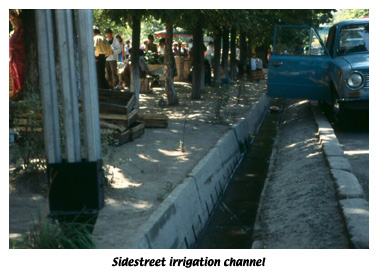
As mentioned, during World War II, the Soviets moved their heavy industry east. The cities of Akmolinsk, Karaganda, and Alma-Ata accommodated some of these plants which produced machinery used in agriculture, mining, and construction. There were also foundries that produced copper, aluminum, and ore bars for use elsewhere in the Union. Today these factories are still in use, but there are frequent shut downs due to lack of parts and managerial cadres. It is noteworthy that these plants create much pollution, but Kazakhstan's real sources of pollution are agricultural and atomic waste. The diversion of the waters of the Amu and Syr, especially the creation of the Kara Kum Canal, and irrigation canals off the rivers, has affected the level of the Aral Sea, transforming it into two relatively small pools. Chemical pesticides, originally used in the fields, appear as a crust on the exposed dry seabed. These substances are picked up by the wind and blown about, creating diverse health problems. Storage of radioactive or toxic chemical waste from the former defense industries and test ranges create a different set of environmental and health hazards. To this, industrial pollution, severe in some cities, must be added.
In the past, Kazakhstan was well known for its wool fabrics, cotton textiles, bags, leather boots, and colorful garments. Kazakhstan's food industry was known for butter, yogurt, and cheese. After the fall of the Soviet Union, cottage industries continued to grow, and Kazakhstan diversified most of its domestic industry. Because of its complexity, diversification of the international side of the economy has been a challenge, especially because of shifts in world demands for commodities, the unpredictability of stocks, and global competition. With the new reserves of oil entering Kazakhstan's future, there are calls for diverting some gas exports from the European to the Asian markets.
Among Kazakhstan's service industries banking is more developed than tourism. Independent Kazakhstan began with 100 banks (reduced from 200). Of these 84 were registered, six were state owned, and 20 were foreign. In 2000, Kazakhstan had 51 banks. Of those, 22 were foreign and the Turkish banks established the other 4.
Tourism is yet to be developed in Kazakhstan, a republic with a genuinely great potential for tourism. Landscape, health resorts, natural preserves, unique mountainous and forest oases, and archaeological and ethnographic relics are among the many attractions in the republic. Additionally, the republic is the birthplace of Abay Kunanbaev, Mukhtar Auezov, and Jambul Jabaev, each a national treasure with a museum to his name.
Kazakhstan's major exports include: fuel, oil products; ferrous metals; copper
and copper products; inorganic chemicals; cotton; precious and semiprecious
stones and other non-precious metals; zinc and zinc products; ores, slag and
cinders; and reactors and machinery. In 2000, there was a rise in the export
of minerals, food and engineering products; but a decline in the export of metallurgic,
chemical and textile products. Russia, Bermuda Islands, Virgin Islands, Italy,
China, Germany, Switzerland, the Netherlands, Ukraine, U.S.A., Uzbekistan, and
Great Britain are among the major importers of Kazakh products.
Kazakhstan's major export in 2000 is estimated at $8.8 billion, 10.5 billion in 2002. Kazakhstan's major imports include: machinery and parts, industrial materials, oil and gas, and vehicles. Kazakhstan's import partners are mostly from among its export partners with the addition of Turkey. Kazakhstan's total import for 2000 is estimated at $6.9 billion, 8.2 billion for 2001.
Kazakhstan's deficit for 2000 is estimated at $12.5 billion, 11.6 billion for 2001.
Between 1992 and 2000, Kazakhstan received $610 million from the United States and $409.6 million in economic aid.
Kazakhstan's currency is the Kazakhstani tenge equivalent to 100 tiyn.
In 2002. the rate of exchange for the tenge was 153.279
tenge per one US dollar.
Nearly one half of the population of Kazakhstan are Russian émigrés.
The establishment of trade relations between the two countries, therefore, is
easier than with most other states. No new funds are required for construction
of pipelines, rails, or roads, for instance. Additionally, as a legacy of the
Soviet economy, the Kazakh and Russian economies complement each other. Neither
are language and culture barriers keeping the populations of the two nations
apart. Besides, Russia can assist Kazakhstan, a member of the CIS, in security
matters, drug traffic, and acquisition of international prestige.
Kazakh transportation uses railway and paved and unpaved roads. Unpaved roads,
made of unstable earth, are difficult to negotiate in wet weather. The Syr and
Irtysh rivers are used as waterways. Gigantic pipelines and tankers (some foreign
owned) carry Kazakh crude to Russia and other countries of the former Soviet
Union and the EU. Kazakhstan has 28 airports with paved and 421 airports with
unpaved runways.
The Kazakh communication system is outdated. Nearly two million main telephone
lines use antiquated equipment and are serviced poorly. Connection to the republics
of the former Soviet Union and China are carried by landline and microwave radio
relay. Connection with other countries is by satellite and by the Trans-Asia-Europe
fiber-optic cable.
Before the influx of the Russians into Central Asia, the nomadic Kazakhs did
not have a system of health care. Living in fresh air and keeping up with the
herds kept them healthy. If they became sick, home remedies and the wisdom and
the experience of the tribal chiefs and the shaman were all they could look
to for surviving the disease. The Russians introduced new medicines and medical
technology whenever they came in contact with the tribes. When the Soviets took
over, they not only introduced a new system of health care but subsidized and
controlled it. During the Soviet period, Kazakhs developed a good system of
health care of their own with many hospitals, clinics, and medical institutions.
After the fall of the Union, the system was decentralized. Furthermore, as
various segments were privatized, various types of independent models of health
care emerged. The more the cost of private care increased, the more the state
reduced its contribution to the system.
Today, Kazakhstan’s hospitals are staffed by well-trained doctors, but
they lack modern technology and medicine. Additionally, shortage of funds has
made Kazakhstan dependent on Japan for medical equipment and on Japan, Austria,
and Portugal for medical training. Respiratory infections, tuberculosis and
cardiovascular diseases are widespread. HIV infections are on the rise as are
cancers and birth deformities caused by pollution and nuclear contamination.
Average life span in Kazakhstan is 64 years for men and 73 years for women.
More than a quarter of the population of Kazakhstan lives below the poverty
line, placing the Kazakh welfare system under financial stress. This burden
was carried by the Soviet system during the Soviet era when social welfare was
subsidized by the state, but that system does not exist any more. Today, independent
Kazakhstan provides many of the previous benefits including pension, social
insurance, and unemployment, as well as assistance for minimum wage, pensions
for the disabled, social benefits for orphans, the elderly and the infirm. To
generate social welfare funds, the republic applies the principle of self-financing.
Before the Soviet era only the sons of tribal chiefs received an education.
But the Soviets' implementation of free and universal education eliminated illiteracy.
Today, seventeen years of compulsory education are provided free of charge.
98% of Kazakhstanis above the age of fifteen are literate. Kazakhs are bilingual.
They speak Kazakh (their official language) and Russian. The Kazakh language
(also Qazaq), a Turkic language of the Uralic-Altaic branch, is spoken by over
40% of population. It has three dialects corresponding to the three hordes or
zhuzes mentioned earlier. A Kazakh literary language was established
at the end of the 19th century but Kazakhs continue to use Tatar as their spoken
language. Russian, also an official language, is spoken by two-thirds of population.
The Kazakh script has gone through the same changes that the scripts of the
other republics have undergone. From the end of 19th century to 1929, the Kazakhs
employed an Arabic-based script. Samples of this writing are preserved at the
library of the Academy of Sciences of Kazakhstan. Between 1929 and 1939 the
Latin script was introduced. Since 1939 the Cyrillic script has been modified
and used for daily needs. There was talk of a return to the Latin script, especially
during the early years after the fall of the Soviet Union, but that talk has
since subsided.
The Kazakhstanis, both Kazakh and Russian, are well educated. All those age
15 and over can read and write. In fact, 98% of the total population (99% male
and 96% female) are literate, a major contribution of the Soviet educational
system of available but limited education.
Institutes of higher education in Kazakhstan include the Kazakhstan Academy
of Sciences, the Al-Farabi State National University, and the Qaraghandy State
University. There are also numerous institutes providing instruction in economics,
civil engineering, and medicine.
Before the Revolution, Kazakhs lived in portable, nomadic tents or yurts
that could be put up and dismantled within an hour. During the Soviet era, those
families that were engaged in herding were allowed to keep their yurts.
Others, due to the promotion of kolkhoz and sovkhoz farms, and
industrialization, were forced to live in apartment blocks. These high-rises,
built on the same blue print, shared the same lines for water, electricity,
and garbage disposal. The apartments on the wings were spacious, in the center
small but efficient. Rather than the size of the family, the prestige of the
individual determined the type of housing assigned. And there was always a long
waiting list.
Today, with privatized housing, there are more choices. Heating and other utilities,
previously heavily subsidized by the government, are no longer subsidized. Neither
are enterprises responsible for managing housing services or maintaining related
utilities for their employees. The government provides the appropriate institutional
and regulatory framework for the transfer of services.
Unlike in the other republics where regionalism plays a major role in politics,
the population of the republic of Kazakhstan are Kazakhstanis first, Kazakhs
second. For its defense, Kazakhstan continues to depend on Russia, its political
partner. But to ensure stability, Kazakhstan has signed treaties with Iran,
Turkey, and China as well. Kazakhstan’s military consists of ground forces,
air and air defense forces, naval force, border service, and the republican
guard. The recruitment age for the military is 18. Kazakhstan’s available
military manpower is 4,580,754 of which 3,658,815 is fit for military service.
Kazakhstan’s annual military expenditure is $221.8 million
The long-standing boundary dispute between Kazakhstan and China has been resolved.
That means now both countries can control their borders better against the movement
of illegal drugs, as well as population control and trade. Similarly, the delimitation
with Kyrgyzstan is largely complete. The situation with regard to Russia and
Turkmenistan is somewhat more complex. No resolution is reached on the division
of the Caspian Seabed and the reserves beneath it.
Kazakhstan is located on the transit point for narcotics produced in Southwest
Asia and bound for the Russian and the European markets. There is a significant
illicit cultivation of cannabis for the CIS markets. A limited amount of opium
poppy and ephedra (for the production of drug ephedrine) are also cultivated.
There is little attempt by the government to eradicate the cultivation of illicit
crops.



See also:
Central Asia: An Overview
Azerbaijan: An Overview
Iran: A Concise Overview
Kazakhstan: An Overview
Kyrgyzstan: An Overview
Tajikistan: An Overview
Turkmenistan: An Overview
Uzbekstan: An Overview
Top of the page