|


| |
 The panoramic view from the top of the Sugar Loaf Mountain is the highlight of
any tour. Board a funicular to reach the summit with its 360º spectrum of golden beaches, green forests and a thriving metropolis that has earned Rio de Janeiro the title of the world's most beautiful city. The panoramic view from the top of the Sugar Loaf Mountain is the highlight of
any tour. Board a funicular to reach the summit with its 360º spectrum of golden beaches, green forests and a thriving metropolis that has earned Rio de Janeiro the title of the world's most beautiful city.

|
| To reach the top of Corcovado Hill, the train crosses the largest urban forest of the planet, Tijuca, also the first to be
replanted. |
| |
|
| Separating the South and North zones of the city, Tijuca is one of the most popular places for walking or bicycle riding, especially on weekends. |
| |
| But it hasn’t been always like this. In the eighteenth century the forest was devastated to give place to the coffee plantation. |
|
This jeopardized the city’s water distribution, forcing emperor Dom Pedro II to make a revolutionary decision in the year of 1881, the replanting of the area.

Major Manoel Gomes Archer was chosen to accomplish the task. Together with six slaves, he planted 60,000 trees during 13 years. The job was so well done that animals like monkeys, sloths, lizards, snakes, birds and butterflies returned to the forest, and can be seen by those who travel in the Corcovado train. It was due to the success of the replanting that Tijuca National Park was chosen as the symbol of Rio-92, the World Environmental Conference. |
 |
The Corcovado Railway was the first electric Brazilian railroad. Inaugurated in October 9th, 1884, it is older than the monument of Christ itself; it was the same train that, for four years carried the parts of the statue to be mounted at the top. |
 |
![[station]](../images/jpg/estationold.jpg) The trip starts at Cosme Velho Station, so old that it is now part of the Brazilian Historical Heritage. The trip starts at Cosme Velho Station, so old that it is now part of the Brazilian Historical Heritage.
|
|
The first famous passenger was Dom Pedro II, emperor of Brazil, who inaugurated the railway in October 9th, 1884. The train, steam powered at that time, was considered a miracle of engineering, climbing 3829 meters of steep incline.Today, to accomplish the ride with maximum safety, the railroad uses the Riggenbach system, in which a turning wheel runs over a third rail, thus moving the train. |
|
![[old]](../images/jpg/antiga1.jpg) After Dom Pedro II, many renowned visitors rode to the statue of Christ, like Vatican’s Secretary of Estate, Eugênio Pacelli, in 1934, who later became Pope Pius XII. After Dom Pedro II, many renowned visitors rode to the statue of Christ, like Vatican’s Secretary of Estate, Eugênio Pacelli, in 1934, who later became Pope Pius XII.
|
|
In 1910, steam trains were substituted for electric ones. After Dom Pedro II, many renowned visitors rode to the statue of Christ, like Vatican?s Secretary of Estate, Eugênio Pacelli, in 1934, who later became Pope Pius XII. |
|
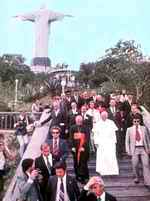 In 1980, it was Pope John Paul II’s turn, as well as Albert Einstein, King Albert of Belgium and Princess Diana. In 1980, it was Pope John Paul II’s turn, as well as Albert Einstein, King Albert of Belgium and Princess Diana.
|
|
The railroad was modernized and new, safer and more modern of trains were brought from Switzerland in 1979. Five years later, in 1984, Esfeco took over the Corcovado Train. |
|
Santos Dumont, the Brazilian Father of Aviation, was a frequent visitor. According to old train operators, he used to appear with his characteristic hat falling to one side, would give good tips and, from time to time, would ask to drive the train. Ex-presidents Getúlio Vargas and Epitácio Pessoa were also frequent passengers

|
Rio
Illustrated | |
|