A Very Simple Transmission
To understand the
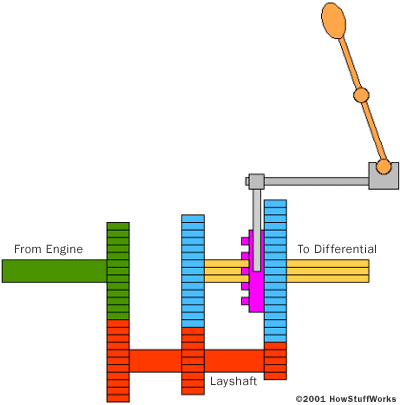
basic idea behind a standard transmission, the diagram below
shows a very simple two-speed transmission in neutral:
Let's look at each of the parts in this diagram to
understand how they fit together:
- The green shaft comes from the engine through the clutch.
The green shaft and green gear are connected as a single
unit. (The clutch is a device that lets you connect and
disconnect the engine and the transmission. When you push in
the clutch pedal, the engine and the transmission are
disconnected so the engine can run even if the car is
standing still. When you release the clutch pedal, the
engine and the green shaft are directly connected to one
another. The green shaft and gear turn at the same rpm as
the engine.)
- The red shaft and gears are called the layshaft.
These are also connected as a single piece, so all of the gears on
the layshaft and the layshaft itself spin as one unit. The
green shaft and the red shaft are directly connected through
their meshed gears so that if the green shaft is spinning,
so is the red shaft. In this way, the layshaft receives its
power directly from the engine
whenever the clutch is engaged.
- The yellow shaft is a splined shaft that connects
directly to the drive shaft through the differential
to the drive wheels of the car. If the wheels are spinning,
the yellow shaft is spinning.
- The blue gears ride on bearings, so they spin on the
yellow shaft. If the engine is off but the car is coasting,
the yellow shaft can turn inside the blue gears while the
blue gears and the layshaft are motionless.
- The purpose of the collar is to connect one of
the two blue gears to the yellow drive shaft. The collar is
connected, through the splines, directly to the yellow shaft
and spins with the yellow shaft. However, the collar can
slide left or right along the yellow shaft to engage either
of the blue gears. Teeth on the collar, called dog
teeth, fit into holes on the sides of the blue gears to
engage them.
The picture below shows how, when
shifted into first gear, the collar engages the blue gear on
the right:
|
In this picture, the green shaft from the engine turns the
layshaft, which turns the blue gear on the right. This gear
transmits its energy through the collar to drive the yellow
drive shaft. Meantime, the blue gear on the left is turning,
but it is freewheeling on its bearing so it has no effect on
the yellow shaft.
When the collar is between the two gears (as shown in the
first figure), the transmission is in neutral. Both of the
blue gears freewheel on the yellow shaft at the different
rates controlled by their ratios to the layshaft.
From this discussion, you can answer several questions:
- When you make a mistake while shifting and hear a
horrible grinding sound, you are not hearing the
sound of gear teeth mis-meshing. As you can see in these
diagrams, all gear teeth are all fully meshed at all times.
The grinding is the sound of the dog teeth trying
unsuccessfully to engage the holes in the side of a blue
gear.
- The transmission shown here does not have "synchros"
(discussed later in the article), so if you were using this
transmission you would have to double-clutch it.
Double-clutching was common in older cars and is still
common in some modern race
cars. In double-clutching, you first push the clutch
pedal in once to disengage the engine from the transmission.
This takes the pressure off the dog teeth so you can move
the collar into neutral. Then you release the clutch pedal
and rev the engine to the "right speed." The right speed is
the rpm value at which the engine should be running in the
next gear. The idea is to get the blue gear of the next gear
and the collar rotating at the same speed so that the dog
teeth can engage. Then you push the clutch pedal in again
and lock the collar into the new gear. At every gear change
you have to press and release the clutch twice, hence the
name "double-clutching."
- You can also see how a small linear motion in the gear
shift knob allows you to change gears. The gear shift knob
moves a rod connected to the fork. The fork slides the
collar on the yellow shaft to engage one of two gears.
In the next section, we'll take a look at a real
transmission.