 |
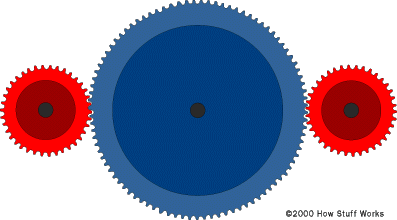
Or you can use two equal-sized gears if you want them to have opposite directions of rotation:
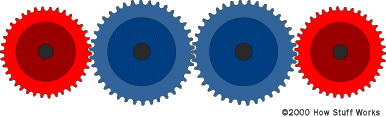 |
However, in both of these cases the extra gears are likely to be heavy and you need to create axles for them. In these cases, the common solution is to use either a chain or a toothed belt, as shown here:
 |
The advantages of chains and belts are light weight, the ability to separate the two gears by some distance, and the ability to connect many gears together on the same chain or belt. For example, in a car engine, the same toothed belt might engage the crankshaft, two camshafts and the alternator. If you had to use gears in place of the belt, it would be a lot harder.
 PREVIOUS |