Valve train
The valve train consists of the
valves and a mechanism that opens and closes them. The opening
and closing system is called a camshaft. The camshaft
has lobes on it that move the valves up and down, as shown in
Figure 5.
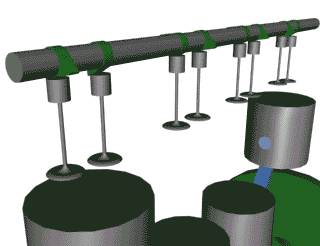
Most modern engines have what are called overhead cams. This means that the camshaft is located above the valves, as you see in Figure 5. The cams on the shaft activate the valves directly or through a very short linkage. Older engines used a camshaft located in the sump near the crankshaft. Rods linked the cam below to valve lifters above the valves. This approach has more moving parts and also causes more lag between the cam's activation of the valve and the valve's subsequent motion. A timing belt or timing chain links the crankshaft to the camshaft so that the valves are in sync with the pistons. The camshaft is geared to turn at one-half the rate of the crankshaft. Many high-performance engines have four valves per cylinder (two for intake, two for exhaust), and this arrangement requires two camshafts per bank of cylinders, hence the phrase "dual overhead cams."
See Camshafts for details.
Ignition system
The ignition system (Figure
6) produces a high-voltage electrical charge and transmits
it to the spark plugs via ignition wires. The charge
first flows to a distributor, which you can easily find
under the hood of most cars. The distributor has one wire
going in the center and four, six, or eight wires (depending
on the number of cylinders) coming out of it. These
ignition wires send the charge to each spark plug. The
engine is timed so that only one cylinder receives a spark
from the distributor at a time. This approach provides maximum
smoothness.
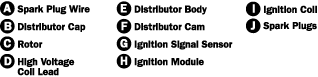 Figure 6. The ignitionsystem |
See Ignition Systems for more details.
Cooling system
The cooling system in most cars
consists of the radiator and water pump. Water circulates
through passages around the cylinders and then travels through
the radiator to cool it off. In a few cars (most notably
Volkswagen Beetles), as well as most motorcycles and lawn
mowers, the engine is air-cooled instead (You can tell an
air-cooled engine by the fins adorning the outside of each
cylinder to help dissipate heat.). Air-cooling makes the
engine lighter but hotter, generally decreasing engine life
and overall performance.
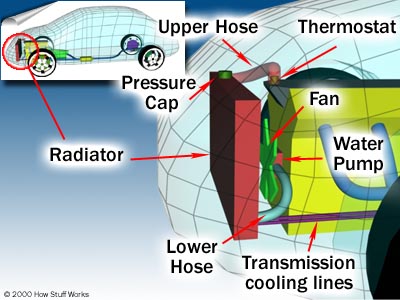 Diagram of a cooling system showing how all the plumbing is connected |
See Car Cooling Systems for details.
Air intake system
Most cars are normally
aspirated, which means that air flows through an air
filter and directly into the cylinders. High-performance
engines are either turbocharged or supercharged,
which means that air coming into the engine is first
pressurized (so that more air/fuel mixture can be squeezed
into each cylinder) to increase performance. The amount of
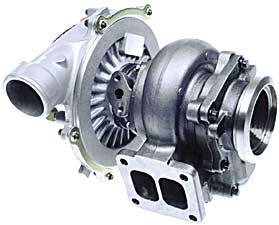
pressurization is called boost. A turbocharger
uses a small turbine attached to the exhaust pipe to spin a
compressing turbine in the incoming air stream. A supercharger
is attached directly to the engine to spin the compressor.
 |
See Turbochargers for details.
Starting system
The starting system consists of
an electric starter motor and a starter solenoid. When
you turn the ignition key, the starter motor spins the engine
a few revolutions so that the combustion process can start. It
takes a powerful motor to spin a cold engine. The starter
motor must overcome:
Lubrication system
The lubrication system makes
sure that every moving part in the engine gets oil so that it
can move easily. The two main parts needing oil are the
pistons (so they can slide easily in their cylinders) and any
bearings that allow things like the crankshaft and camshafts
to rotate freely. In most cars, oil is sucked out of the oil
pan by the oil pump, run through the oil filter to remove any
grit, and then squirted under high pressure onto bearings and
the cylinder walls. The oil then trickles down into the sump,
where it is collected again and the cycle repeats.
Fuel system
The fuel system pumps gas from the
gas tank and mixes it with air so that the proper air/fuel
mixture can flow into the cylinders. Fuel is delivered in
three common ways: carburetion, port fuel injection and direct
fuel injection.
Exhaust system
The exhaust system includes the
exhaust pipe and the muffler. Without a muffler, what you
would hear is the sound of thousands of small explosions
coming out your tailpipe. A muffler dampens the sound. The
exhaust system also includes a catalytic converter. See
Catalytic Converters for details.
Emission control system
The emission control
system in modern cars consists of a catalytic
converter, a collection of sensors and actuators, and a
computer to monitor and adjust everything. For example, the
catalytic converter uses a catalyst and oxygen to burn off any
unused fuel and certain other chemicals in the exhaust. An
oxygen sensor in the exhaust stream makes sure there is enough
oxygen available for the catalyst to work and adjusts things
if necessary.
Electrical system
The electrical system consists
of a battery and an alternator. The alternator
is connected to the engine by a belt and generates electricity
to recharge the battery. The battery
makes 12-volt power available to everything in the car needing
electricity (the ignition
system, radio,
headlights, windshield
wipers, power
windows and seats, computers,
etc.) through the vehicle's wiring.
 PREVIOUS |
 NEXT |