Front-wheel drive cars have electric fans because the engine is usually mounted transversely, meaning the output of the engine points toward the side of the car. The fans are controlled either with a thermostatic switch or by the engine computer, and they turn on when the temperature of the coolant goes above a set point. They turn back off when the temperature drops below that point.
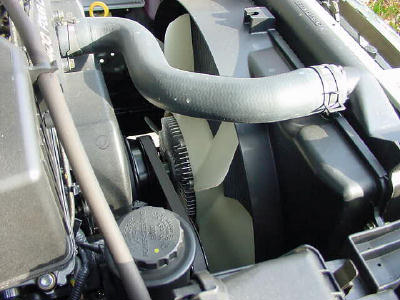 Cooling fan |
Rear-wheel drive cars with longitudinal engines usually have engine-driven cooling fans. These fans have a thermostatically controlled viscous clutch. This clutch is positioned at the hub of the fan, in the airflow coming through the radiator. This special viscous clutch is much like the viscous coupling sometimes found in all-wheel drive cars.
 PREVIOUS |
 NEXT |