
My Favorite Things About Gerbils
My Favorite Web sites for Gerbils
My friend's web site...a little sloppy like mine but carrys quite alot of pictures!
A very informative site. You will learn the behavior of gerbils and learn many other things in the meantime!

Introduction
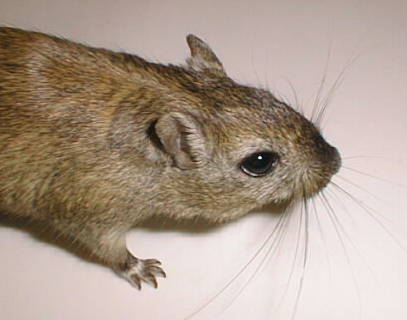
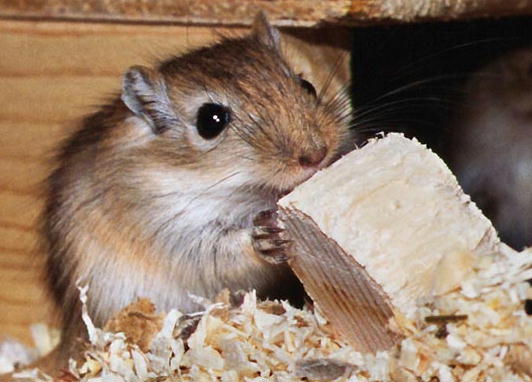
The Mongolian gerbil is a mammal that belongs to the order of the Rodentia (rodents) and to the family of Cricetidae. His Latin name is Meriones unguiculatus, this means clawed warrior. He is most related to the hamsters.
In Asia and Africa, many species of gerbils are found, especially in arid, barren and sandy steppe areas. In Northern-Africa, Russia, Iran, Turkey, Sri Lanka, India, North-China and Mongolia. The Mongolian Gerbil, of all gerbil species, is the most known and especially suitable as a pet.
The Mongolian steppe, where the Mongolian gerbil lives, is a biotope with harsh, extreme circumstances. Due to the fact that not many animals can live under such circumstances, the gerbil has not many natural enemies. To escape from enemies, such as birds of prey, the gerbil is able to jump very well. These jumping capabilities, which come also handy in escaping attacking gerbil rivals, are a result of the gerbils very strong hind legs.
Gerbils are talented diggers, they make very complicated subterranean networks, including tunnels, special storage- and nestrooms.
The strong hind legs are a good tool for digging. Gerbils dig the soil with their short, but strong front legs, and kick the earth out with their hind legs. The gerbil burrow system has more than one exit, this gives them more escape routes, in case a pursuer entered the burrow system. The tunnels are mostly dug near vegetation, in this way plant roots can support the tunnels.
Normally, there is one gerbil family living in a burrow system, but sometimes there is a co-operation between different families, especially when it comes to warning for danger. Gerbils usually stay near their burrow system, also when they are foraging.
Gerbils are typical desert animals. They can hear very well, are good in retaining water and are capable to store water in fat cell layers. They are very economic with water, they produce little urine, and their faeces is also very dry.
Unlike most desert animals, the Mongolian gerbil is not a characteristic nocturnal animal. During the hottest and coldest periods of the day, the gerbil stays in its burrow. By turns the gerbil undergoes periods of sleep and periods of activity. This cycle is being continued in captivity.
Another major positive to gerbils is that they are absolutely fearless. People have speculated that this may be due to a limited number of predators in their home environment or that nothing in their "pet" environment pushes their buttons. Since the animals are not afraid, they are generally easier to tame, and their response to new stimuli is generally to explore (they are very curious) or flee rather than to bite.
Gerbils are very tolerant and require little in the way of special care. One thing which should be mentioned is that many books claim that gerbils can absorb enough water from occasional feedings of lettuce or celery and that this can substitute for a water bottle. It is no substitute! You will need a bottle just as with every other type of rodent pet.
