Housing and Care

Housing is very important to any rodent pet you have.
One of the reasons rodents make such excellent pets is the minimal care required to keep one. You don't really need a whole lot and once you know the basics, all rodents are more or less the same in their needs. You'll need a cage or tank to keep the animals in, some type of bedding for them to nest in, food and water, anything special the particular animal needs, and some basic knowledge.
|

Cages
What type of cage is required depends on what type of pet you are interested in keeping. Most rodents are kept in one of three types of cages: aquariums, hamster environments, and wire cages. Each has its own advantages and disadvantages.
The first thing to keep in mind is size. My general rule is that an animal should have enough room in its home to run around and get up a reasonable head of steam without running into its food or nesting area. Rodents are also very fond of standing on their hind legs, particularly on top of whatever toys are in the cage, so any housing should be tall enough for the bedding, the standing animal, and a bit more. At some point, aquariums become too expensive, and if you are keeping something larger than a rat, you should consider a wire cage.
Aquariums are the most popular and in most cases are the cheapest and most sensible places for smaller rodents, particularly smaller species. The big advantage aquariums have is that they are completely contained. Many rodents will dig, sometimes constantly, and aquariums keep the litter in where wire cages are usually surrounded by tossed out wood chips and other bedding. The disadvantage of this, obviously, is that there is not quite as much air circulation, but as long as the animals are not over crowded, this should not be a problem. Glass aquariums are also resistant to gnawing, although the animals will usually dig out most of the (non-toxic) silicone cement that lines the joints--this means that an aquarium used for a small animal will no longer hold water. If you are going to use an aquarium, do yourself a favor and purchase a glass one, some rodents will frequently sit in a corner and dig against the wall, which will scratch a plexiglass or plastic aquarium. Expect to pay between $5-10 for a 10 gallon aquarium and between $10-20 for a cover. I would consider only 10 gallon and 20 gallon wide aquariums for housing animals. If you need more space than this, consider a cage.
 Hamster Environments such as Habitrail or S.A.M. are very popular, particularly with kids, but have many drawbacks. They are very expensive compared to similar sized aquariums. The tubes are too small for rats and larger animals (be careful, most animals are sold as juveniles, the rat that fits in your environment tube today won't tomorrow). They are also made of plastic, which makes them unsuitable for gerbils who will scratch the clear plastic sides incessantly quickly making it difficult or impossible to see through them. Gerbils will also gnaw a hole through the walls (probably at the tube connection) in anywhere from a month to a year depending on how quickly they catch on. Essentially, the only animals suitable for habitats are hamsters and mice. Adult mice can navigate the vertical tubes, although it takes them a while to learn how. The only caution with mice is that if a litter is born into a module without a water bottle and connected to a module with a water bottle only through a vertical tube, the juveniles will not be able to navigate the vertical tube and may die of thirst. However, modules, with the exception of "sky houses" etc. are usually connected with horizontal tubes and these present no difficulties. One very positive thing about the environments is that they usually come with a plastic wheel that does not have spokes, these are prefered to wire wheels with spokes, which can sometimes trap animals tails.
|
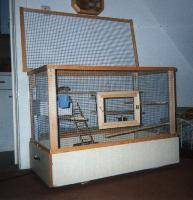
Wire Cages are the housing of choice for rats and larger animals and are pretty much self-explanatory. You need to be careful of three things in a selection of a cage. First, make sure the grate is small enough for the animals you are keeping. Rodents are very adept at escape, and if there is any question whatsoever, don't take chances--particularly if you are breeding. Second, many cages come with wire floors and these can irritate the feet of some rodents. Read up on your rodent and determine whether your choice of pet prefers a grate or solid floor (you can usually remove the floor grate or cover it in litter). Finally, if the cage has a plastic floor pan, make sure there are no exposed edges that would allow a gnawing animal to get a start on his or her way out. The major downside of a cage is that if there is litter (shavings, etc.) in the cage, the animals will probably toss it out on the floor. Cages have greater air flow, which is good for the animals. This also means that you will smell the cage a bit more because the odor can escape, but that the smell won't be as concentrated. Tanks generally smell less, but if you stick your snout in, you often figure out they're are much more in need of cleaning than you thought. In general, I would recommend that unless the rodent you wish to keep is too large for a tank (ie, a rat or chinchilla), don't purchase a wire cage. Building a cage is another matter entirely. If you have a basic wood or metal shop you can easily and very cheaply build a nice cage. Make sure the wood and metal screen (don't use window screening--it will trap wood dust) isn't toxic. A sheet metal floor is prefered because wood will soak up urine.
Bedding
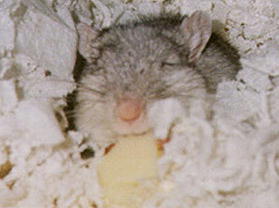
You will need to provide bedding or litter for the animals in order to provide them with some warmth and insulation, set them at ease, and absorb waste. This has generally been in the form of wood shavings, usually cedar. This was very very wrong. Do not use cedar for bedding for rodents. It contains some very strong oils, which provide the cedar scent that masks the smell of the cage. However, these volatile oils can also irritate the skin and eyes of many rodents and possibly even cause permanent damage or death. Some people say the same thing about pine shavings, which also contain some volatile oils. The current RC (rodentially correct) litter is either aspen chips/shavings which have no such oils or a reprocessed paper litter, most often Care-Fresh. I have found the animals prefer the aspen chips. I have found that Care-Fresh seems to absorb odors better. There are actually two types of reprocessed paper litters, one is in the form of chips that most closely resemble wood chips or shavings, the other in the form of pellets, closely resembling rabbit pellets (the food, not the...) You want the chip type. There are also plenty of folks who still use pine--if you do use it, let it air out for a while, especially if you buy it in the compressed "bricks" rather than in a loose bag. I have heard reported, but never seen, negative reactions to pine among rats and gerbils. I have seen irritation among Duprasi (fat-tailed gerbils).
Corn cob, often used for birds, isn't very absorbent and is hard for animals to make nests in because it shifts too much. You can also use shredded newspaper if it uses non-toxic ink. A lot of environmentally concerned newspapers will note this someplace, usually in the fine print next to the "recycled" symbol. This type of ink is usually found in smaller papers, particularly liberal oriented publications where using environmentally friendly products is a political priority or will increase readership. Most major dailies use old style inks. There are other caveats, if your rodent turns black from ink rubbing off, it really doesn't matter how non-toxic it is. You can also use unscented paper towels or toilet paper. None of these are as good at absorbing urine or controlling odors as any type of chip or commercial paper litter.
|
Basic Care
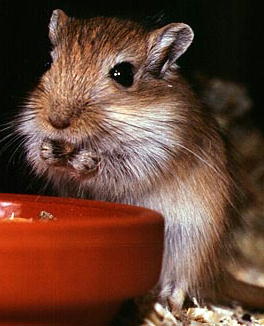
Daily Care: All pets, even small ones, require day to day care. You'll need to monitor their food and water intake. Even if they don't empty the bottle, change the water every few days. You wouldn't drink it, they feel the same way. You'll also need to make sure that they have enough food. And change the bedding once every week or so. This is a common sense sort of thing. About the same time the environment becomes too dirty for the animals it will become too smelly for your nose. Some animals will choose an area as a toilet and you'll be able to scoop out wet litter from here on a more frequent basis.
Taming: You'll want to handle the rodents on a daily basis if you want them to be friendly. When you handle, make sure your hands are clean. Strange smells can frighten some rodents, and other smells might convince them that you are something good to eat. When you first begin to tame animals, just put your hand in the cage and let them approach you. Don't make sudden moves or otherwise scare them. If that does not work put a treat for them in the middle of your palm. While they are eating the treat pet them and talk softly so it gets to recognize your voice better. After your pet has eaten let it roam from hand to hand for ten to fifteen minutes. People are frequently advised to pick up rodents by the base of their tails. You can do this with most rodents and its convenient for a lab or pet shop, but they aren't going to appreciate it and this is not going to calm their fears of you.
Bringing Home an Animal: When you first get an animal or animals, you want to set up the cage ahead of time and simply open the box the breeder or pet shop and put it in inside of the cage. Don't try to interact with the animal for the first day. Let it get used to its surroundings. It'll probably hide in its box for a while and then come out and look around, probably at night.
Adding an animal to an established colony, if this is possible, should not be too difficult. (Check the species information--male mice won't get along and hamsters don't get along with anything.) you always want to change the litter and clean the cage before you put an animal in. This is very important because it gives all the animals a neutral ground. Then spread some food around the cage, which will give them something to distract them from each other. Put the animals together and watch for any negative reactions. If they fight, separate them before they hurt each other and try again later. Don't worry if one is "left out" and sleeps alone, as long as they aren't actively fighting they will eventually be integrated into the colony.
|

