
Our group really had no clue how a biospere worked but after some extensive research, we felt confident enough to design a biosphere for ourselves. We looked from website to website and when we found the site for the Biosphere II in Oracle, Arizona we got a better understanding of how to design a biosphere.
Here is a design of the Biosphere II in Oracle, Arizona. 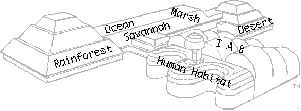
This appeared to be a great design because after all it was designed by experts. We did add a bit of modifications to the Biosphere II, mainly just more domes. The Biosphere II contained 6 biomes: a tropical forest, an ocean and corral reef, a savannah, a fresh water marsh, a desert, and an agricultural field. It also has a living habitat that has a computer control center, library, kitchen, dining room, gym, and private quarters.While ours on the other hand was a bit like the BIosphere II our contained 7 biomes: a temperate forest, tundra, grassland, tropical forest, taiga, desert, and an ocean. We also included the human habitat as well. We had two designs for a Biosphere one with 2 lungs and another with 4 lungs. We will discuss more about this later in the Fesibility report.
Design #1 To be honest agian, we really didn't know how much a Biosphere woule cost. At first guest we thought it might run up to maybe 10 million dollars but agian, after the research we were way off. We found out that the Biosphere II in Oracle, Arizona cost just about 200 million dollars. That's a lot of money if you think about it.
Biosphere II is a 139,935 square foot (3.15 acre) facility made of glass and spaceframe, the largest total enclosed ecosystem ever built. It contained soil, air, water, animals, and plants. About 4,000 plants and animals were introduced to Biosphere II, and the ocean contained 900,000 gallons of water. Biosphere Ii also had 750 sensors monitor the vital statistics of this living laboratory - the sensors measure temperature, light, humidity, carbon dioxide and other qualities of the air and soil. In response to these readings, operators can, for example, turn on blowers for cooling and heating or create a miniature rainstorm to change the humidity. Heating and cooling is provided by B2C's campus Energy Center.
When we considered the budget we need to think that since Biosphere II cost 200 million dollars and contained everything it did well ours needed to be a bit more expensive. We all thought that ours was going to be a bit biggier then Biosphere II because we had more domes to include in ours. So an estimate on price we figured that 250 million would be enough to support our biosphere.
[Mission]
[Understanding the Biomes of the Earth!!!][Our Design for a Dome and the Budget]
[Fesibility Report] [Resources]
Contact WebMasters:
Nick Ipapo
