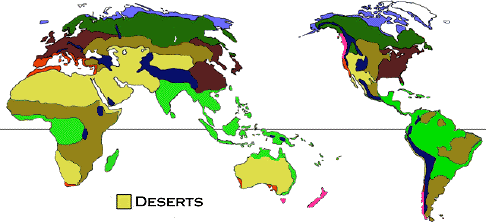
Deserts are places on earth that are characterized by little vegetation and rain. They are made up of sand or rocks and gravel. Deserts cover about one-fifth of all the land in the world. Most deserts lie along the Tropic of Cancer and Tropic of Capricorn, imaginary lines that lie north and south of the equator.
Oases are parts of the desert where plants grow and water is almost always available. An oasis is formed by a pool of water trapped between layers of rock beneath the desert floor. The regular water in an oasis allows people to settle in the desert and even grow crops.
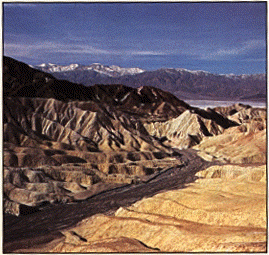
Some deserts are named and nicknamed things like Death Valley, "the empty quarter," and "the place from where there is no return" because of the lack of water there.
What is the weather like in the desert?
The desert is the hottest biome on earth. However, the desert is also a land of extremes. It can be over 100 degrees Farenheit during the day but below 32 degrees at night. This change is because deserts are bare. There is little protection to keep them from heating up in the sun and cooling off when the sun disappears at night.
The amount of rainfall also varies. Though there is little rain in a desert, when it does rain, it pours. Violent rainstorms can cause flashfloods in the desert. After a storm, the desert may not see any rain for weeks or months.
Does anything grow in the desert? There are some plants that are able to survive in the desert. They may have to go without fresh water for over a year! They also have to adjust to very hot days and very cold nights.
Some plants have very long roots which grow in to the ground to reach underground water sources. Some suck up as much water as they can during the rain and save it in their stems and leaves. Some store the food and water underground in thick roots.
Rain brings life to the desert. Shortly after a big storm, billions of seeds come to life in the form of flowering plants. These plants are called ephemerals. Eight weeks after a rain, the flowers are gone.
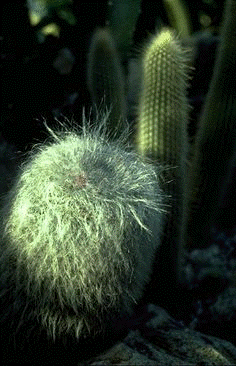
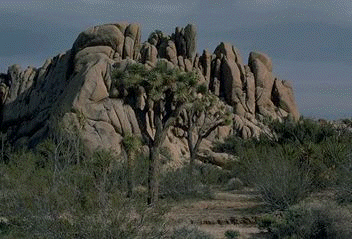
Cacti are the most well known desert plants. This old man cactus has a layer of hair that helps it to store water. The joshua tree is similar to a cactus. It belongs to the lily family.
Can animals survive the heat of the desert? There are hundreds of different animals that live in deserts. However, most of them can only be found at dawn or dusk because that is when they move around. For the rest of the day, animals bury themselves in the sand or hide beneath rocks to keep cool. Animals that come out at night are called nocturnal.
Animals in the desert eat plants and each other to survive. Many feed on the roots, stems, leaves, and seeds of plants. These animals are then eaten by bigger animals. Some animals get enough water from their food, but others must travel to water holes.
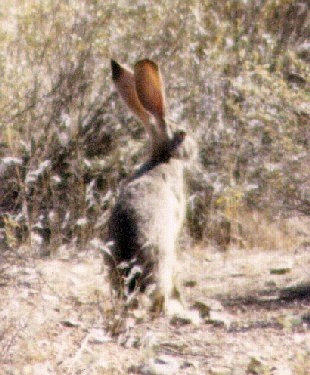
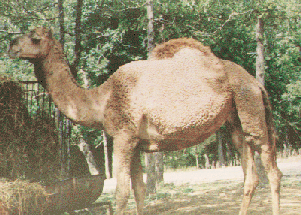
The desert jack rabbit eats plants, such as the cactus. It is very careful to avoid the prickly spines! Its ears pick up any sound of danger. They also help keep the rabbit cool because heat can escape through the tiny blood vessels that are found there. Camels are the most well known desert animals. They are sometimes called "the ship of the desert" because they can cross the desert better than any other animal. Camels have bushy eyebrows and two rows of eyelashes to keep the sand out of their eyes. Their nostrils can also be closed. The humps on camels' backs do not hold water as commonly believed. Instead they store fat reserves that can be broken down into food when crossing the desert. The hump will shrink if a camel is starving.
Desert Facts
The Gobi Desert in Asia is cold for most of the year. Mountains on the edge of deserts prevent rain from entering. The rain stays on the other side of the mountain creating rain forests next to many deserts. These deserts are called rain shadows. The world's deserts are growing through desertification. This happens when grasslands that border the desert become as dry as the desert. Desertification can also be caused by intense farming. Deserts are second only to tropical rain forests in the variety of plants and animals that live there.
Back to Biomes
[Mission]
[Understanding the Biomes of the Earth!!!][Our Design for a Dome and the Budget]
[Fesibility Report] [Resources]
Contact WebMasters:
Nick Ipapo