Introduction -
Computers, Programs and Generations
After completing this lesson you should be able to:
- define what is meant by a computer
- define what is meant by a computer program
- briefly describe the development of computer
languages
- sketch a simple model of a computer program and
its environment
- explain how data differs from information
If you are new to computing or computer program or
this is the first time you have used this lesson then
you should start with the first topic and follow the
suggested order. This lesson introduces some basic
concepts which will be useful when it comes to dealing
with some of the later topics.
When you have finished the lesson you will find some
Questions to do. These will help you to assess how much
you have learned.
What is a computer?
Since the objective of this course is to learn how to
design 3GL programs it might be helpful to try to
understand what is meant by some of the terms used. For
instance what is a computer, what is a computer program
and what is a generation in the computer programming
language sense?
A computer is a machine, probably the most complex
machine yet devised by man. If I were to define a
computer I might say that:
 | A computer has input and output circuitry. |
| A computer has a central processing unit for
carrying out arithmetical and logical operations. |
| A computer has memory for the storage of programs
and data. |
| A computer can execute sequences of instructions.
|
What is a computer program?
If you look at the computer definition in reverse order
- starting with "A computer can execute sequences of
instructions" - you have a definition of a computer
program - it is a sequence of instructions which the CPU
interprets as arithmetical and logical operations. A
computer program is stored in memory and also consists
of data and instructions. The input-output circuits
(I/O) enable the machine to transfer data between the
machine and the external world.
Instructions and programs imply that there is some order
in what the computer does, that is, there is an element
of design. A program designer determines what
instructions and data structures are required in order
to get the machine, the computer, to complete some given
task. Most significantly the designer determines the
sequence in which the instructions will be carried out
(executed) in order to successfully complete the
program.
We have some idea of what a computer is and what a
computer program is, what about generations of
languages?
The generations of computer languages

The notion of generation implies growth and Figure 1
depicts the growth in computer languages since the
1940's. This figure is not meant to be exact, just to
give some idea of the times that the different
generations appeared, time scales and the relativity of
computer languages to each other and the world of
problem-solving.
The vertical axis represents problem-definition in
computer terms; in other words it represents how we
state or write computer programs. At the bottom of the
scale is the machine-oriented definition. This means
that a computer program is stated in a language which is
closer to the native language of the computer than it is
to the native language of the program designers - you
and me. At the top of this axis is the human-oriented
problem definition. This means that the problem
definition - the computer program - is stated in terms
that are closer to the language of the designer than the
language of the machine. This obviously is the preferred
way of programming.
The machine understands problems stated in terms of 1's
and 0's, for example:
101011110001010001000101111010010101010
but humans prefer to state problems in a human language,
like this:
ADD this week's total to last weeks
The horizontal axis of Figure 1 shows time and
represents the approximate time at which a given
generation of computer language came into use and the
period over which the language generation was or is in
use.
Keep in mind that this figure is an approximation and
just because it shows 3GL's finishing in the late 1980's
it doesn't mean that 3GL's are no longer used. If only
life was so simple! In practice there are no
well-defined leaps from one generation to another and no
well-defined times when one generation comes into
general use. You could look into almost any significant
programming project and probably find that there may be
three generations of computer language being used at the
same time. It is quite common to find projects that use
some assembly language, some 3GL and some 4GL.
The later generations of computer language enable
program designers and programmers to write programs
which use approximations to human language.
A computer program model
Since a computer program is a sequence of instructions
which operate on data we can show this in a simple
model:
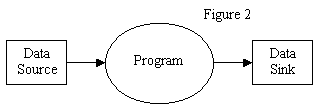
The model implies that the program processes data which
comes from a source and goes to a destination - the data
sink. Although it isn't always the case, in larger
programs and programming systems the source and sink are
usually external to the program. A data source will be
an input or storage device like a keyboard, disk drive,
scanner, tape drive, a data sink will be an output or
storage device like a computer screen, printer, disk
drive, tape drive, plotter etc.
Data and information
The last topic in this section is a brief explanation of
the terms data and information. These terms tend to be
used interchangeably but should not be, even "reliable"
dictionaries tend to use data as a synonym for
information. Data represents a value which in the
absence of a context has no specific meaning.
Information is data with meaning. For example, assume we
have the list of numbers: 24.56, 11.94, 27.23, 40.11
What do they mean? The meaning of the numbers depends on
the context in which they are used. They might represent
average temperatures in a room, or hourly payrates in a
small business. The numbers might be stored on a disk
drive and it would be possible to write a computer
program which read the numbers from the disk drive - the
data source - and treated them as temperatures. Another
program could read the same numbers and treat them as
dollar values. The program determines the context.
Summary
In this lesson you were introduced to some basic
concepts which will helpful in understanding the later
lessons. You should now be able to define what is meant
by the terms computer and computer program, you should
have some idea of how computer languages have developed,
and you should have some undestanding of how data and
information differ.
|