
 |
 |
 |
 |
 |
 |
 |
 |
 |
 |
Meet Elena the Zebra!
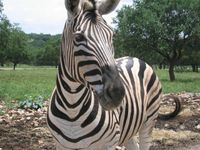
Naaaayyyy! Nice to Meet You!
Name: Elena
Age: 4
Likes to Eat: Grass
Place of Origin: Africa
Zebras are members of the horse family, native to central and southern Africa. All have vividly contrasting black and white vertical stripes (hence the zebra crossing named after it) on the forequarters, often tending towards the horizontal at the rear of the animal. Originally, most zoologists assumed that the stripes acted as a camouflage mechanism, while others believed them to play a role in social interactions, with slight variations of the pattern allowing the animals to distinguish between individuals. A more recent theory, supported by experiment, posits that the disruptive coloration is an effective means of confusing the visual system of the blood-sucking tsetse fly.
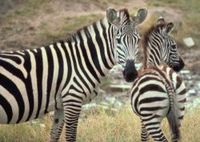 A zebra can travel at a top speed of fifty-five kilometres per hour, slower than a horse. However, it has much greater stamina. During the course of a day the plains zebra can walk around forty kilometres (from its herd, and back again in the evening)
There are three species and many subspecies. Zebra populations vary a great deal, and the relationships between and the taxonomic status of several of the subspecies are unclear.
The Plains Zebra (Equus quagga, formerly Equus burchelli) is the most common, and has or had about five subspecies distributed across much of southern and eastern Africa. It, or particular subspecies of it, have also been known as the Common Zebra, the Dauw, Burchell's Zebra (actually the extinct subspecies, Equus quagga burchelli), and the Quagga (another extinct subspecies, Equus quagga quagga).
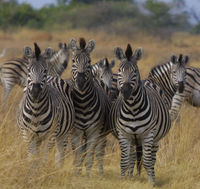 The Mountain Zebra (Equus zebra) of southwest Africa tends to have a sleek coat with a white belly and narrower stripes than the Plains Zebra. It has two subspecies and is classified as endangered.
