INTRODUCTION
By 1787, the new government of the United States proved to be weak. It was based on the Articles of Confederation. People such as Washington, Madison and Hamilton knew that the government would not survive unless there was a strong central government and more cooperation among the states. Although a committee was formed for the sole purpose of reviving the Articles of Confederation, the delegates knew that it would never work out. A majority of the delegates decided to scrap the Articles and draft a new constitution. Of the 55 original delegates, 42 remained and of these 42 only 39 agreed to sign it.
The men who drew up this Constitution drew on many philosophies of government, including the idea from Aristotle that people should rule the government. This Federal Convention of 1787 was a remarkable gathering of some of the most important men in the history of that era. George Washington was elected president of the Convention. Benjamin Franklin at age 81 was the oldest. John Adams and Thomas Jefferson were abroad at the time and were not present. Washington and a half dozen other delegates had been military leaders during the Revolutionary War. Five had been or were still governors of their states. Nearly all of these men had important offices of one sort or another. Forty of the 55 had been in Congress. These delegates relied greatly on their past experiences. They often disagreed on details, but they were united in wanting a government which would be strong enough to rule the new nation. Each of these men came to Philadelphia with their own set of values and managed to produce a document that is still in effect over 200 years later. The study of these men is as informative as the document itself and enables one to get an up-close and personal view of the convention and the document that was produced.
This book is designed to acquaint young citizens with the lives of the men who wrote our Constitution. Part Two of this workbook is Rights, Camera, Action which acquaints them with the Bill of Rights and our legal system. All of the activities were developed to enable students to think about the Constitution and Bill of Rights not just to read about it.
SAMPLE PAGE

|
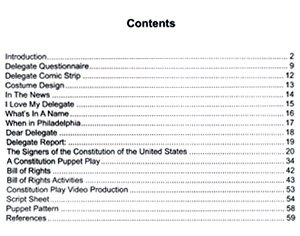
TABLE OF CONTENTS
SAMPLE PAGE
SAMPLE PAGE
|