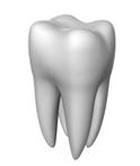
The visible part of a tooth, otherwise known as the crown, is only a small portion of the living system. The crown is made up of enamel, the hardest substance found within the body. It is bone that has been enriched with large percentages of calcium. That's why people who drink lots of milk or take calcium supplements have strong bones and teeth. The enamel is thickest at the crown, and thinnest near the roots of the teeth. Your teeth are by far one of the most important things you use every day. Many people end up neglecting their teeth with improper oral hygiene. You should take care of them by brushing at least twice a day, flossing once per day, and going for regular dental checkups at least twice per year. New developments include the implantation of artificial teeth or binding posts into the gums or jawbone; antibiotic fiber for periodontal disease; root canal surgery, a procedure that ameliorates pain while permitting teeth to remain in place; and nearly painless lasers to repair dental cavities, usually making local anesthesia unnecessary.
If you a space from a missing tooth, a bridge will be custom made to fill in the space with a false tooth. The false tooth is attached by the bridge to the two other teeth around the space - bridging them together. Your cosmetic dentist will prepare your teeth on either side of the space for the false tooth. You will be given a mild anesthetic to numb the area, and the cosmetic dentist will remove the an area of each abutment (teeth on either side of the space) to accommodate for the thickness of the crown. When these teeth already have fillings, part of the filling may be left in place to help as a foundation for the crown. Your cosmetic dentist may have you use a Flipper appliance. A Flipper is a false tooth to temporarily take the place of a missing tooth before the permanent bridge is placed. A Flipper can be attached via either a wire or a plastic piece that fits in the roof of your mouth. Flippers are meant to be a temporary solution while awaiting the permanent bridge.
For individuals who have chipped, cracked or irregularly shaped teeth, dental contouring and reshaping can be just the ticket for a more beautiful smile. Tooth reshaping, or contouring, is one of few instant treatments now available in cosmetic dentistry. Dental reshaping and contouring is a procedure to correct crooked teeth, chipped teeth, cracked teeth or even overlapping teeth in just one session. The dental contouring procedure can even be a substitute for braces under certain circumstances. It is also a procedure of subtle changes. A few millimeters of reduction and a few millimeters of tooth-colored laminate can create a beautiful smile when performed by a cosmetic dentist, with no discomfort to you. Tooth reshaping, or dental contouring, is commonly used to alter the length, shape or position of your teeth.

Terms and definitions on this pageDental fillings
- Dental fillings are inserted as restorations in the treatment of dental cavities, after drilling out the cavities.
Dental implants
- Dental implants are surgically fixed substitutes for roots of missing teeth. Embedded in the jawbone, they act as anchors for a replacement tooth, also known as a crown, or a full set of replacement teeth.
Dentures
- Removable complete dentures are full-mouth false teeth, which are used when a patient has no teeth left on either the mandibular arch, the maxillary arch, or both.
Veneer
- A layer of tooth-colored material, usually porcelain or acrylic resin, attached to and covering the surface of a metal crown or natural tooth structure.
Anesthesia
- Total or partial loss of sensation, especially tactile sensibility, induced by disease, injury, acupuncture, or an anesthetic, such as chloroform or nitrous oxide.
- Local or general insensibility to pain with or without the loss of consciousness, induced by an anesthetic.
- A drug, administered for medical or surgical purposes, that induces partial or total loss of sensation and may be topical, local, regional, or general, depending on the method of administration and area of the body affected.
Bridge
- A dental bridge is a prosthesis used in place of missing teeth and may be removable or permanently attached.
Dental cavities
- The formation of cavities in the teeth by the action of bacteria; tooth decay.
- Also known colloquially as tooth decay.
Dental crown
- Full-coverage restoration (sometimes incorrectly called a cap) is a prosthetic tooth designed by a dentist and usually created by a lab technician.
Porcelain
- A hard, white, translucent ceramic made by firing a pure clay and then glazing it with variously colored fusible materials.
Stomatology
- The medical study of the mouth and its diseases.
Tooth bleaching
- Also known as tooth whitening.
|


