
Long Meg and Her Daughters
Nobody could remember a more terrifying thunderstorm. Locals shook
their heads and blamed it on Colonel Lacy's workmen for attempting to remove the old
Druidic stone circle by blasting. You never knew what might happen when you started
interfering with such things. Some talked about the thunder and lightning being the anger
of the old pagan gods. Of course, that was just heathen superstition, others said, not to
be believed in by God-fearing Christians. But, anyway, it was true that Lacy's workmen had
fled in blind terror from the circle and could not be induced to return.
This is just one of the many stories about Long Meg and Her Daughters, a stone circle at
Little Salkeld, Cumbria. It can be found in the lovely Eden Valley between Penrith and
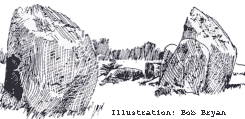
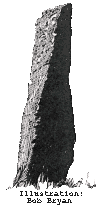
Lazonby. Long Meg is a 12-ft. high stone standing outside and overlooking a large circle
of some 66 smaller stones which are the Daughters. |
 |
According to one popular legend, a coven of witches holding their Sabbat were turned to
stone by the wizard Michael Scot in the 13th century. Another version of the same story
tells how the witches chose this place for their 'infernal dances' and were turned into
pillars of stone by the prayers of a saint. |
In common with many other stone circles is the belief that the exact number of stones
cannot be accurately counted. One story says that if anyone can count them twice and
arrive at the same number, then the enchantment will be broken. There is also a tradition
that if Long Meg itself is ever broken, the stone will run with blood.
'When I first saw this monument, as I came upon it by
surprise, I might overrate its importance as an object; though it would not bear
comparison with Stonehenge,' wrote William Wordsworth from nearby Dove Cottage, Grasmere,
at the beginning of the 19th century. 'I must say I have not seen any other relic of those
dark ages which can pretend to rival it in singularity and dignity of appearance.'
No one can say with any certainty who erected the megaliths
or for what purpose. Their very age precludes the popular claim that they were built by
the Druids. And, in fact, it has been pointed out that the Druids held their religious
rites in forest groves. (Like Long Meg and Her Daughters, most circles are to be found in
exposed locations.) |
 |
One suggestion is that in a primitive agrarian society they were a sort of astronomical
calendar to predict seasonal changes. The sun can be seen at a particular position in
relation to the stones at various times of the year. Long Meg, for instance, throws its
shadow to the farthest perimeter of the large circle (the Daughters) at midwinter sunset.
Another theory, much favoured at present, involves
earth-energy. Dowsers say they can discern underground energy travelling along ley-lines
between stone circles. Some people claim the circles were built as a kind of access point
with megaliths like acupuncture needles on the energy meridians. |
The romantic Wordsworth would probably have been fascinated by such theories which add to
the 'singularity' and 'dignity' of the stones. He expressed in the following lines the
aura of mystery surrounding Long Meg and Her Daughters: |
********
Copyright © Peter Bayliss
View My Guestbook
 Sign My Guestbook
Website Copyright © 1997 by
Peter Bayliss. All rights reserved.
|


