| 
The Faerie
Lady of Llyny Fan Fach
In a strange old volume called The Physicians of Myddfai can be
found some curious prescriptions that sound more like charms from a medieval grimoire or
spell-book than healing remedies. But the story of how it came into existence is even
stranger. The contents were reputedly handed down through generations of Myddfai
physicians from the secret wisdom imparted by the faerie lady of Llyny Fan Fach.
Myddfai is a small village in the desolate hills of
north Carmarthenshire, not far from which there is a reputedly bottomless lake called
Llyny Fan Fach. Legend says that near this lake there once lived a peasant woman and her
son, Rhiwallon, who worked hard for their living on a small mountain farm. One of the
young man's jobs was to look after the cattle as they grazed on the hillside.
It was a hot summer day, and feeling very tired and drowsy, Rhiwallon left his cattle and
sat down on a favourite stone by the edge of the lake. He soon drifted off to sleep, but
when he was awakened a little while later by the lowing of his cattle, he was astonished
to see a beautiful lady standing in the middle of the lake. According to the story, the
young man tried to entice the lady to come to him by offering her some of his barley
bread.
"Hard baked is thy bread!" she cried.
"'Tis not easy to catch me."
The next day, he returned with some unbaked dough.
"Moist is thy bread," was the reply. "I do not want thee."
On the third day, he took some lightly baked bread,
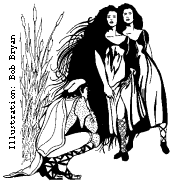
which the lady accepted. She disappeared below the surface of the lake, reappearing a
moment later with her father and an identical twin sister.
|
The old man said he'd consent to a marriage between the farmer and his daughter if the
young man could distinguish between the two sisters. He could not tell at first, which of
the ladies had appeared to him before. But then one of the sisters thrust her foot forward
and he recognised the particular way she had laced her sandals.
"I am the faerie Lord of Llyny Fan Fach," said
the old man, "and there is only one condition on which I'll let my daughter marry a
mortal. If you strike her three times without cause, she leaves you and returns here to
me." |
 |
| As a wedding present, he gave the young farmer some of the best
cattle out of his ghostly herd, and the creatures came dripping up out of the lake. So the
young man and the faerie lady of the Lake were married and lived happily together for many
years. The farm became very prosperous, and the young couple bore three sons. The
possibility of Rhiwallon ever striking his wife three times without cause - the old man's
condition for letting his daughter marry - seemed too remote to be even worth considering.
The farmer adored his beautiful faerie lady. |
Then one spring, the couple was
invited to a christening party. Rhiwallon was anxious to get back to the farm after the
service was over. In order to summon his wife, who was talking with the other guests, he
tapped her lightly on the shoulder with his glove. She looked at him reproachfully and
said, "Beware, Rhiwallon, beware! A christening-time is a beginning. But this is a
beginning of our grief. This is the first time that you've struck me without cause."
The young man was very alarmed at this, and vowed it
would never happen again. If such a harmless blow had such an effect on her, he would have
to be very careful in future.
The next year, the couple was invited to a
wedding. At the height of the celebrations, the farmer's wife suddenly burst into tears.
As a faerie, she had second sight and could foresee all the troubles and difficulties that
lay in store for the newly married pair. Rhiwallon was embarrassed and tried to get her to
control herself. He tapped her lightly on the arm with his glove. "Stop crying, dear!
This is supposed to be a happy occasion. Don't ruin everything."
She looked at him sadly. "Today is a sad day both
for them and for us," she said. "It's the beginning of their troubles, and it's
the confirmation of ours. That's the second time you've struck me without cause."
Rhiwallon was dumbfounded, suddenly remembering what had
happened the previous year at the christening. Once more, he vowed to be very careful with
her. It would never happen again, he said.
A neighbour died a few years later and the farmer
and his wife attended the funeral. In the middle of all the grieving, people were aghast
to see Rhiwallon's wife suddenly burst out laughing. Her faerie nature told her this was
really a happy time since all the dead man's troubles were over. But her husband was
deeply shocked. He looked at her with a fierce frown, but she couldn't cease her laughter.
Tapping her arm to make her stop, he said, "Please don't laugh, my dear. This is a
very sad day for everyone."
She looked back at him. "This is indeed a sad day,
for us as well as for them. I was laughing for the dead man because all his troubles are
at an end. And so is our marriage. That was the third time you've struck me without cause.
And so I have to go back to my father and to Llyny Fan Fach."
Returning to the farm, the faerie lady called her
cattle by name. They all came, even the little black calf that had just been slaughtered
and was hanging from a hook in the cool-house:
"Hump-brindled, rump-brindled, white-freckled,
Old white-faced, and grey squint-eye,
With the white bull from the king's court
And the little black calf which is on the hook,
Do thou also come home quite sound." |
With the other cattle also came
four oxen, which were in the middle of ploughing, and the furrow they were cutting can
still be seen. They all followed their mistress back to Llyny Fan Fach, where they
disappeared below the surface of the Lake.
Rhiwallon never saw his beautiful faerie wife
again. But their three sons, who were watching by the Lake one night, saw their mother
emerge from the water and glide towards them. "Your work, my sons, is to become great
physicians," she said. "You will heal all those who suffer ill-health. I will
tell you of the healing herbs, and I will guide your footsteps to the places where they
grow." And so, following their faerie mother's mysterious form, Rhiwallon's sons
climbed the mountainsides and collected herbs to heal the sick.
In time the three young men became very skilful and
reports of their healing powers spread throughout the land. The knowledge which they
gained was passed on in turn to their own sons, and so for many generations the skill was
kept in the family. The last descendant is said to have died in the 19th-century, but the
prescriptions were all written down in The Physicians of Myddfai, where they can still be
seen today.
The story of the faerie lady of Llyny Fan Fach,
like many other ancient tales, is a mixture of pagan and Christian ideas, which has
evolved throughout the centuries. It is interesting to observe how the concept of bread
being offered, as in the Eucharist, comes into the first part of the tale. The idea of the
bread being too hard or too soft is difficult to interpret, except that faerie-folk would
supposedly be more sensitive in their tastes than mortals.
A Biblical allusion can also be seen in the notion of
walking on the water, as when Rhiwallon first saw his faerie lady standing in the middle
of the lake. Then there is the idea of the miraculous cures of the Myddfai physicians,
passed down through generations, then written in a book.
The affair of the faerie Lord`s injunction about
Rhiwallon not striking his wife without cause can be seen as an ironic comment on the
brutality of husbands to their wives. Many marriages were wrecked (and still are) by
physical violence on the man's part. When a woman walks out on her spouse, a supernatural
explanation might be offered by the husband for her disappearance, especially if the man
pleaded his innocence by saying he only tapped his wife lightly. Of course, her
disappearance might have a more sinister explanation, in which case such stories could
also cover up the truth.
In our secular age, it is sometimes easy to forget how
people in the past accepted the supernatural as part of their everyday lives. Envious
neighbours would explain the success of Rhiwallon's farm by making up the story of his
faerie wife and her cattle. In the same way, the success of the Myddfai physicians could
be explained.
After his wife disappeared, tradition tells of how
Rhiwallon used to sit on his favourite stone by the edge of the lake. He would look out
forlornly over the water, hoping his beautiful faerie lady of Llyny Fan Fach would come
back to him.
********
Copyright ©
Peter Bayliss
View My Guestbook
 Sign My Guestbook
Website Copyright © 1997 by
Peter Bayliss. All rights reserved.
|


