
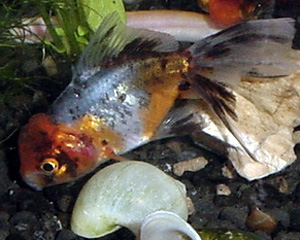
Symptoms: tiny white-green or red worms attached to wound on fish, goldfish may scrape against objects to get the worms off.
These parasites will appear as tiny worms, trailing from a wound on the fish. Most commonly found at the base of the fins. Anchor Worms are contagious and should be treated immediately. When an Anchor Worm leaves its host, it may also leave an ulcer.
Constipation
If your fish is having trouble passing feces, or if they are constantly trailing behind a fish, your fish has constipation. This is often caused by a diet without enough variety, or by feeding too many starchy foods.
This problem is easily solved by feeding your fish a diet with more variety and roughage. Some suggestions are live foods, peas, spinach, and tubifex worms. Enticing your fish to swallow one grain of Epsom salt is also said to be beneficial.
It is also advised that dry fishfood be soaked in water until it is soft before feeding it to your goldfish. This helps in digestion, and also reduces the likelihood of constipation.
The problem should clear up in a day or two. If it does not, you are advised to contact a vet or pet expert for further instruction.
Childodinella
Childodinella is an external parasite causing the fish to secrete excess mucous, resulting in the apperance of a blueish-white film on the body of the fish. In severe conditions the skin peels off, gills are damaged and the fish dies. Gills are usually attacked first and teh symptoms of oxygen starvation are noted.
Dropsy
Symptoms: Fish's abdomen becomes unusually large and swollen, scales may stick out Dropsy is not, in itself, a specific disease, but rather refers to a condition where the fish's abdomen becomes swollen. A sudden swelling of the abdomen (scales may stick out) is known as acute dropsy while a slow swelling of the abdomen is known as chronic dropsy. The actual cause of this swelling could be indicitive of any one of several conditions:
Acute Dropsy - septicemia: Internal bacterial infection can cause internal bleeding and thus cause acute dropsy. (See septicemia).
Chronic Dropsy - cancer: In this case, the abdomen is slow to swell as the cancer affects the fish's internal organs. If the fish is not isolated in the early stages of the disease, it could spread to other fish.
Chronic Dropsy - parasites: Internal parasites can cause dropsy (abdominal swelling) either because they are very large, or because of the damage they are causing to a fish's organs. The abdomen tends to swell gradually if the fish has internal parasites. Isolating the fish helps prevent the spread of the condition.
Other Dropsy: There are other less common causes for both acute and chronic dropsy, and not all causes are known. Your vet will provide additional details.
Goldfish are said to be somewhat more prone to dropsy than other fish.
Finrot
Symptoms: ragged fins, white 'edge' on fins Most common in the fancy varieties of goldfish, finrot can occur as a result of an injury, as a secondary infection once the fish has been weakened by another disease, or in some cases, as a primary infection (bacterial).
Finrot can be the result of a bacterial infection (which causes a more ragged rotting), or as a fungal infection (which rots the tail more evenly and is more likely to produce a white 'edge'). Sometimes, both types of infection are seen together. Infection is commonly brought on by bad water conditions, injury, poor diet, or outwintering fancy goldfish (who should live in warmer temperatures).
Finrot starts at the edge of the fins, and destroys more and more tissue until it reaches the fin base. If it does reach the fin base, the fish will never be able to regenerate the lost tissue. At this point, the disease may attack the fish's body directly.
Fish Lice
Symptoms: goldfish may scrape against objects to get the lice off, parasites of up to 1/4 inch may be visible, attached to the fish's body These parasites are a kind of crustacean which are capable of swimming from fish to fish. It appears as a very flat, round, transleucent louse. It punctures the fish's skin with a poisonous proboscis spine as it holds fast to the fish with its suckers
The female louse will lay her eggs on the tank bottom or on tank decorations in straight lines where she coats them with a jelly-like substance. There they stay until they are ready to hatch.
Gill Flukes
Symptoms: Fish gasps for air at the water's surface, gills open and close rapidly, gills are covered in mucus, part of gills may be eaten away, goldfish may scrape against objects to get the flukes off These parasites will appear as tiny worms, but are very difficult to see. Gill Flukes are contagious and should be treated immediately. Gill Fluke eggs are resistant to medications, but the larvae and adults are susceptible.
Ich
Symptoms: body and/or fins are covered with tiny white dots, rapid gill movements possible in late stages Ich is one of the more common afflictions of goldfish. Left untreated, it can be fatal to your fish, and because treatment takes many days to work, every moment counts. Ich is highly contageous.
The disease is easy to spot. The white dots are small and sometimes numerous, about a millimeter each. They are easiest to see on the fish's transparent fins. When on the fish, medications have no affect on Ich. As the parasite grows, however, it will eventually drop off the fish to reproduce. At the bottom of the tank, it will form a cyst (also resistant to medications) and soon hatch into hundreds of baby parasites which will seek a new host animal. This process weakens the fish and leaves holes in the fish's body. A badly afflicted fish will likely display rapid gill movements.
Fungus
Symptoms: Grey, dirty-grey, or grey-white tufts of cottony material covering areas of the fish's body ... sometimes covering almost all of the fish's skin When you suspect a fungus, there are several possible causes. All are somewhat similar in appearance, and include common Fungus, Mouth Fungus, and Body Fungus.
The most common of the fungus-type infections is described here. The material on the fish often appears grey or dirty-grey because algae often grow on this fungus.
Fungus always indicates that there is another problem which has weakened the fish. Some possibilities are parasites or even an injury due to spawning or due to running into a tank decoration. Whatever the secondary reason, it should be found and taken into account when the fish is treated for fungus.
Mouth Fungus
Symptoms: Tufts of white, grey, or grey-white material around the mouth region, white or grey patches on the fish's skin When you suspect a fungus, there are several possible causes. All are somewhat similar in appearance, and include common Fungus, Mouth Fungus, and Body Fungus.
In fact, Mouth Fungus isn't a fungus at all, but a kind of bacterial infection. The slime bacteria string together as very fine 'threads' to form the white, tufty appearance.
Pop-eye
Symptoms: Fish's eyes stick out unusually It is important to realize that some varieties of goldfish have eyes which naturally protrude, like the Moor, the Celestial, and the Water Bubble Eye. If your fish is a juvenile, it is possible that its eyes are developing into their adult configuration, perhaps to your surprise. (Sometimes, a fish will not develop telescopic eyes until it is two years of age).
Pop-eye, however, is a condition which causes a fish's eyes to protrude away from the fish's head in an unusual way. Pop-eye is usually caused by septicemia or tuberculosis.
Septicemia
Symptoms: Redness on fish, bloodstreaks on skin without apparent injury, especially blood streaks in the fins, inflamed blood vessels in the skin and at fin bases stand out, small haemorrhages around eyes, loss of appetite, sluggish or very sluggish behavior.
Septicemia can come as a result of another infection or illness (such as finrot) or it can result instead from dirty water.
When the bacteria enter the goldfish's circulatory system, they are able to travel throughout the fish's body very quickly, causing damage to body tissue, blood vessel, and the fish's heart. This often results in internal bleeding. Because these fluids may fill the fish's abdomen, dropsy may also result. This is a very serious condition and must be treated immediately.
Skin Flukes
Symptoms: goldfish may scrape against objects to get the flukes off, fading of colors (fish becomes mucus-covered), skin becomes red in places, fins may become frayed.
These parasites may appear as tiny worms, but are difficult to see. Gill Flukes are contagious and should be treated immediately.
Slime Diseases
Symptoms: sluggishness, frayed fins, dulled coloration (fish has bcome mucus covered), damaged gills, death There are various types of protozoa which can cause these symptoms, and they are treated in a similar way. The different parasites are Costia (Ichtybodo), Cyclochaeta (Trichodina), and Chilodonella respectively, the last being the most resistant of the parasites. Once the disease has spread to the gills, it is at its most deadly, and could prove fatal to the affected fish. Tuberculosis
Symptoms: ulcerous wounds on body, faded colors, fins clamped shut, weight loss or wasting, pop-eye Tuberculosis is becoming a more common occurrence in recent years, and is an especially serious disease. By the time symptoms appear, the fish has already been harbouring this internal infection for some time. It is very contageous, and in some cases, it is also transmittable and dangerous to humans. Vetrinary advice is an absolute must if you suspect that you have a tubercular fish.
A fish may exhibit wasting or other loss of weight for no apparent reason. A tubercular fish has a normal appetite, but as internal organs become damaged by the disease, the fish slowly loses weight to the point where the fish's head will appear too big for her body.
If a nodule forms under the fish's eye, it may protrude, causing pop-eye. These nodules on other parts of the body develop into ulcers.
The utmost care must be given to prevent the spread of this disease to humans or other fish. Unfortunately, tuberculosis is very difficult to treat, and is most often fatal.
Velvet Disease
Symptoms: tiny gold or yellow specs covering a fish's body, fins, or gills, Rapid gill movements Similar to ich, but much more difficult to spot (especially on a gold-fish), Velvet Disease appears as a very fine yellow or gold dust. The gold specs are small and often numerous, usually appearing first on the back of the fish, eventually spreading to other areas of the body and gills. Checking a fish's transparent fins is often the best way to check for Velvet. Although the disease may not be present there, if it is, it will show up much more easily.
Wasting
Symptoms: Fish appears to be losing weight, head may appear too large for the body It is first important to determine if your fish is feeding normally. Most often, goldfish are good eaters and are not too shy about eating. However, a more timid fish may be at a loss during feeding time, and so fish should be observed during feeding to make sure each gets a share of the food. In general, if a fish is rather smaller than his tankmates, he may not get as much food. If a fancy goldfish is kept with more common varieties, the fancy goldfish may be unable to acquire adequate food. Extra effort on the part of the keeper can often alleviate this trouble, with separation for the fish in question if necessary.
Wasting can also, however, be caused by tuberculosis. A tubercular fish usually feeds normally. For the sake of your other fish, it is important to determine if Tuberculosis is the cause.
