|
|
|
|
|
The Spread of Disease
Cells are microscopic entities that make up the bodies of all living organisms. Each cell is surrounded by a thin membrane, which separates it from other cells. Cells grow by dividing. They only stop dividing when they touch other cells. A cancer cell doesn't respond to the "stop growing" signals and keeps on dividing repeatedly. A single cancer cell can soon become a clump of cells. That clump of cells is known as a tumor. Benign tumors grow larger, but do not spread, and thus are not truly cancerous. Cells from malignant tumors break loose and travel through the blood stream or the lymph vessels and attach themselves to another organ or surface in the body. Cancerous cells push aside the normal cells, and starve them from getting nutrition by taking over the blood stream. Once they begin to spread, it is almost impossible to stop them because the cells usually spread to many different parts of the body. However, if caught early enough, the spread of cancer can be ceased by one of three methods.
|
|
|
|
|
|
|
|
|
|
Ridding the Body of Disease
There are three main ways to treat cancer: surgery, radiation, and treatment with drugs also known as chemotherapy. The treatment the doctor prescribes depends on the kind of cancer one has and how advanced it has become. Surgery is the oldest method employed. Until about the 1950's, it was the only effective way to treat cancer because new technologies had not yet surfaced. Surgeons used to remove the entire tumor and much of the area around the tumor so that any remaining cancerous cells would be sure to be removed. Recent surgical techniques involve removing just the tumor and using radiation or chemotherapy to get rid of all of the remaining cancerous cells.
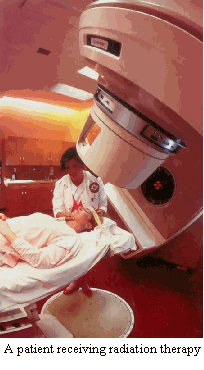
Radiation therapy is another common way to treat cancer. A beam of radiation (high-energy particles) comes from a machine that destroys a cancer cells' ability to divide. Thus, the cancer cells stop dividing and eventually die. As more and more of the cells die, the tumor shrinks or disappears. Unfortunately, some of the radiation also reaches healthy cells and damages them also. This can be quite a problem when a patient has brain cancer because certain motor functions can be destroyed during radiation.
Chemotherapy, or anticancer drugs, are capable of destroying cancer cells anywhere in the body, including those cells missed by surgery or radiation. Similar to radiation therapy, chemotherapy also destroys healthy cells at the same time it destroys cancerous cells. Therefore, doctors, also called oncologists, have to be careful not to give more chemotherapy drugs than one's body can handle. Chemotherapy may be taken as pills or injections. The drugs may be mixed in a solution and administered slowly into the body through an IV in the arm or chest.
|
|
|
|
|