
Home Page:
Year 2000 Economics
by
Daniel

[Note: this was written in the middle of 1999]
While the long-term outlook for stocks remains extremely bearish , there is a significant possibility of a "melt-up rally" over the next few weeks that may surpass Dow 12,000 and 1,500 for the S&P 500.
It seems that Alan Greenspan (who knows darn well we are in a bubble), in trying to avoid a replay of the 1929 crash, has actually created a self-fulfilling prophecy. By raising interest rates a mere quarter of one percent then going neutral he has given the current bubble permission to under-go one last blow-off through this summer. This is by no means guaranteed to happen and may simply hover around 11,000. Or it may only reach 11,600. On the VERY optimistic side it could exceed 13,000.
Should this rally take place we will witness an near exact mirror of 1929 as illustrated by the chart below (Thanks George):
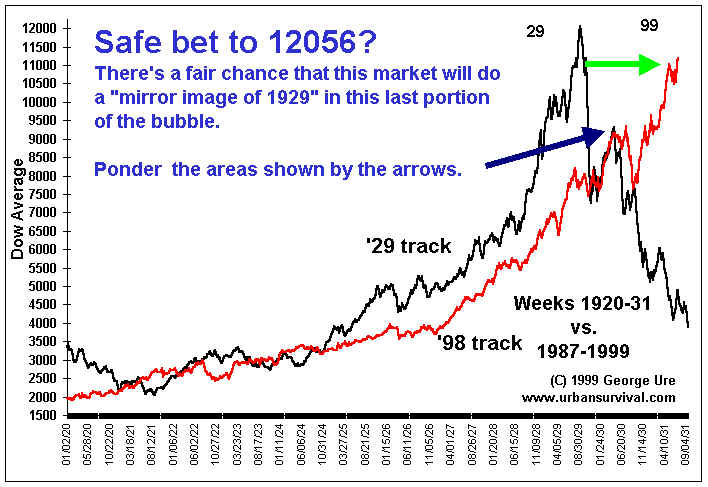
Here are George Ure's comments:
Here are the points of my thinking in summary form:****************
- The premise is the Fed is trying to work through the present by rereading history.
- The Fed has done a fair chunk of research in this regard.
- Placement of news has been shown, in simulation works, to shape how bubbles burst.
- The Fed has created "front side news" that it hoped would bust the bubble (rate jawboning)
- Their timing was too early and caused a "front side dip". So a peak lies directly ahead. news now would only bifurcate or confuse the top.
- Multiagent studies can give excellent direction on excellent input, such as you would expect from bright, highly educated managers at the Fed.
- Bubbles burst from a combination of regime-switching and speculative excess. Policy options are limited. Exit Rubin. Exit Mr. Yen saying this week he expects the US market to crash in the coming year.
- With elections coming, exit Al.
- With this possibility, as the backside shock, the market's low speed crash, the mirror predicted event, seems close enough to be almost certain.
- Given the slow backside, and following Bill's excellent turning point calls, I expect to make out OK. Keep reading and see how we do...
My main point is simply this: In attempting to avoid a Replay of 1929, there's a statstically significant chance that the Fed is being "boxed into an outcome" by events of its own shaping.
If you picture a timeline of events, you can describe them as having an amplitude (how high is the spike in the market?) and what is its longitude (how long did it take to develop over time?).
My supposition supported by some facts is simply that if you have nearly perfect knowledge of a previus event, the Fed may tend to replay a "mirror version in longitude, while the market itself declares amplitude. Event simpler: Put a mirror up to 1929 and look at it backwards. We are so concentrating on the minutia of history that it forces a macro (big picture) replay in mirror form...."
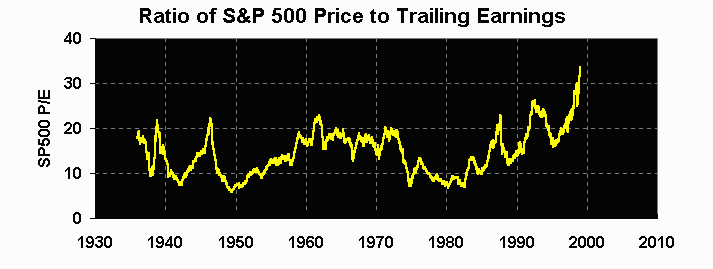
With P/E ratios at record levels and an overvaluation of 44.5% , it is clear the "mother of all crashes" is not only possible, but inevitable.
With Y2K only months away it is doubly inevitable.
P/E ratios for US stocks:
The vast bulk of investors are completely out to lunch on what y2k will do to their investments. The tendency is to look ahead to the next quarter and thereby disregard y2k...that is at the present.
After the crash of 40%-ish that I am expecting no later than October, the current hubristic euphoria will turn to despair and pessimism. After a brief suckers rally, Y2k will suddenly appear on the radar screen and thousands (then millions) will take action and become defensive as it becomes clear that the y2k situation is not as rosy as currently depicted by the mainstream.
The flight to quality will begin. Short-term government bonds will do well initially. But the flight will continue. In (mid?) December, as the public wakes up and prepares for y2k bank runs will begin. This would quickly turn into a panic where a freeze on the bank accounts would occur.
It is at this point that a series of pre-ordained presidential directives, executive orders are enacted and martial law implemented.
There won't be much (if any) trading for the weeks following Jan 1, 2000 as the infrastructure goes haywire. If the financial and banking system is in complete collapse the ability to trade will be nil. Baring this scenario, and assuming the system manages to hold relatively intact, it will continue to tumble down at a ferocious pace, breaking all previous records--including 1929.
After record bankruptcies, default and mass layoffs throughout 2000 and 2001 the market should reach a trough no later than 2003 and begin recovery.
As previously forecast, Dow 400 should not be ruled out. Optimistically Dow 1000 could be possible. Of course, this assumes the power grid stays up , no serious nuclear accidents or outbreak of global war occurs.
Home Page:
Year 2000 Economics
by
Daniel
