
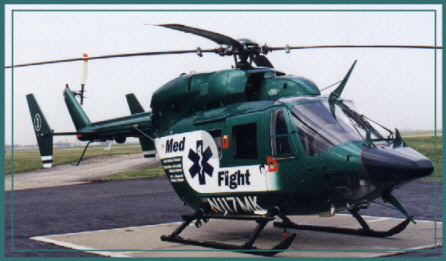
The B2 has 1500 horsepower and a 2 hour & 20 minutes fuel range. Medflight is also equipped to utilize GPS avionics. GPS instrument approaches use satellites for locataing and are more accurate than traditional approaches. This translates into safe operations in rough weather conditions and will allow instrument approaches down to a few hundred feet above the ground. Although the FAA guarantees 30 minutes to process an IFR flight plan, Columbus Medflight which is under Port Columbus Approach Control authority, in an emergency situation can call and get clearance within a few minutes. Medflight is on the breaking edge of technology and takes great pride in their success in patient transport. |




Pulling up over the crash site of a downed aircraft, S-51 pilot Viner and Rullo saw no sign of life. Then the pilot, Lieutenant Commander George R. Stablein, bobbed to the surface. The crewman, August J. Rinella, perished in the accident, either knocked out by the impact or unable to free himself from the smashed airplane.
Badly hurt and unable to inflate his life jacket, Stablein went down twice and was
sinking a third time as Viner guided the helicopter right down to the water. Rullo
lowered his hoist cable directly into the drowning man's hands. Stablein clutched
frantically at the cable, grabbed it and hung on.
Viner lifted the S-51 clear of the waves as Rullo used the hydraulic hoist to haul the
230-pound Stablein up alongside the helicopter's open door. Stablein, too dazed to
fasten a rescue belt harness, with which the cable was fitted, still clung by his hands.
At the top of the hoist his fingers were pinched by the pulley wheel and he released
his grip. But split-second teamwork by Rullo and Viner saved the day. Rullo threw
his arm around the falling man and Viner, at that instant, tilted the helicopter sharply
to the right. The result: Stablein toppled into the helicopter instead of back into the
water.
Back aboard the FDR, Viner and Rullo suddenly realized how low they'd flown.
Water was pouring from the helicopter's nose wheel pylon, evidence enough that the
nose wheel had actually been under the surface. It was an unbeatable example of
precision flying and a most convincing demonstration of the helicopter's rescue
capabilities.
Complete story available at Igor Sikorsky Archives. |
ICE RESCUES |
In the first week of winter, 1999 twenty four people have required helicopter rescues on Lake Erie and Lake St.Clair. Helicopters were dispatched from Selfridge Air National Guard base. Each resuce using two helicopters during an average 3 hour rescue cost an estimated $15,000.00. This does not include the support costs from fire, ambulance, police and other ground support personnel on shore. |
