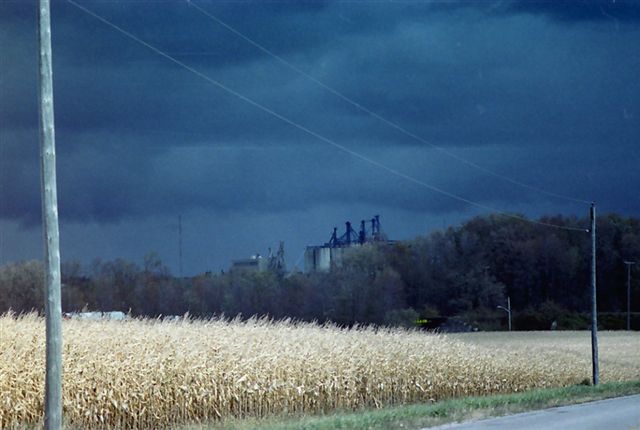
Storms of Autumn

Harvest Time
The above photographs are the work of Bruce Reeves and are printed with permission. Thank you Bruce.
two tanka sequences, a solo tanka, and a free versepoem.   The sequence "Love Songs" is in the zip format for tanka and I
have included dots to maintain the proper spacing.  The dots should be color coded the same as the background so
they don't show.  This seems to work fairly well to preserve the spacing when sending these
through email and coding them in html.
 2 A.M.

the house
is absolutely quiet
at 2 a.m.
drinking a mug of hot tea
I revel in the silence


hearing
nothing and seeing the familiar
as though
for the very first time
in the silence of early morning


in the stillness
of the house at 2 a.m.
the only sound
is the heavy breathing
of my old dog sleeping


absolute
silence this winter’s night
in the yard
reaches into the house
until the furnace comes on


I wonder
what others are thinking
at 2 a.m.
do they enjoy the stillness
or is the TV talking


how many
relish the quiet
of the night
that soft silky silence
more soothing than kisses


hurry
off to bed with you all
it’s late
and I am missing my tryst
with the stillness of the night


so much noise
pounding on my ears each day
I embrace
the solitude of the weekends
at my farm in the country


my eyes
full of sleep and yawns
so big
I reluctantly leave
my chair for the bed


LOVE SONGS


I love to sing...a song
.and it is one...I love very much
and yet...it is not...the only one I sing


there is a song...I love to sing
......of all songs...I love it best
and yet...there are times...when I grow tired of it


..............right now...I am not singing
I have grown tired...of all the songs
even so...my ear listens...for a new tune


................sometimes...when I sing a song
there’s another tune...in my head
so I’m singing...but...it is not with my heart


I heard a new tune...the other day
..............and I tried...to learn it
but...I never did gain mastery...of it


once there was a song...that kept going through my head
..............................day...and night
years later...I still think of it...now and then


some songs...are easy
...and some...are very difficult to learn
but the songs I like...are quite...impossible


no matter how many songs...I sing
................................always...I find myself
returning...to that one song...I love the most

------------------------------------------


................tomorrow...the first day of September
and another month...gone
and another summer...passes...into fall

-----------------------------------------


               DOUGHNUTS


Every Saturday,
when she went shopping,
my grandmother
would bring back a package of doughnuts.
They weren’t round with a hole in the middle;
they were oblong, glazed, cake doughnuts
that looked like fat fingers.
She brought them home
for me.


Many years have gone by
since she last went shopping,
and now she is gone;
this Saturday
I think I’ll go to the store
and bring back a package of doughnuts,
those fat, oblong, glazed, cake doughnuts,
and share them
with my  daughter.


CW Hayes
JILTED

The morning is  mellow
There's a softness riveting through it
Like a cotton blanket snuggled over you
Or like the surface of a clear crystal lake
Your're floating on...

Everyone seems faceless
Almost like shadows or even mannequins
Everyone is in their own cubicle of life...
Oblivious to the signs of life around them....

It's one for #1
...but that's it...
Gestures of kindness are thankless
Almost considered foolish...

What kind of fear envelopes mankinds????


What ANARCHY??

I'm crying for the world
It isn't even for myself...

It's for

Potential lost...
Love forgotton...
Messages never connected....

          Jeanne Fiedler
          CATSCRUBS@aol.com
pSycHO BAbbLe
good morning
repeat after me
I am expert
neuro-behavioral
specialist
(lethal weapon)
you are (mere)
chemicals
complexity
complexity
a S
k
     E
  w
but better chemicals
will cure
don't worry
(be a zombie)
I research (ruthlessly)
creating life
(in cauldrons
boiling) neatly
over bunsen burners
I (disguised)
distill (amnesia)
wonders
in these test tubes
see my lab coat?
all very scientific
you wouldn't understand
(spirit
not
not spirit
spirit spooky
all is matter
soulvoid
chemical
snakes writhing
in brain waves)
II
I provide
a needed service
I do care (pretend)
I listen
(never really
to your inane prattle)
I tolerate (your ugliness)
(eliminate)
your imperfections
(write prescriptions)
to help you
face reality
life is chaos
I offer you escape
voila !
you overdosed
so sorry
you refused
your medication
I did try
to warn you
III
relax
(while I eradicate)
your (terrifying) mind
I know what's best
for your own
(inferior) good
gratify yourself
there is no right
no wrong
congratulationsÂ
on your (breakdown
…OOPS)
breakthrough
do come again
next week
and the week after
the politicians pay
all treatment costs
(puppets
wielding
let's call it power
deluded fools
we know
who rules the world
down goes the gavel
up pops money
they pay me
to forget
I drug
their wives)
IV
poor children
so misguided
I do what's necessary
I do it all for you
I make the world
a nicer place
calm
quiet
(dead)
people everywhere
so sick
I provide
protection
isolation
name diseases
(labels) for your kids
so they too
can be safe
life is very dangerous
we can cure infants now
V
I could give you secrets
incantations
to protect you
(I know voodoo)
I could let the demons out
(out damned spot)
I have extensive training
(would love to pierce
your brain)
they took awayÂ
my lovely stainless steel
(cold gleaming
titillating
surgical)
my tools
but do come visit
not so bad here
in this padded cell
you'll bring some leeches?
and a knife?
Copyright© 1999,2003 Jan Houston
All Rights Reserved (feel free to pass along with authorship intact:)
From Russia, with love comes these poems from Dina Televitskaya
You and I.
Dedicated to Edward Roberts - an American Poet
We still do not know each other-
You and I.
We live in different parts of the World-
You and I.
We have different destinies and problems,
Ideas and hopings,
Customs and mentalities of our countries-
You and I.
But both of us are Poets!
You and I.
That is why we should understand and take into our hearts
Ideas, feelings and poetry of each other-
You and I.
The whole world was for us as a cosy room.
May evening went around ( go around)
A little drunk from love.
And the organ somewhere sang for us,
You remember?
But time went,
Light extinguished
In windows of the houses,
And you extinguished frequently cigarettes.
To you was too much years,
You nobly remembered it.
Understand, I am not afraid of a gray hair!
I and now, loved,
With my heart with you,
And you are very necessary for me
Together with all
With your huge years!
You remember? Trees were yellow.
You went from me on a wet grass into October.
The sky fell. And the last flowers cried.
And
you have looked back, remember?
When it is raining...
When it is raining,
Listen, please, listen! -
Drip! Drip! Drip! (kap,kap,kap)
The sky is crying
Or it is telling about something to you?
When it is raining,
Listen, please, listen!
The songs of our dreams,
The thoughts of the nature
Or the whisper of the time?
When it is raining,
Listen, please, listen! -
Drip, drip, drip! (kap, kap, kap!) -
We are becoming more kind,
We can see, hear and understand
Senses and problems of each other -
When it is raining...
Death of the Poet


The poet succumbed at eight o'clock AM.

Five minutes prior to his death, he made use of a stained rotary dial
phone,
its duct-taped parts precariously clinging to each other. His speech
was
slurred but his interlocutor - a fan - thought it nothing
extraordinary.

Sighing ostentatiously, she reluctantly agreed to come to him, volubly
replacing her receiver in its cradle.

She was not surprised to be met by others he had called, nor was she
astounded to learn that he had died all by himself, wrapped in two
dusty
khaki blankets, sprawled on a tattered mattress, flung on an iron frame
that
served as both bed and escritoire. It was so like him, to die like
that.

Removing the rigored cadaver through the narrow doorway was tricky. The
medics rolled it down the claustrophobic and penumbral staircase (there
was
no lift). His ink-tainted right hand kept striking the peeling yarns of
greenery that hung, flayed, from crumbling concrete walls.

Panting, they laid him on the bottom stair, an outsized embryo with jet
black hair and eagled nose. His nostrils quivered.

The radio reported his passing and lengthy obituaries adorned
tomorrow's
press. The critics cloaked with affected objectivity the overpowering
disdain they held the man, his lifestyle, and his work in. They claimed
to
have been his closest friends and recounted some futile anecdotes.

The ceremony held by the municipality in the Writers Hall was open to
the
public.

I said to Nomi:

"Why don't you approach the organizers? Tell them that you have
composed
music to some of his poems and that you are willing to perform them.'

They were thrilled and Nomi settled on two songs - one that I liked and
one
that was her preference. She had a fortnight to rehearse them
ceaselessly.

Then Dani phoned me. Years ago, still adolescent, he costarred with the
poet
in a television show. They spent the night discoursing, which rendered
them
inseparable thereafter, the apprentice and his mentor. Because Dani is
what
he is - he turned into the poet's fan. And because he is what he is -
he
abruptly brought it to a halt. They never met again. Dani never thinks
of
himself in terms of extremism but his relationship with the dead poet
was
such.

And now he enquired:

"You heard? He is dead."

But he did not pause for a response. He went on to recount the by now
familiar story of how they met, and how he admired the poet's
ingenuity,
inventiveness, aplomb, the love he made to the Hebrew language. And how
it
was all over.

"I am not attending this fallacious wake." - Dani is soft-spoken even
when
his words are not.

That evening, Nomi and I went to the Writers' Hall. A woman with
anorectic
eyes compared our invitation to a clammy list. We slumped into some
wooden
deck chairs, attired steamily in our discomfiture. People climbed onto
a
squeaky stage and then retreated, having recited the poet's work in a
post-mortem elocution. They argued with venomous scholarship some fine
points.

The poet's raisiny and birdlike mother was all aflutter in the front
raw,
flanked by the agitated organizers. She flung herself at the poet's ex
spouse and at her son, protesting creakily and waving a hefty purse:

"Away with you!" - she screamed - "You killed my boy!"

The divorcee approached, her black dress rustling, hand soothingly
extended,
but midway changed her mind and climbed the podium.

She promised anodynely to preserve the poet's heritage by issuing a
definitive edition of his writings, both published and in manuscript.
Her
voice was steady, her gestures assured, her son clung to her dress
eyeing us
and the scenery indifferently. He dismounted as he climbed, obediently
and
unaffectedly.

On cue, Nomi sang two bits, her voice a luscious blond. She looked so
lonesome onstage, a battered playback cassette-recorder, a wireless
microphone, her quaking palms. When the last note died I discovered
that I
am not breathing and that I turned her notepad into pulp.

On her odyssey from stage to seat, Nomi glanced coyly at the poet's
still
roiled mother, who hastened to hug and compliment her warmly.

The night was over and the mob dispersed.

The poet's mother stood forlorn, tugging at the impatient sleeves of
the
departing as she demanded: "How shall I get back?" - but she wouldn't
say
whereto. Roundly ignored by the pulsating throngs of well-wishers, she
watched them comparing impressions, exchanging phone numbers, mourning
the
poet and, through his agency, themselves.

"I knew your son" - I said.

I really did - perhaps not as intimately as a friend, but probably more
than
did most of those present. Once I visited that warehouse of weathered
books
he called his home, sat on his monkish bed, played the effaced keys of
his
battered typewriter.

I offered her a ride and she accepted, sighing with childish relief.

Nomi drove and I listened to the poet's mother. Like him she wept in
words.

"He used to visit me every week" - with pride. Invited us for a drink
in her
room at the seniors' home. The evening chilled, she observed. How about
a
warm libation ("I have even hot chocolate"). When we declined politely,
she
tempted us with exclusive access to letters the poet wrote to her.

We took a rain check and made a heartening spectacle out of noting down
her
address and her phone number.

The night guard at the entrance, besieged by a polished wooden counter
and
facing banks of noiseless television screens, winked at us.

"Thank you for bringing her back. A wonderful woman but lousy kids. No
one
ever visits."

He turned to face the poet's mother, raising his voice unnecessarily:

"And how are you tonight?"

Ignoring him, she eyed us inquisitively:

"You have children? No? What are you waiting for?" - her shriveled
finger
spiraling - "Make a few children and hurry about it. Believe me,
nothing in
life is more important. Nothing if not ..."

The swooshing elevator doors, an amputated sentence, and she was gone.

At home, we lay on our backs, each in its corner of our bed, trying to
pierce the darkness blindly.

We never mentioned that evening, neither have we returned to visit the
poet's mother. We came close to doing so, though. One Saturday we
mutely
decided to climb the hill and drop by the seniors' home. Instead, we
ventured further, to Jaffa, and bought Sambusak pastry, filled with
boiled
eggs and acrid cheese.

Side by side we lived, my Nomi and I.

And then she divorced me and so many things transpired that the poet
and his mother and this story were all but forgotten.


============================
The Out Kid
Sima was six years old when she died. Mother turned off the television
and
instructed me to go to my grandma's home at once. It was that time of
day
between retiring sunlight and emerging gloom. My grandmother was
sobbing
silently, seated gingerly on a shabby couch, her face buried in an
oversized
and crumpled handkerchief. My grandpa, muted, just hugged her close. It
all
reminded me of a Passover Eve, refreshments strewn on tables, hastily
appended by my uncles and covered with flowery rags.

All lights were on, tarring the wiry tree in the garden with juddering
shadows. I sat in the corner, thinking about Sima, wondering if her
beauty
survived her death. They said she had leukemia and vomited blood
incessantly. She died, awash with it, her pallid face depressed against
my
grandpa's shoulder. I pondered if it was right to go on loving her. I
thought about Uzi, her brother and my cousin.

After the funeral, Uzi was sent to a Kibbutz, never to return, leaving
behind unfinished cowboy-and-Indian games on my grandmother's verandah.
There were so many things I had to tell him but he was gone.

A few months later, my aunt invited me to join her to visit the
Kibbutz. In
her youth, she was a green-eyed, lithe beauty - cascading, raven hair
and my
mother's cheekbones, but gentler. She divorced still young and then
Sima
died on her and she found employment in Haifa, in a hospice for the
terminally ill.

She was a recluse, living in a tiny, viewless flat which she
compulsively
scoured and polished. She spared her words and I was deterred by these
and
other eccentricities. But I wanted to see Uzi again and talk to him, as
we
used to. I imagined his full-cheeked laughter and the sparkle in his
eyes,
under his curls.

So, I said I'll come along and found myself, one summer morning,
accompanying my aunt to the Kibbutz, a winding, dusty way. We switched
countless buses and sipped orange juice through straws and my aunt
tilted
her wide-brimmed hat to expose a lock of graying hair. Her eyes were
moist.
She said: "I am going to see my Uzi now. It's been so long." The sun
invaded
her fedora, imprisoning her quavering lips behind a beaming grid.

I wanted to enquire why did she send Uzi to the Kibbutz to start with
and
tell her how I missed his smile, our games, the bucket loads of water
he
would pour on me after we bathed in the nearby sea. But I refrained
because
her eyes went metal when she mentioned him. She never even mentioned
Sima.

So, there we were, standing at the gate, she and I and our gear, all
packed
in fading plastic bags at our feet, enshrouded by the black vapor of
the
shimmering asphalt and the roaring and receding bus. My aunt,
contemplating
the waning transport, grabbed my sweaty palm and lifted the rustling
shopping bags. A whiskered driver of a tractor regarded us with
curiosity,
then guided us to our destination.

My aunt clenched a childish fist to tap the door, but left it hanging
in
mid-air awhile. Then, she let it drop, an alien appendage. She removed
her
hat, clinging to it awkwardly, straightened the wrinkles in her dress
and
gazed at her flat patent shoes uncomfortably. She knocked on the outer
screen rigidly and the sounds reverberated in the house like distant
thunder.

The door was opened so instantly that we recoiled. My aunt stared at
the
middle-aged woman and returned her barely audible "hello". It was as
though
her body shrunk. She undulated with her baggage eagerly. The older
woman's
lips were smiling at my aunt, but her eyes remained on guard.

She told me to look for Uzi in the animal corner, close to the
mountain,
among the cowsheds and cages. She needs to talk to my aunt in private,
she
ventured unnecessarily.

She softly shut the door behind me and I stood, dazed by the scorching
sun.
Barefoot and well-tanned kids, clad in shorts and T-shirts, surrounded
and
studied me and I reciprocated. I froze and they did not get closer. We
formed two groups and measured one another.

A bird-like girl broke the spell: "Are you a new Out Kid?"

I didn't know what was an Out Kid. I told her that I was Uzi's cousin
and
that I am searching for him.

She gave a toothy smile, crossed the invisible barrier and held my
trembling
hand: "Let's go". She examined me, astounded, when I withdrew and
violently
extracted myself from her grasp.

We silently traversed some green-hedged paths. Brown signs with massive
yellow lettering were everywhere. She navigated deftly among the gravel
and
the fences until we reached a bank of crates, laid on the sun-parched
ground
and hosting rabbits. Their wheezy, ribbed breathing nearly unstitched
their
fur.

Uzi was standing there, his back to us. He leaned his head on an
extended
arm, supported by the cage's frame, perusing a frightened rodent, whose
nostrils twitched with desperation.

I called out: Uzi! He turned around listlessly and looked at me, as
though
unsure of my identity. My guide hopped from one dainty foot to another,
her
discomfiture increasing. Finally she departed and joined the growing
bunch
of children that monitored us from afar.

"It is a porcupine" - said Uzi, his eyes averted. "I tend to it and to
the
entire animal corner. We have sheep and horses, too" - he hugged the
circumference with a bronzed gesticulation. "I climb the mountain daily
with
my father" - he added. I kept silent. His real father deserted him when
he
was toddler.

Uzi grew quiet, too. He kicked a pile of dry manure and asked me if I
want
to see the cows and I said I did and off we went. It was like in the
olden
days, when he and Sima and myself strolled down the white-hot
pavements. She
had an auburn mane she locked into a ponytail, her mother's eyes, green
tarns, a swan's own neck. She made us laugh at the unexpected
femininity of
her most childish enquiries.

Then and there, with Uzi by my side, it was as nothing happened, a
midsummer's nightmare, when you wake, perspiring, but in a familiar
bed.

We talked profusely and laughed and I inevitably dived into some
straw-infested fertilizer and didn't mind at all because Uzi was with
me to
pour large bucketfuls of glacial water he carried from a nearby stream.
I
closed my eyes and pretended to be at sea, to have brought along the
spraying waves and the caressing breeze, a gift to Uzi, and a reminder.

The native kids just followed us, their eyes azure, their skins a
seamless
copper. They tracked our movements with naked, strapping bodies and
clean-smelling hair. They clung to us and giggled secretly and pointed
at
Uzi and whispered in each other's elfin ears, and then they chuckled.

Uzi said not a word. He passed a soothing hand on a horse's muzzle and
a
cow's leg and the pulsating furs of bunnies. He gently pulled their
elongated ears and they scurried to and fro and made him laugh. He had
a
gurgling, erupting laughter, Uzi had.

We climbed a thorny, stone-filled road atop a hill, pausing to look at
the
vanishing Kibbutz at our feet. "There's my home" - Uzi singled out a
cubicle. I wasn't sure which one he meant, but I did not insist. I only
looked at the hazy greenery and at the gleaming swimming pool and said:
"Let's go down, I am worn out."

The children awaited our descent and cried at Uzi, who ignored them. He
only
hastened his steps and so did I. They followed us. Surrounded, stranded
on a
tiny path, we stopped. They shoved Uzi and pulled.

"Who is he?" - they demanded - "Why did he come here? Where is he
from?"

He frowned and said: "It's no one special. He just came with my mother
from
over there" - with a vague gesture to indicate the nowhere.

The girl fixed me with her gaze.

"It's nothing, it's no one! He is only here for a visit, I am telling
you!" - Uzi pleaded.

"He must return where he came from" - said one of them, his eye a cold
blue
sparkle. His jaws rippled as he spoke, skin smooth and dry. My shirt
was
dabbed in sweat and hung, keeled over, from my thick, long trousers.
"Let
him go back" - echoed the girl - "We cannot have another one of you.
Isn't
it enough that you gorge on our food and have new parents?"

Uzi was soundless, his head lowered. I couldn't look into his eyes like
we
used to do when we were sad. Sima and I had this game of who would be
the
first to stare down the other with an invincible, metallic look. Deep
inside, I thought, this must be how Uzi sees them - as enemies to be
stared
down and out and away.

One kid approached and tugged him at the shoulder and Uzi stooped. It
was as
if a valve was drawn, the air let out, to render a misshapen Uzi.
Another
child stepped forcefully on Uzi's earth-baked, sweat-furrowed toes. His
breath mingled with his quarry's as he increased the pressure. Uzi's
face
contorted but he didn't budge.

Jaded and starved they left and we proceeded to Uzi's new abode, amidst
the
well-trimmed lawns and neck-high hedges. He knocked hesitantly and
someone
let us in. Uzi erupted in bitter sobbing, beating his sides with
pale-clenched fists. He stood there, squealing and grunting, like the
animals in his corner and the muffled sounds filled the house and
washed
over the bowl of fruits and the heavy, murky curtains, and the antique
wooden furniture, rebounding, a thousand echoes.

My aunt called his name. His new parents entered the kitchenette and
sealed
the sliding door. I had nowhere else to be. "I brought you some food" -
said
the mother and he nodded bravely and brushed aside the tears that
threatened
to emerge. She opened the overflowing plastic bags with learned
helplessness, displaying pastries she prepared at home.

But Uzi selected a mid-size orange and peeled it expertly, stuffing his
mouth as he progressed. The orphaned pies adorned the table that stood
between them. They both avoided looking at each other. Still with
diverted
eyes she extended an uncertain hand and touched his shoulder. He shrank
under her stroke, so she withdrew and sat up, tense, straddling the
edge of
a recliner.

Thus, they circled one another wearyingly. A longcase clock ticked
minutes
and then hours before my aunt got up, mauling her wide-brimmed hat, and
said: "I must be going now" and Uzi nodded, devouring yet another
orange. He
didn't even rise to bid farewell.

"I'll come to visit you" - she promised but her pledge sounded tinny
and
rehearsed. Uzi consumed the fruit and stared intently at the floor. His
mother took my soiled palm in hers and exited the house. No one
escorted us
to the gate or to the grimy station. We stood there, in the sweltering
sun,
until we heard the bus, uproarious, like echoes of a far-off battle.


Sam Vaknin ( http://samvak.tripod.com ) is the author of Malignant Self
Love - Narcissism Revisited and After the Rain - How the West Lost the East.
He served as a columnist for Central Europe Review, PopMatters, and
eBookWeb, a United Press International (UPI) Senior Business Correspondent, and
the editor of mental health and Central East Europe categories in The Open Directory Bellaonline, and Suite101.

Sam's Web Site:

http://www.narcissistic-abuse.com


==========================