When I planned this month's theme, I thought it was appropriate as to the
fact that many people make their music purchases during the Christmas season.
I know that I made a few purchases, and one will be featured in the review
section.
Since then, I noticed there has been a change with music, at least here
in North America. Just this past week, one of my favourite radio
stations has gone to an all jazz format. CJRT
has gone from a classical/jazz to all jazz. Not that I'm complaining
any, I think its a very good thing. As well, we who live near a PBS
station or has it on our cable should be able to watch Ken Burn's seminal
study of American jazz, "Jazz". I see that the companion book is
available, but for $95.00 Cdn. I think I'll pass and wait for it
to show up in the local library.
Music is a two-edged sword, or should I say 'sound'. We listen to it voluntarily
or its forced upon us. It either enhances our situation and mood
or drives us to distraction. Music uplifts or annoys. We either
have it as an interest, or as background to whatever work we're doing at
the moment. Right now, I've got some jazz playing on the computer,
through an mp3 disc. So its there. Some people need it desparately,
others may feel it has a particular place and time.
Music, a collection of sound waves of different pitch and intensity that
either pleases us or bugs us. It acts upon our emotions, bringing
us up or leading us downward.
Although can it be another sympton that our culture has become too noisy,
and so it become intrusive and bothersome.
Music is creative, certainly we can appreciate the fact that it takes talent
to compose, but how about to enjoy do we need to be creative and imaginative
to allow ourselves to be moved and swept along with the imagery of sound?
I think so. It's another act of creation that exists in all of us,
to develop or enjoy. Perhaps you use music to aid in your creative
acts, or you use music as your theme. Perhaps as you read the
poetry contained in this month's issue, you can here the music of their
spirit.
"Zeitgeist"
by Bruce Sterling may be his best writing in years, if not then at least
for his last three books. Sterling has made a name for himself as one of
the founders of the cyberpunk school of science fiction. While he
has written much about the near future, and he portrays it as a dytopic
world of corrupt nations, crashing and underground economies, where technology
is both advancing and decaying, he turns his attention to the present day.
The book follows the exploits of "Leggy" Starlitz, the manager and creator
of an all-girl band "G-7". The name is derived from the fact that
the members all come from countries of the G-7. The band is a sham,
they are all talentless. They can't sing, write or even dance.
However, through the use of merchandising and public relations, they are
the hottest thing on the planet. After winning over the Western world
with cheap merchandising and highly creative press releases, the band is
poised to take over the Middle East and Asia.
However, the band has a time limit, they will exist as a unit until y2k,
when the girls will go home and pocket some serious money. With the
band is the entourage, composed of a Russian veteran of Afganistan, an
accountant who brought down a British bank, who just happens to have the
name 'Nick', and a number of chapereons.
Their first stop in the Middle East is Turkey, but before that, they spend
some time in the Turkish Republic of Cyprus, the northern part of this
divided island. Sterling has obviously done a great deal of research
in this forgotten and ignored part of the world. While there, Leggy
meets an interesting Turkish entrepeneur, who promises to take over the
lead the band in their triumphant conquest of the Islamic world.
Not all is it seems, living in a pariah states bring Leggy face to face
with drug smugglers, terrorists, counter-terrorist, the Mafia and his daughter,
who he meets for the first time. With his introduction of his daughter,
he realizes he has to find his father and leaves the band in the care of
the Turk. Of course nothing as it seems, Sterling adds just enough sci-fi
elements to remind us he is not just writing fiction, but speculative fiction.
Sterling is able to portray the underbelly of life very effectively, whether
these characters exist you culd believe it is possible for them to be alive
in all the backwater places of culture. He reminds us that the year
1999 was not a very nice time and it was alive with the xenophobia and
hatred that we do remember. Add to this mix the backdrop of the NATO
war against Yugoslavia, you are reminded that maybe his view of the near
future will be as bad as he says.
Music does exist is the background of this novel and you get the idea of
the shallowness of pop music and culture. A fascinating read from
beginning to end.
Early
in 2000 I reviewed the cd "Slow Fox" by Patricia O'Callaghan, a collection
of cabaret songs sung by a fast growing talent. This past October
she released another disc by the name of "Real Emotional Girl". Her
first disc was definately an interpretation of the cabaret style of music,
with songs of Kurt Weill, among others. With this cd she brings her cabaret
interpretation to the music of others. This CD features the work
of Bob Dylan, Pearl Jam, Leonard Cohen, Leonard Bernstein and Randy Newman.
If anything you have to credit her with creativity and a willingness to
include the ecletic in her repertoire.
If there is a disappointment it is the fact that 5 of the songs are from
"Slow Fox", why not continue with other artists. She continues her
fascination with the work of Cohen, with 5 of his poems interpreted in
her style of music and voice.
If you're not familiar with her, this would be a good start to appreciating
her art, if you are already interested, you may be wanting more and not
a repeat.
PatriciaOCallaghan.com
A Poetic of Music
Around and around the plaza in a taxi
he improvises oboe in a minor purple mood:
the notes as rich as chocolate pudding
oozing out the window and sliding down
the yellow door. It gathers in the gutters
and spreads across the street, as silky
sweet as memory, to trip the blind dead
marching feet and gag the harping anthem
of the same old panic in the ears of each
benighted passerby.
The Silent Opera
The seeming enigma behind this libretto
is a gate where every juxtaposition meets
in aria or sextet – stairways included,
at the end of a long silken walk
set in concrete. How long the late-
afternoon stars drink at the fountain
before a soprano appears on the balcony
overlooking a broad tenor going,
these latter days, to overmuch vibrato
(the magic, tonight, that we can’t hear
him). Four hours we have to admire
the set designer’s art; he hints
at fields for traveling, but no
one strays farther than the wings.
All waiting for the first note,
a reason to be here at all.
Strip-Tease
It’s come to this, spinning
Ravel in the silence of a room
without him. Bolero begins,
she unclasps the sapphire clasp
and flings it on the carpet.
The Indian silk scarf grows wings
then lands – she doesn’t care.
Music meditates its mantra.
She unhooks her belt and sends it
snaking. Ravel, no earthly lover,
ratchets up the tempo.
Buttons almost undo themselves.
Free wrists and arms, she swirls
hypnotic as the same same phrase
repeating like any lover’s lie.
The skirt, that’s easy, she hula-
hoops her hips right out of it,
sails off skivvies like a silk-
worm, whirls a frenzy till
the after-bath evaporates
and it’s only sweat glistening
as if she could slip into
her soul.
Taylor Graham
Have a joke
Here’s a toke
Pass the joint around
Turn the music on real nice and loud
Rid your face of indented frowns
Act like some crazy clowns
Laugh till your memory’s floating in a cloud
Be in like me
Till you can’t see
The lines that go straight or go round
LSD - - lick the stamp - - we’ll dance Pentango’s dance
Till the sun rise - - when it all tumbles down
Hash will ease the mind
In a place that we can find
Our Johnny Walker resting place for two
The day will end in score
When we hit the floor
Only this time - - it’s a bigger score we’ll do
Jake the Snake is waiting
To sell his hits of crack
His chosen drug of want is always smack
He revs on low because
He says he likes the buzz
For the crack deploys his askew mind a -fuzz
We’d hit the main line easy then
The world was on our plate
We’d drink, we’d smoke, we’d shoot n’ snort some more
Then we’d have a chaser of J W to ease the pain
Then go visit Jake again
Ta freshen the score
So now we’re in the big league
It’s the methadone parade
A fixed procession slurping down our juice
But turn the music down
For my face now holds a frown
Till I shake the sunshine and make my mood go looseCharlotte Mair
Poetry of Life, Love and Existence
Tell me about your sunshine
and the sounds of coffee
and of barefeet pounding the earthen floor
the creaking trees
and the skinned memory of hugs
you gave
and you received.
Sit down, yes, here,
the intermittent sobbing
of the shades
slit by your golden face.
Now listen to the hundred children
that are your womb.
I am among them.
Tableaux (on Van Gogh)
Listening to a scarlet sink, detached
an ear, still glistening wax,
in bloody conch.
The gaping flesh.
Wild scattered eyes
fiercing the mirror.
Light ricochets from trembling blade
(it's gaslight evening and the breeze ...)
Behind his stooping shoulders,
a painted room ablaze
the dripping composition of his blood.
The winding crowd
inflates the curtains inwards,
sails of a flying Dutchman.
Prowling
The little things we do together
to give up life.
The percolating coffee,
your aromatic breath,
the dream that glues
your eyelids to my cheek.
We both relent relentlessly.
Your hair flows to its end,
a natural cascade,
a velvet avalanche
buries my hands.
In motion paralyzed,
we prowl each other's
hunting grounds.
Day breaks, our backs
turned to the light
in dark refusal.
TITLE: Prague at dusk
Prague lays over its inhabitants in shades of grey. Oppressively close to the surface, some of us duck, others simply walk carefully, our shoulders stooped, trying to avoid the monochrome rainbow at the end of the hesitant rain. Prague rains itself on us, impaled on one hundreds towers, on a thousand immolated golden domes. We pretend not to see it bleeding to the river. We just cross each other in ornate street corners, from behind exquisite palaces. We don't shake heads politely anymore. We are not sure whether they will stay connected if we do.
It is in such times that I remember an especially sad song, Arabic sounds interlaced with Jewish wailing. Wall after wall, turret after turret, I re-visit my homeland. It is there, in that city, which is not Arab, nor Jewish, not entirely modern, nor decidedly antique that I met her.
And the pain was strong.
More poems here: http://www.geocities.com/vaksam/contents.html
I know a couple of old buildings
might could be torn down or fall
anyway and maybe could be restored
or given a new make-up you know
but there they are as old as they are
and you look back at their youth
as a time when such things are done
as you and you watch the years age them
and a coat of paint in the Mexican way
could go over them or the way we do with pictures
a marvelous life
“the look of love is in your eyes”
and everywhere else on you
that is your love your servile thing
it obeyed you but not me
the King of Erl goes dryshod
in spite of what you may have heard
what Mr. Lincoln have we any?
no smokn inna palace
picking the brains of my cousin
the aesthete saith who giveth life
or his critics or the paraliteratus
who puts it all together on my head
To abide deep in unfathomable realms,
Engulfed in a deluge of lucid images.
There- There- Resides the mystical authority,
Hallways to paradise emerge from the haze.
What mysteries unfold in silent thought,
Visualize images within life's enigma.
Ponder a reflection and see it's echo,
Taste Joy, kiss love, hug quietude.
Release the unknown glory of magnificence. M. L.
I thought today of her awakening
Her movements a shadow
In the predawn darkness
A phantom floating
No more than a chimera of shape
A nude that Picasso might sketch
No more than a few sloping lines that curve
Toward soft inclines and rise gently
Toward feathered intersections
And fall toward full divergence
Backlit in silhouette from the bedroom window
Her breasts and buttocks
The simple elegance of lines in
Erotic waves and fluid motion
And as she moves near
I smell the citrus of orange slices
That is the fragrance and scent
That forms a perfumed wake as she passes
And the “sh” and “ch” sounds of her dressing
Are a bird’s wings flapping
A slight rustling of fabric
A finch in the shrub
I am the slave of her motion
The serf of her smells
The prisoner of her naked beauty
Who wakes each morning in bondage
To the changing shape of curves
To the texture of delicate sound
And a still life with oranges
_____________________________________
The Wedding
Poem
(For Terra)
Time upon a once I do now recall
In memory rich with childhood wonder
The fairy tales read at bedtime
And prayers said at her bedside
Now I lay me down to rest
I hope your dreams are just the best
Heaven and hell are chambers of the heart
For when I am dead I will spend eternity
Strolling through summer afternoons
A little hand in mine as we walk
And talk quite casually of birds and trees
And bumblebees burrowing deep in blossoms
Awakening to absence that is her finding
The fullness of a wonderful womanhood
That is her finding now the meaning of mature love
And living her days in a happy place of her own making
That is crafted by her own choices and
Sustained by her own hands
I sing now no more in half whispers
My tenor rising just above the organ notes
The Kyrie and Agnus Dei
The Sanctus and Benedictus
My prayers of happiness are sung
For Latin is the language of heartfelt love
Walk once more with me down the nave
Toward the altar of this country church
Awash in the color of stained-glass light
My chest that rises and falls with each breath
Is a warehouse of fervent worship
As I walk with her toward her life
_______________________________
Greek Echo
(A Hollywood Park Poem)
I see her naked
With my eyes closed
Each breast a half peach
And the cheeks of her ass
Symmetrical hemispheres
A sliced melon
I can touch her
Deeply in my dreams
Her flesh feels firm
Yet soft like ripe mango
And the taste of kiwi
Lingers on my tongue
I can see the smell
Of her moving like
A shadow around me
A flicker of motion
A flash of movement
That is Venus waking
I received an interesting mix of writings from Sam, so take the time to read his writing and enjoy his point of view.
The Magla Vocables
by: Dr. Sam Vaknin
The Macedonians have a word for it - "Magla", fog. It signifies the twin arts of duplicity and ambiguity. In the mental asylum that the swathe of socialist countries was, even language was pathologized. It mutated into a weapon of self defence, a verbal fortification, a medium without a message, replacing words with vocables. Easterners (in this text, the unfortunate residents of the Kafkaesque landscape which stretches between Russia and Albania) don't talk or communicate. They fend off. They hide and evade and avoid and disguise. In the planet of capricious and arbitrary unpredictability, of shifting semiotic and semantic dunes, that they inhabited for so many decades (or centuries) - they perfected the ability to say nothing in lengthy, Castro-like speeches. The ensuing convoluted sentences are Arabesques of meaninglessness, acrobatics of evasion, lack of commitment elevated to an ideology. The Easterner prefers to wait and see and see what waiting brings. It is the postponement of the inevitable that leads to the inevitability of postponement as a strategy of survival.
It is impossible to really understand an Easterner. The syntax fast deteriorates into ever more labyrinthine structures. The grammar tortured to produce the verbal Doppler shifts essential to disguise the source of the information, its distance from reality, the speed of its degeneration into rigid official versions. Buried under the lush flora and fauna of idioms without an end, the language erupts, like some exotic rash, an autoimmune reaction to its infection and contamination. And this newspeak, this malignant form of political correctness is not the exclusive domain of politicians or "intellectuals". Like vile weeds it spread throughout, strangling with absent minded persistence the ability to understand, to agree, to disagree and to debate, to present arguments, to compare notes, to learn and to teach. Easterners, therefore, never talk to each other - rather, they talk at each other. They exchange subtexts, camouflage-wrapped by elaborate, florid, texts. They read between the lines, spawning a multitude of private languages, prejudices, superstitions, conspiracy theories, rumours, phobias and mass hysterias. Theirs is a solipsistic world - where communication is permitted only with oneself and the aim of language is to throw others off the scent.
This has profound implications. Communication through unequivocal, unambiguous, information-rich symbol systems is such an integral and crucial part of our world - that its absence is not postulated even in the remotest galaxies which grace the skies of science fiction. In this sense, Easterners are nothing short of aliens. It is not that they employ a different language, a code to be deciphered by a new Champollion. The Cyrillic alphabet is not the obstacle. It is also not the outcome of cultural differences. It is the fact that language is put by Easterners to a different use - not to communicate but to obscure, not to share but to abstain, not to learn but to defend and resist, not to teach but to preserve ever less tenable monopolies, to disagree without incurring wrath, to criticize without commitment, to agree without appearing to do so. Thus, Eastern contracts are vague statements of intentions at a given moment - rather than the clear listing of long term, iron-cast and mutual commitments. Eastern laws are loopholed incomprehensibles, open to an exegesis so wide and so self-contradictory that it renders them meaningless. Eastern politicians and Eastern intellectuals often hang themselves by their own verbose Gordic knots, having stumbled through a minefield of logical fallacies and endured self inflicted inconsistencies. Unfinished sentences hover in the air, like vapour above a semantic swamp.
In some countries (the poorer ones, which were suppressed for centuries by foreign occupiers), there is the strong urge not to offend. Still at the tribal-village stage of social development, intimacy and inter-dependence are great. Peer pressure is irresistible and it results in conformity and mental homogeneity. Aggressive tendencies, strongly repressed in this social pressure cooker, are close under the veneer of forced civility and violent politeness. Constructive ambiguity, a non-committal "everyone is good and right", an atavistic variant of moral relativism and tolerance bred of fear and of contempt - are all at the service of this eternal vigilance against aggressive drives, at the disposal of a never ending peacekeeping mission.
In other countries, language is used cruelly and ruthlessly to ensnare one's enemies, to saw confusion and panic, to move the masses, to leave the listeners in doubt, in hesitation, in paralysis, to gain control, or to punish. There, symbols are death sentences in both the literal and the figurative senses. Poets, authors and journalists still vanish regularly and newspapers and books are compiled into black lists with dreadful consequences. In these countries, language is enslaved and forced to lie. There are no news - only views, no interest - only interests, no facts - only propaganda, no communication - only ex-communication. The language is appropriated and expropriated. It is considered to be a weapon, an asset, a piece of lethal property, a traitorous mistress to be gang raped into submission.
And yet in other places in the East, the language is a lover. The infatuation with its very sound leads to a pyrotechnic type of speech which sacrifices its meaning to its music. Its speakers pay more attention to the composition than to the content. They are swept by it, intoxicated by its perfection, inebriated by the spiralling complexity of its forms. Here, language is an inflammatory process. It attacks the social tissues with artistic fierceness. It invades the healthy cells of reason and logic, of cool headed argumentation and level headed debate. It raises the temperature of the body politic. It often kills. It moves masses. Submerged in and lured by the notes issued forth by the pied piper of the moment - nations go to war, or to civil war, resonating with the echoes of their language.
Language is a leading indicator of the psychological and institutional
health of social units. Social capital can often be measured in cognitive
(hence, verbal-lingual) terms. To monitor the level of comprehensibility
and lucidity of texts is to study the degree of sanity of nations (think
about the rambling "Mein Kampf"). There can exist no hale society without
unambiguous speech, without clear communications, without the traffic of
idioms and content that is an inseparable part of every social contract.
Our language determines how we perceive our world. It IS our mind and our
consciousness. The much touted transition starts in the mind and consciousness
determines reality. Marx would have approved.
Much of the work in this issue is from first time poets and writers, thank you all for taking the time for writing and submitting this fascinating work. As always, this issue exists because of the creative power of others.
If you want to know what's coming up,. February will feature a Winter
theme. Up here in Canada, winter has made its presence known and
since it is a "few acres of snow", which is how Voltaire described us,
why not a theme of the season. If you want to write about winter
in your land, please submit. As always, I never limit the work received
to just one theme.
Also, March will be an issue dedicated to the work
of Australia. This will be a great issue, already a number of poets
have submitted some incredible work, so look forward to it.
If you want to contribute, write me at pabear_7@yahoo.com
All work is copywrited by the various authors. ©2000-2001.
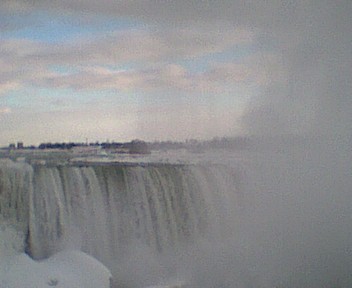
A bit of inspiration. The Horseshoe Falls on January 1st.