

Official name Republika Makedonija (Republic of Macedonia).
Form of government Unitary multiparty republic with a unicameral legislature (Assembly [120]).
Head of state President.
Head of government Prime Minister.
Independence 17 September 1991 (from former Yugoslavia)
Constitution Adopted 17 November 1991, effective 20 November 1991
Voting Rights Universal at age 18
Membership of international organizations
CCC, CE, CEI, EBRD, IAEA, ICAO, IFRCS, IMF, INTELSAT (non-signatory user), INTERPOL, IOC,
OSCE, UN, UNCTAD, WMO
Capital Skopje 563,102 (1994)
Official language Macedonian.The language uses the Cyrillic script.
Religions
Macedonian Orthodox 67 per cent
Land and Resources
The terrain of Macedonia is punctuated alternately by deep
valleys and rugged mountains and hills. More than one-third of the republic's territory-primarily
along the western side-is forested with trees such as beech, pine, and oak. The republic's four
largest lakes-Ohrid, Prespa, Dojran, and Mavrovo-occupy a total area of 679.2 sq km (407.5 sq mi)
Mount Korab, the highest point in Macedonia on the western border with Albania, rises 2,751 m
(9,026 ft). The Vardar River, which originates in the north-western part of the republic and
bisects it, is the longest river. It flows into Greece in the south-east, where it is called
the Axiós River, and drains into the Aegean Sea.
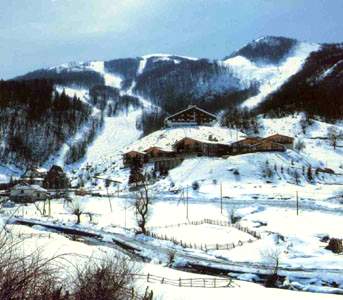
MACEDONIA has a mixed Mediterranean-continental climate. The republic's mountainous regions are characterized by hot and dry summers and autumns, while winters are cold with heavy snowfalls.
The republic is relatively rich in mineral resources, including zinc, lead, silver, gold,
antimony, manganese, nickel, chromium, copper, iron ore, and tungsten. Output in 1992 included
1.13 million tonnes of lead-zinc ore, 54,758 tonnes of lead-zinc concentrate, 3.57 million
tonnes of copper ore, 39,099 tonnes of copper concentrate, and 13,572 tonnes of chromium ore
and concentrate. Mineral and thermal springs are also common. The republic is in an area of
high seismic activity. Skopje suffered a devastating earthquake in 1963.

Muslim 30 per cent
Other 3 per cent

Population 2,163,000 (1995 estimate)
Population growth rate 1.1 per cent (1990-1995 average)
Population density
84 persons per square kilometre (1995 estimate)
217.6 persons per square mile (1995 estimate)
Life Expectancy
Total 72 years (1995 estimate)
Female 75 years (1995 estimate)
Male 69 years (1995 estimate)
Ethnic Divisions
Macedonian 65 per cent
Albanian 22 per cent
Turkish 4 per cent
Serb 2 per cent
Other 7 per cent
Urban-rural (1994) urban 58.7%; rural 41.3%.
Principal Cities
More than half (about 54 per cent, 1994) of the republic's population lives in urban areas. The main cities are the capital- Skopje (population, 1994; 563,102), Tetovo (180,605), Kumanovo (135,482), Bitola (population, 1991; 84,000), and Prilep (70,150), Ohrid.
Education
Education is free and compulsory for eight years, and nearly 90 per cent of the population over the age of ten can read and write. Approximately 70 per cent of the population also completes secondary or tertiary education. In the early 1990s approximately 262,100 children attended primary schools, 72,000 pupils were in secondary and tertiary schools, and 24,800 students were in higher education. The University of Skopje, which was founded in 1949, and Bitola University (1979) are the republic's two accepted universities.
ECONOMY
Unit of currency 1 denar, consisting of 100 para
Exports
Manufactured goods, machinery and transport equipment, raw materials, food (rice), livestock, beverages, tobacco, chemicals
Imports
Fuels and lubricants, manufactured goods, machinery and transport equipment, food and livestock, chemicals, raw materials, beverages, tobacco
Major trading partners for exports
Federal Republic of Yugoslavia, Bosnia and Herzegovina, Croatia, Slovenia, Germany, Greece, Albania
Major trading partners for imports
Other former Yugoslav republics, Greece, Albania, Germany, Bulgaria
Industries
Low levels of technology predominate, such as oil refining by distillation only; production of basic liquid fuels, coal, metallic chromium, lead, zinc, and ferronickel; light industry produces basic textiles, wood products, and tobacco.
Agriculture
Meets the basic need for food; principal crops are rice, tobacco, wheat, corn, and millet; also grown are cotton, sesame, mulberry leaves, citrus fruits and vegetables; agricultural production is highly labour intensive.
