


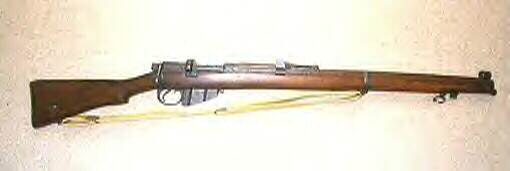
The 27th Division arrived in France equipped with the US Rifle, .30 Cal. Model 1917. It was probably with some trepidation that the men, who had trained and become familiar with this weapon, turned them in upon being assigned to serve with the British Army. They need not have worried. The replacement was one of the finest military bolt action rifles ever produced, the British service rifle, The Short Lee-Enfield Mark III*. The Mark III was accepted into service with the British Army on January 26, 1907. The Mark III*, introduced in January 1916 was the same rifle with minor design changes intended to speed and simplify wartime production.
The Lee-Enfield bolt operating system differed greatly from that of most other bolt action rifles of the period. The bolt locking lugs were at the rear of the bolt rather than at the face as with rifles using the Mauser system. Although this meant that the action was weaker in theory, in practice it proved to be rugged and reliable. This feature, combined with a relatively short bolt throw and a 10 round magazine created what was the fastest operating military bolt action rifle of the period. At the battle of Mons in August of 1914 German troops faced a small, professional British Expeditionary Force armed with this rifle. The Huns were reluctant to attack this force believing they were facing massed machine-guns. They could not believe that the heavy fire from such a small force was in fact rifle fire.
The Mark III's greatest drawback was its ammunition. The bullet for the Mark VII service cartridge had an aluminum or fiber-filled tip with a lead base. This made the bullet longer than normal for its weight. As a result the projectile was unstable in flight and its ballistic characteristics did not compare favorably with the US . 30-06 or the Mauser's 7.9x57m.m. at long ranges. At short to medium ranges its accuracy was acceptable and the speed of its action and 10 round magazine more than made up for this shortcoming. The cartridge's rimmed case could also cause feed problems but this could be corrected by proper training.
Caliber................303 Inch (174 Gr. cupro-nickel jacketed, MK VII)
Overall length....44.5 inches (length varied + or - 1 inch depending on butt stock which came in three sizes)
Barrel length.......25.19 inches
Feed device.........10 round detachable box, charger (stripper) loaded
Muzzle velocity..2440 Feet/Second
Weight.................8.62 lbs
Note on nomenclature: It should be noted that the correct WWI nomenclature for this weapon is Rifle, Short Lee-Enfield Mark III (or MK III*). It wasn't until the early 1930s that the weapon was renamed Rifle No. 1, Short Magazine, Lee-Enfield Mark III (or MK III*)
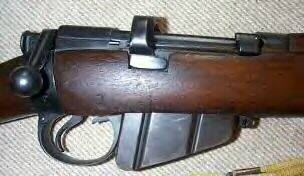

Most distinctive feature of the Mk. III is its muzzle end. Note the large sight ears and that the barrel does not extend beyond the nose cap.
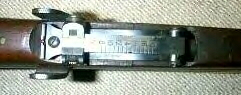
Rear sight
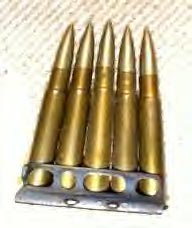
.303 rounds in charger


