The machine gun used by the 27th Division was the British "Gun, Machine, .303, Mark I" commonly known as the Vickers. The Vickers was a modified Maxim gun designed by American inventor Hiram Maxim. The Maxim underwent many design changes over the years and the product that emerged from the Vickers plant in 1912, the Mark I, was to become a major player in human conflict for the next 50 years. It remained in service until 1965 and had a reputation for reliability and durability that made it loved by all who used it.
The following orders were issued to the machine gun units of the 27th Division
ORDERS
- This position will be held, and the section will remain here until relieved.
- The enemy cannot be allowed to interfere with this program.
- If the gun-team cannot remain here alive, it will remain here dead, but in any case it will remain here.
- Should any man, through shell-shock or other cause, attempt to surrender, he will remain here dead.
- Should the gun be put out of action the team will use rifles, revolvers, grenades, and other novelties.
- Finally, the position, as stated, will be held.
Signed: O'Ryan
Specifications for the "GUN, MACHINE, VICKERS .303 inch, Mk. I"
Length:
Weight:
Sights:
Operation:
Cartridge:

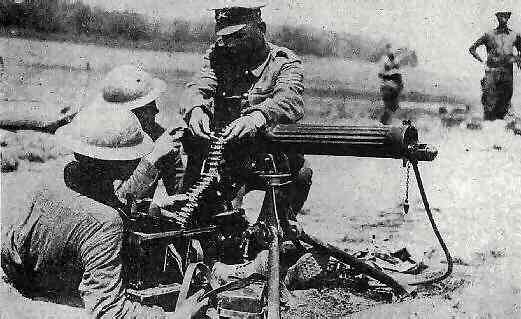
Doughboys training with British instructor on a Vickers
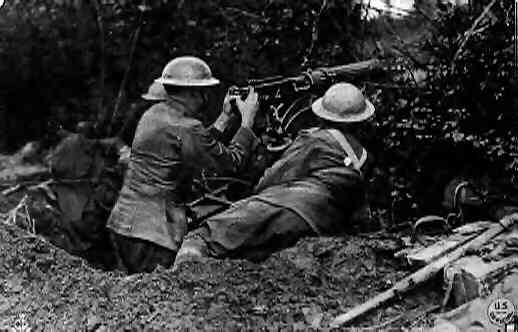
105th MG Bn. gunners in action at Mazinghein, near St. Souplet
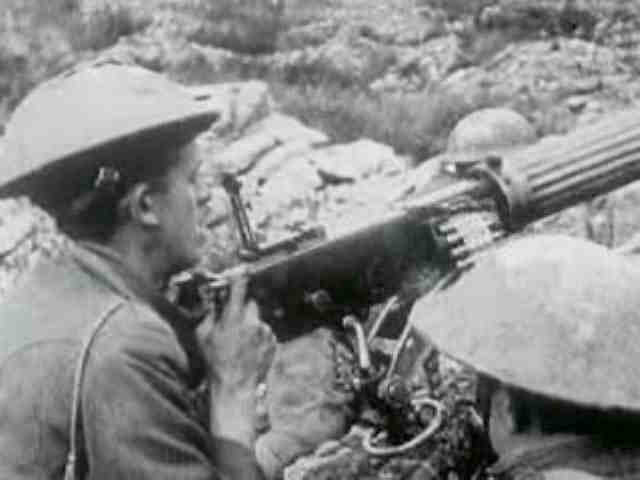
Closeup view of Doughboy firing Vickers. Note sight position, indicating that this gun is engaged in long range indirect fire.

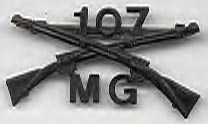
105th MG officer's collar device

Our Vickers. It was made at the Vickers Works, Crayford, Kent in January 1918

Left side view showing fusee spring cover, crosspiece (firing grips) and Crosshead (cradle) with elevating mechanism

A restored M-1917 Machinegun cart


"Box, Spare Parts & Tools, .303 inch Vickers Gun, Mark I"
The metal box strapped to the lid contains a waterjacket repair kit
ORGANIZATION OF MACHINE GUN UNITS
As a general rule, each infantry division in the A.E.F. contained 260 machine guns. Thirty-six of these guns were assigned to the Artillery brigade as anti-aircraft defense. The remaining 224 guns were assigned to the 3 machine gun battalions and to the machine gun company that was an organic part of each of the 4 infantry regiments .
One machine gun battalion was assigned to each of the division's two infantry brigades. Under the command of a Major, the battalion consisted of four companies. Each battalion had an authorized strength of 28 officers and 748 enlisted men with 64 guns divided equally between the companies. Each company had 6 officers and 172 enlisted men and was assigned 16 guns, 4 of which were carried as spares. The company had 3 platoons and a headquarters section. Each platoon had two sections of 2 guns each. Each gun squad consisted of 9 men lead by a corporal. The machine gun companies attached to each regiment had the same composition as the companies assigned to the battalions.
The third machine gun battalion was a division unit, under command of the division commander. The battalion had a strength of 16 officers and 377 enlisted men and was motorized. It had only two companies, identical to the other machine gun companies in terms of personnel and weapons.