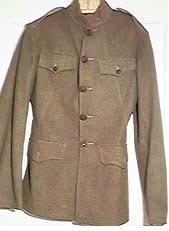
Doughboy uniforms of the Great War can be found in a variety of shades, fabric weights and fabric quality. Uniforms were made in the U.S., Great Britian and France. Men with a little cash also had uniforms custom tailored for them. Officer's uniforms were almost always custom tailored in high quality wool serge and whipcord fabrics.
There are two basic styles of enlisted men's uniform coats encountered; the Model 1917 coat and the Model 1918. Among the differences are: the 1917 coats have patch pockets, no lining and are generally found in coarser quality wool. The 1918 had internal pockets, a full lining, tapered shoulder straps. To further complicate matters, soldiers of the 27th Division often wore British coats and trousers. Since supply of the 27th was strictly a British concern items of clothing that needed replacement were often replaced with British coats and trousers. U.S. buttons were sewn on (usually) and American collar disks were worn. There are many photographs of 27th Division men in British uniforms.
Trousers were of two types also. The most common style and the one usually identified with the Doughboy are the type known as breeches (usually pronounced "britches"). These were a riding style of trousers with laced calves and re-inforcing at the knee inseam. There was also a straight legged trouser sometimes refered to as the M1918 that eliminated the calf lacing and reinforcements. This later style was not often encountered.
Overseas caps are also encountered in a variety of fabrics and shades. They were also made in three styles; U.S., British and French. It is quite common to see pictures of Doughboys from the same unit with overseas caps in all three styles in evidence.
COAT, SERVICE
1918 OVERCOAT
The Model 1918 overcoat is slightly shorter and lacks the button tab adjustment
on the cuffs found on the Model 1917 overcoat.
TROUSERS/ BREECHES
SHIRT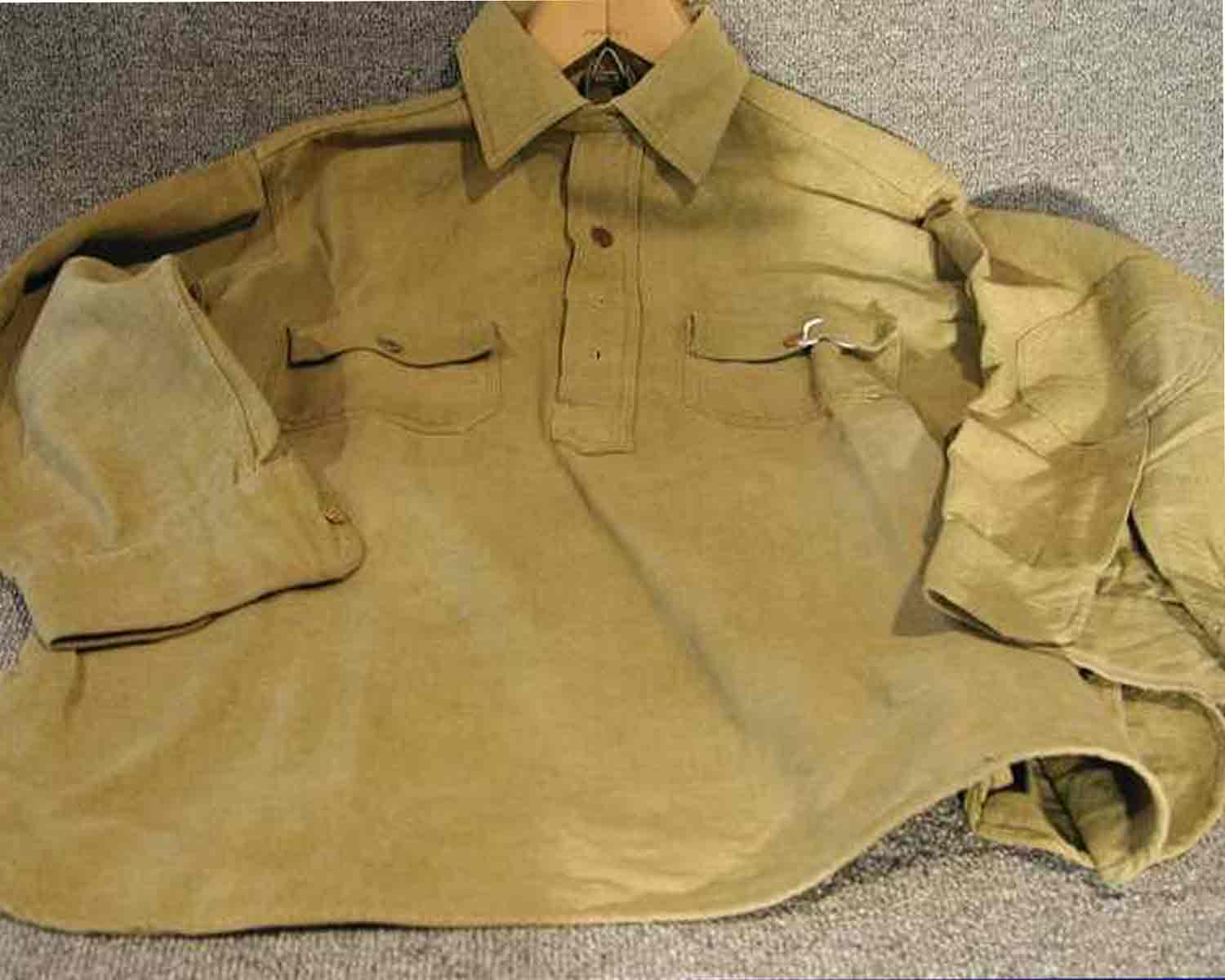
five button "pullover" style with reinforcing patches at the elbows
PUTTEES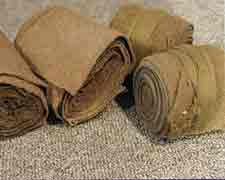
The U.S. Army entered the war with 2 or 3 types of canvas leggings but soon adopted the European style of leg wrap known as puttees. These are wool strips approximately 8 feet in length and 3 to 4 inches wide. They were universally disliked, difficult to wrap correctly (see "HOW TO") and generally uncomfortable to wear.
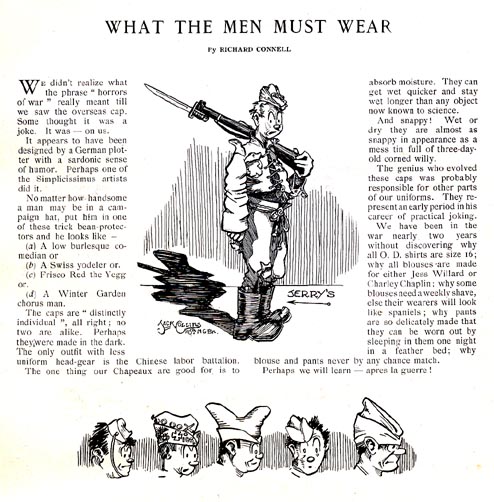
OVERSEAS CAP
The article and drawings appearing below are from the Christmas 1918 issue of the 27th Division's weekly publication, THE GAS ATTACK. Although the article is a satirical look at the overseas cap it can easily be applied to other items of uniform.
MODEL 1910 ENLISTED MAN'S SERVICE CAP
CAMPAIGN HAT
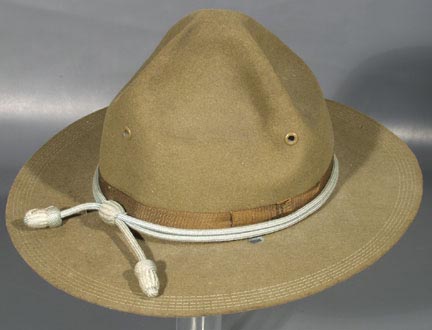
Although popular with troops the impracticality of the campaign hat for overseas use (how do you carry it when wearing a helmet?) led to its replacement by the overseas cap. It remained in use for troops stationed Stateside. The hat cord for enlisted men (in this case "Infantry blue") indicated the wearers branch of service. Officer's hat cords were black and gold. The rows of stitching on the brim are a pretty good indication of a WWI period campaing hat. Most were issued without chin straps. The men were expected to use shoelace for that purpose.
JERKIN


A sleeveless leather garment lined in wool. A British item that was quickly adopted by the AEF. It provided warmth with much less bulk and more freedom of movement than the standard Doughboy overcoat.
MARCHING SHOE
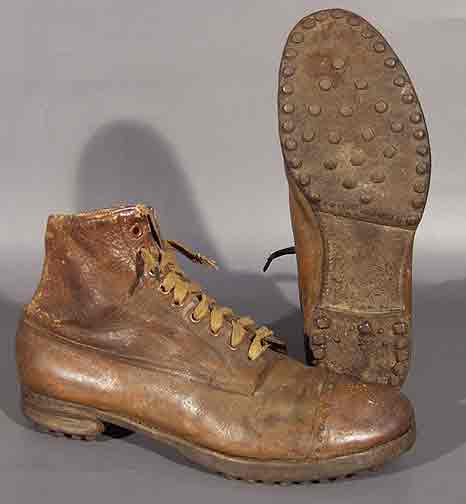
Mexican border period and earlier issue shoe. Interiors have back strap pull and white cotton lining with stamp "HAMILTON-BROWN SHOE CO. / CONTRACT 673 / St. LOUIS DEPOT" and size "9D".
THE AMERICAN SOLDIER, 1918
click on picture for larger image
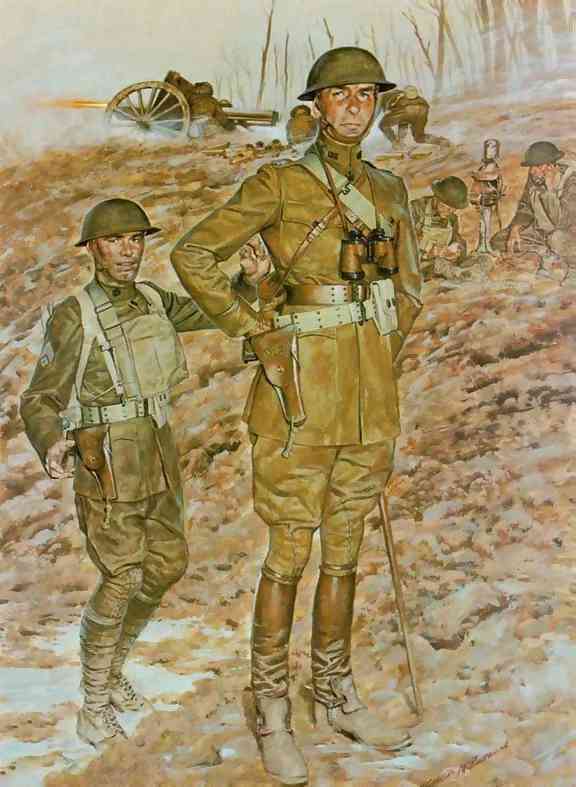
In the front center is a lieutenant colonel with the silver oak leaf of his rank on his shoulder strap, and the bronzed branch insignia and the block-style letters U.S. on the high standing collar. The cut and color of his coat and breeches are a sign that it was tailored in England or France—a common practice among officers. (It was also common practice, especially among junior, company grade officers to obtain enlisted men's coats and breeches for field wear.) Two other distinctive features of his officer's rank are the brown braid on his sleeve and his brown leather Sam Browne belt, adopted by the officers of the AEF from the British. The colonel also wears high, brown boots prescribed for officers. They were a private purchase item, as was most officer's clothing and uniform, and available in several styles.The machine gun company first sergeant in the left foreground wears an issue olive drab uniform with the wrap-around puttees adopted by the AEF during the war when production difficulties slowed procurement of the canvas leggings formerly worn. His grade is indicated by the three stripes and diamond on his sleeve. Insignia of rank was worn on the right sleeve only to save material.