The Wheel Lock was invented by Johann Kiefuss of
Nuremberg in 1517. He may have derived the idea of the wheel lock design
from the spring driven tinder lighter, which was in use at that time. The
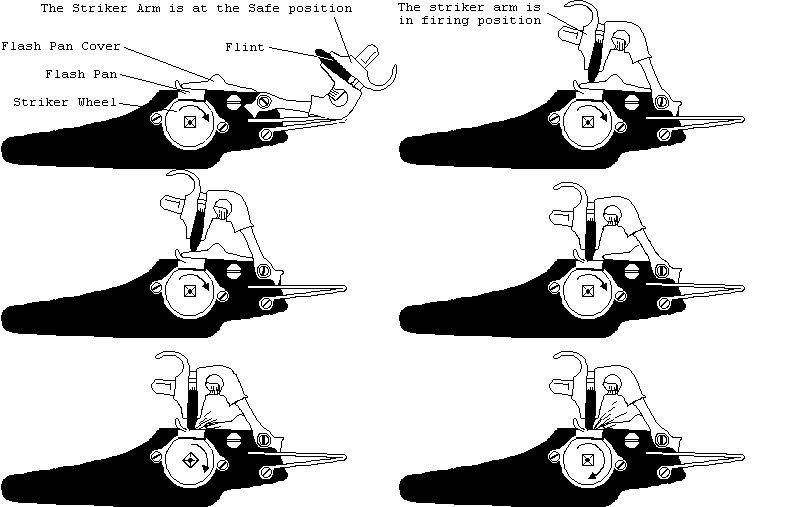
idea of this mechanism is simple, a roughened wheel is turned and
a iron pyrite flint is pressed against it, causing a spark that lights
the powder in the flash pan. The action was done with over 50 moving
parts that were very similar to the fine time pieces of the day. This made
the wheel lock very expensive to make and maintain.
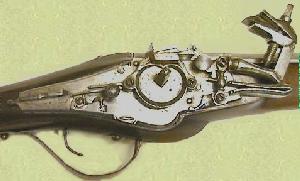
The wheel lock shown above is a German Wheel
lock Horse Pistol from the 1570s. This one has an octagonal barrel which
is 20 inches in length. The stock is fruit wood. It has a standard
military style Wheelock action. Its over all length is 28 inches and has
a value of around $6,000 (1998).
The wheel lock design was improved with stronger, more
durable springs and a cover over the wheel mechanism to protect it and
keep it dry by the Marquarte brothers in the 1530s. The wheel lock
was even more expensive to make after these improvements, but the gun tended
to be more reliable. Costing about twice as much as the match lock,
this firearm was only a rich noblemen's property.
By around the late 1550s German gunsmiths were using
wooden stocks and adorning them with inlays of ivory and horn. Often these
designs showed the hobby of its owner. Even the Spanner wrench,
the device used to wine up the wheel, was artistically made. Other
improvements included fire bluing the metal parts to add extra beauty
and to protect against corrosion and a new way of making the barrels. Metallurgy
had improved to the point that gun barrels were no longer bursting as often.
The strongest barrels were of damascene manufacture. In this process, strips
of metal about the thickness of a man's finger would be wound together.
Then, another strip would be wound around them for the full length of the
piece, then the whole thing would be heated and welded. It was then hammered
and forged into the final shape, then bored out. The damascene barrel was
the only one that could survive being packed for its full length with gunpowder
then fired. Other gun barrels were at risk with only a quarter of their
length packed.
The wheel lock brought about the time of true
"hand guns" that could be carried under one's coat and used when needed.
For this reason, some areas outlawed the use of these guns. These
guns where in wide use with noblemen until the 1650s, when a new lock type
became very popular,the flint lock.