The flint Lock firearm came about during the early 1600s
from a group of dutch chicken thieves, who needed a gun that was easier
to maintain than the wheel lock, yet did not have the glowing wick of the
match lock. The flint lock fit the bill. The very first flint
locks were very crude.
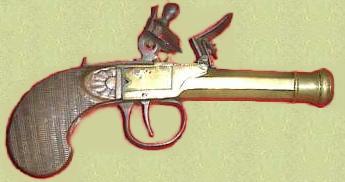
The flint lock shown above is a French Flintlock
Brass Frame and Barreled Blunderbuss Pistol from 1780. This Box lock action
pocket pistol has a 4 inch barrel and cannon muzzle. Its length is
7.5 inches.
In 1612 a frenchman, Marin le Bourgeoys,
refined
the flint lock into a more usable and potent firearm. This newer and better
design slowly spread throughout Europe, and by the 1650s these guns had
become more popular than the Wheel Lock or Match Lock. The main difference
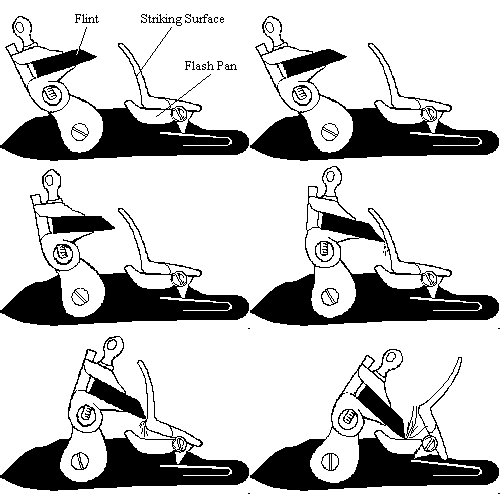
between the Flint lock and Wheel lock is that the flint strikes a striking
surface which sends sparks onto the flash pan, where the wheel lock has
its wheel move against a iron pyrite flint to create a spark. The flintlock's
design was far cheaper to build and proved longer lasting. This simplicity
in mechanics allowed for more creative gun designs, such as firearms with
multiple barrels and miniature pistols which could be concealed more easily
inside a garment. By 1664 experiments with rotating block repeated fire
guns were under way (like a revolver which holds a number of shots in a
rotating cylinder) but such weapons were dangerous to operate and would
have to wait for another century and a half to be made a standard weapon.
In the early 1700s the Brown Bess Flintlock made its
appearance. This was the first gun to become a standardized military
firearm. It probably got its name from the acid brown treatment of
its barrel.
The early 1700s guns had a smooth bore and the bullet
tended to bounce as it was shot out, so the smooth bore flint lock was
accurate up to about 60 to 70 yards. A shooter of average experience could
load and fire two to three rounds per minute. Later, the americans
began riffling their barrels with grooves. These grooves tended to cause
the bullet to spin and therefore become very stable in flight, improving
accuracy again.
The Kentucky rifle was a big step forward in the flintlock
design and took advantage of many of the newest technologies of the day.
The Springfield armory began making firearms during
the flint lock area and proved to be of a great benefit to the American
military. To see the Flint Lock
display, click here. The area of the flint lock would have gone on forever,
if it was not for a Scots clergyman, who needed a firearm that would not
scare off his dinner before the bullet left the barrel. He thought
up a firearm design that used a percussion cap instead of a bright spark.
This lead the way to the new Percussion cap firearm.